

The healthcare industry is undergoing a digital transformation, and voice AI for healthcare is at the forefront of this revolution. From automating patient intake and appointment scheduling to enabling 24/7 virtual support and clinical decision-making, voice AI technologies are reshaping how hospitals, clinics, and healthcare providers deliver care. In 2026, the adoption of intelligent voice agents has accelerated, driven by staffing shortages, rising patient expectations, and the need for scalable, cost-effective solutions.
This comprehensive guide explores how voice AI for healthcare is transforming medical operations, the specific use cases where it excels, the measurable benefits backed by research, and how platforms like OpenMic.ai enable healthcare organizations to deploy secure, HIPAA-compliant voice agents that integrate seamlessly with existing EHR and CRM systems.
What Is Voice AI for Healthcare?
Voice AI for healthcare refers to conversational artificial intelligence systems that use natural language processing (NLP), speech recognition, and machine learning to interact with patients, clinicians, and administrative staff via voice. These intelligent voice agents can handle inbound and outbound calls, perform patient triage, schedule appointments, send reminders, collect health data, and even assist in diagnostics.
Unlike traditional IVR (interactive voice response) systems that rely on rigid menus and touch-tone inputs, modern voice AI agents understand natural language, context, and intent. They can engage in multi-turn conversations, ask clarifying questions, and adapt responses based on patient history or clinical protocols.
The technology leverages advanced signal processing, real-time transcription, and integration with electronic health records (EHR) to deliver personalized, compliant, and efficient patient interactions. For tech-savvy healthcare leaders and developers, voice AI represents a powerful API-first platform to scale operations, reduce costs, and enhance patient responsiveness without compromising care quality.
Why Healthcare Needs Voice AI Now
The healthcare sector faces unique challenges that make voice AI adoption not just beneficial but essential:
- Staffing Shortages: Hospitals and clinics struggle with nurse and administrative staff shortages, leading to longer wait times and missed calls.
- High Operational Costs: Maintaining 24/7 human support is expensive, particularly for smaller practices and rural healthcare facilities.
- Patient Expectations: Patients demand instant, personalized responses and convenient digital-first experiences similar to other industries.
- Administrative Burden: Manual appointment scheduling, insurance verification, and follow-up calls consume significant staff time that could be dedicated to direct patient care.
- Compliance and Security: Healthcare organizations must adhere to strict HIPAA regulations, requiring secure and auditable communication channels.
Voice AI for healthcare addresses these pain points by automating routine interactions, enabling scalable patient monitoring, and freeing clinical staff to focus on complex cases. Research from IBM demonstrates that AI-driven voice agents enhance healthcare scalability with huge cost savings for routine monitoring, particularly in preventive care and patient monitoring where human intervention is unfeasible.
Proven Benefits of Voice AI for Healthcare Backed by Research
The effectiveness of voice AI for healthcare is not theoretical it is supported by peer-reviewed studies and real-world implementations:
Cost Savings and Scalability
An economic model published by IBM Research shows that voice-based AI agents provide cost-effective services for preventive care and patient monitoring, particularly in underserved populations. By automating routine check-ins, medication adherence reminders, and symptom screening, healthcare organizations can extend their reach without proportional increases in staffing costs.
Clinical Accuracy and Patient Satisfaction
A randomized trial published in the National Institutes of Health demonstrated that AI voice agents achieved 97.7% agreement with human staff in patient screening. The study focused on SARS-CoV-2 screening histories and found that 87% of participants rated the AI assistant as 'good or outstanding.' This level of accuracy enables healthcare providers to handle routine interactions at scale while maintaining clinical reliability.
Diagnostics and Prognostics
Voice AI extends beyond administrative tasks into clinical applications. Research published in the Journal of Medical Internet Research indicates that voice AI analysis links to reduced hospitalization and mortality in heart failure patients. Quantitative voice signal analysis using AI shows independent association with hospitalization and mortality, with applications in neurodegenerative diseases and COVID-19 diagnostics.
Patient Education and Engagement
Studies evaluate the effectiveness of AI with voice cloning and ChatGPT for patient education, comparing it to physician voice to enhance operational effectiveness and patient management. This personalized approach improves health literacy and patient compliance with treatment plans.
Accelerated Analytics
Voice AI systems analyze voice data to uncover patterns, accelerating diagnostics by nearly 400% compared to human analysts. This capability enables real-time analytics for patient feedback, clinical research insights, and population health management.
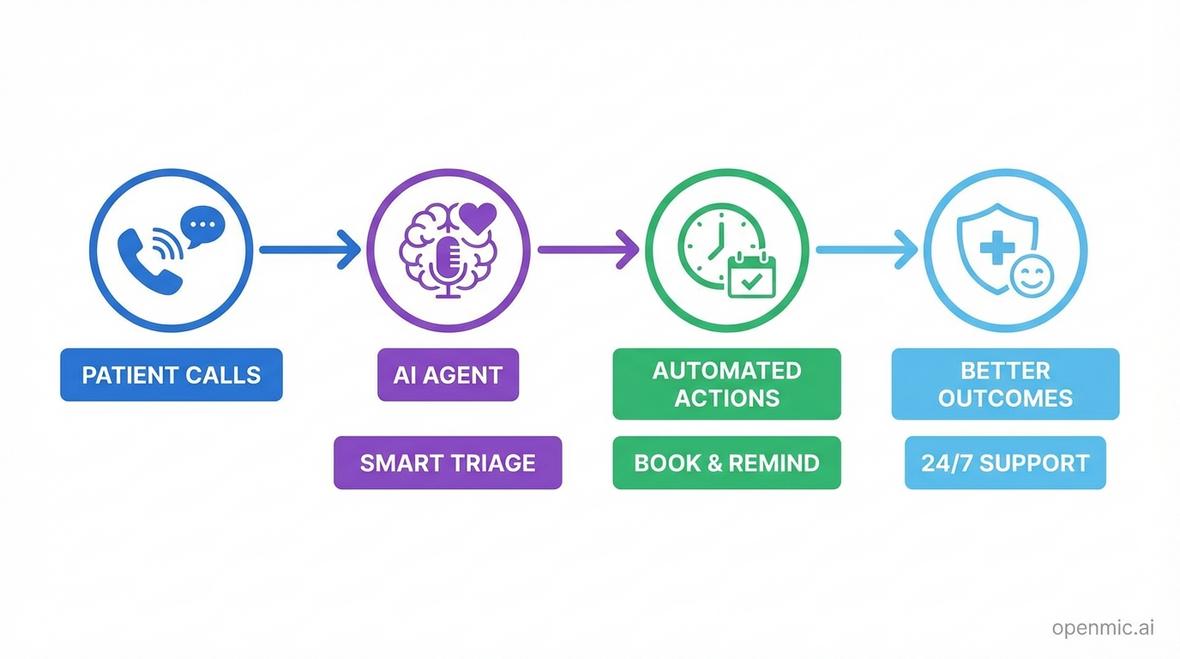
Key Use Cases for Voice AI in Healthcare
Voice AI for healthcare delivers measurable impact across multiple operational and clinical scenarios:
Appointment Scheduling and Reminders
AI voice agents can handle appointment booking, rescheduling, and automated reminders, reducing no-show rates and administrative workload. Platforms like OpenMic's appointment booking agent integrate directly with practice management systems to provide seamless scheduling experiences.
Patient Intake and Triage
Voice AI can conduct pre-visit screenings, collect medical histories, verify insurance, and perform intelligent triage to prioritize urgent cases. This reduces wait times in emergency departments and ensures patients are directed to appropriate care levels.
24/7 Virtual Reception
Healthcare facilities can deploy AI receptionists that answer patient inquiries, provide directions, and handle routine requests around the clock, ensuring no call goes unanswered.
Chronic Disease Management
Voice AI enables proactive monitoring of patients with chronic conditions such as diabetes, hypertension, and heart failure. Automated check-in calls assess symptoms, medication adherence, and lifestyle factors, triggering alerts for clinicians when intervention is needed.
Post-Discharge Follow-Up
Automated follow-up calls after hospital discharge improve patient outcomes by ensuring medication compliance, identifying complications early, and scheduling follow-up appointments. This reduces readmission rates and enhances continuity of care.
Mental Health Support
Voice AI can provide initial mental health screening, crisis support, and wellness check-ins, extending access to behavioral health services in areas with provider shortages.
Clinical Research and Surveys
Researchers can deploy voice survey agents to collect patient-reported outcomes, conduct epidemiological studies, and gather real-world evidence at scale with consistent data quality.
Security, Compliance, and Ethical Considerations
Deploying voice AI in healthcare requires strict adherence to regulatory and ethical standards:
HIPAA Compliance
All voice AI systems handling protected health information (PHI) must comply with HIPAA regulations, including encryption in transit and at rest, access controls, audit logging, and business associate agreements (BAAs). Platforms like OpenMic.ai are designed with healthcare compliance in mind, offering HIPAA-compliant infrastructure and data handling practices.
Patient Consent and Transparency
Patients must be informed when interacting with AI systems and have the option to speak with a human representative. Transparent disclosure builds trust and aligns with ethical AI principles.
Bias and Fairness
Voice AI must be trained on diverse datasets to avoid bias related to accent, age, gender, or socioeconomic status. Research emphasizes transparency, consent, and bias-free datasets for ethical voice AI in healthcare, supporting trustworthy use as disease biomarkers.
Data Governance
Healthcare organizations must establish clear policies for data retention, anonymization, and usage. Voice recordings and transcripts should be stored securely with strict access controls and regular audits.
How to Implement Voice AI in Your Healthcare Organization
Successful voice AI deployment in healthcare follows a structured approach:
Step 1: Identify High-Impact Use Cases
Start with workflows that are repetitive, time-consuming, and do not require complex clinical judgment. Common starting points include appointment scheduling, patient reminders, and after-hours call handling.
Step 2: Select a Compliant Platform
Choose a voice AI platform that offers HIPAA compliance, EHR integration, and API-first architecture. OpenMic.ai's healthcare solutions provide pre-built integrations with major EHR systems and customizable workflows tailored to clinical needs.
Step 3: Design Conversational Flows
Work with clinical and administrative stakeholders to map out conversation scripts, decision trees, and escalation protocols. Ensure the voice agent can handle edge cases and transfer seamlessly to human staff when needed.
Step 4: Integrate with Existing Systems
Use APIs to connect the voice AI platform with your EHR, practice management software, telephony systems, and CRM. Platforms like OpenMic's integrations support thousands of applications through native connectors and Zapier.
Step 5: Pilot and Iterate
Launch a pilot program with a limited patient population or specific use case. Collect feedback, monitor performance metrics, and refine conversational flows before scaling.
Step 6: Train Staff and Educate Patients
Ensure clinical and administrative staff understand how to work alongside AI agents, and educate patients on the benefits and capabilities of voice AI through signage, website content, and direct communication.
Comparing Voice AI Platforms for Healthcare
When evaluating voice AI platforms, healthcare organizations should consider:
- Compliance: HIPAA, GDPR, and other regulatory certifications
- Integration: Compatibility with EHR systems like Epic, Cerner, Allscripts, and practice management tools
- Customization: Ability to tailor conversation flows, voice personas, and business logic
- Scalability: Support for high call volumes and multi-location deployments
- Analytics: Real-time dashboards, call transcripts, sentiment analysis, and performance metrics
- Pricing: Transparent, predictable pricing models aligned with healthcare budgets
OpenMic.ai stands out by offering an API-first platform designed for developers and business leaders who need deep customization, robust security, and seamless integration. Unlike rigid SaaS solutions, OpenMic enables healthcare organizations to build tailored voice AI agents that fit their unique workflows and patient populations.
Real-World Success Stories
Healthcare organizations worldwide are realizing tangible benefits from voice AI:
Dental Practices
Dental clinics use AI voice agents for dental practices to handle appointment confirmations, insurance verification, and post-procedure follow-ups, freeing front-desk staff to focus on in-office patient care.
Medical Receptionists
Busy healthcare facilities deploy AI-powered receptionists that manage incoming calls, triage patient inquiries, and route urgent cases to on-call clinicians, ensuring no patient is left waiting.
Telehealth Platforms
Telehealth providers integrate voice AI to pre-screen patients before virtual consultations, collect vitals and symptoms, and schedule follow-up appointments, streamlining the end-to-end telehealth experience.
The Future of Voice AI in Healthcare
Looking ahead, voice AI for healthcare will continue to evolve with advances in natural language understanding, multimodal AI (combining voice, vision, and text), and integration with wearable devices and IoT sensors. Emerging trends include:
- Voice Biomarkers: Using acoustic features to detect early signs of Parkinson's, Alzheimer's, depression, and cardiovascular disease
- Multilingual Support: Expanding access to non-English speaking populations with real-time translation and culturally adapted conversational flows
- Ambient Clinical Intelligence: Passively listening during patient-clinician encounters to auto-generate clinical notes, order entry, and billing codes
- Predictive Analytics: Combining voice data with EHR records to predict patient deterioration, readmission risk, and treatment adherence
- Personalized Health Coaching: Delivering tailored wellness programs, chronic disease management, and behavior change interventions through conversational AI
For developers and healthcare innovators, platforms like OpenMic.ai provide comprehensive SDKs and APIs to build, test, and deploy next-generation voice AI solutions.
How OpenMic.ai Empowers Healthcare Organizations
OpenMic.ai is purpose-built for healthcare providers, developers, and business leaders who need a secure, scalable, and highly integrable voice AI platform. Key differentiators include:
- HIPAA-Compliant Infrastructure: End-to-end encryption, audit logging, and BAA support
- EHR and CRM Integration: Native connectors for Epic, Cerner, Salesforce Health Cloud, HubSpot, and more
- API-First Architecture: Programmatic control over call flows, voice synthesis, and data extraction
- Customizable Voice Agents: Tailor conversation scripts, voice personas, and escalation logic to your clinical workflows
- Real-Time Analytics: Monitor call performance, patient sentiment, and operational KPIs via intuitive dashboards
- Scalable Pricing: Transparent, usage-based pricing aligned with healthcare budgets, detailed at OpenMic.ai pricing
Whether you're a solo practitioner looking to automate appointment reminders or a multi-hospital system deploying enterprise-wide patient engagement platforms, OpenMic.ai provides the tools, integrations, and support to succeed.
Getting Started with Voice AI for Healthcare
Ready to transform your healthcare operations with voice AI? Here's how to get started:
- Assess Your Needs: Identify the workflows, pain points, and patient populations where voice AI can deliver the most value.
- Explore OpenMic.ai: Visit OpenMic.ai to explore platform capabilities, integration options, and healthcare-specific use cases.
- Request a Demo: Schedule a personalized demo to see how OpenMic can integrate with your existing systems and workflows.
- Pilot a Use Case: Start with a focused pilot such as appointment scheduling or patient surveys to validate ROI and refine your approach.
- Scale and Optimize: Expand to additional use cases, locations, and patient populations, leveraging real-time analytics to continuously improve performance.
For additional guidance, explore OpenMic.ai's guide section for tutorials, best practices, and integration walkthroughs.
Frequently Asked Questions
Is Voice AI HIPAA Compliant?
Yes, when deployed on compliant platforms like OpenMic.ai. Ensure your provider offers encryption, access controls, audit logs, and signs a Business Associate Agreement (BAA).
Can Voice AI Replace Human Staff?
Voice AI is designed to augment, not replace, human staff. It handles routine, repetitive tasks, freeing clinical and administrative teams to focus on complex, high-value interactions. For more insights, read Will AI Replace Call Center Agents?.
What Are the Costs?
Pricing varies by platform and usage. OpenMic.ai offers transparent, usage-based pricing with no hidden fees. Visit OpenMic.ai pricing for details.
How Long Does Implementation Take?
Pilot deployments can be live in weeks, while enterprise-wide rollouts may take several months depending on integration complexity and stakeholder coordination.
What Languages Are Supported?
Leading voice AI platforms support dozens of languages and dialects. OpenMic.ai offers multilingual capabilities to serve diverse patient populations.
Conclusion
Voice AI for healthcare is no longer a futuristic concept it is a proven, scalable solution transforming patient care and operational efficiency in 2026. From automating administrative workflows and enabling 24/7 support to enhancing clinical diagnostics and patient engagement, voice AI delivers measurable benefits backed by peer-reviewed research and real-world success stories. Healthcare organizations seeking to reduce costs, improve patient outcomes, and scale operations must embrace intelligent voice agents as a core component of their digital transformation strategy. Platforms like OpenMic.ai empower tech-savvy leaders and developers to deploy secure, HIPAA-compliant, and highly integrable voice AI solutions tailored to the unique demands of healthcare. Start your journey today and unlock the full potential of voice AI for your organization.