

Introduction
Voice AI for developers has emerged as one of the most transformative technologies in 2026, enabling businesses to automate customer interactions, scale operations, and reduce costs dramatically. As enterprises seek to deploy intelligent voice agents for inbound and outbound call automation, developers are increasingly tasked with integrating powerful, secure, and highly flexible API-first platforms into their existing infrastructure. According to Straits Research, the AI voice generators market is projected to reach $54.54 billion by 2033 with a 30.7% CAGR, driven by applications in customer service, call centers, and media. This explosive growth reflects the rising demand for conversational AI solutions that can handle complex, real-time interactions with human-like fluency.
For tech-savvy business leaders, founders, and developers within SMEs and enterprises, the challenge is not just adopting voice AI, but choosing the right platform that offers seamless integration, robust security, and the flexibility to customize voice agents for unique business needs. Whether you're automating appointment scheduling, lead qualification, or customer support, understanding the technical landscape of voice AI for developers is critical. This guide explores the essential components, integration strategies, performance benchmarks, and best practices for deploying voice AI solutions that scale efficiently and deliver measurable ROI.
What Is Voice AI for Developers?
Voice AI for developers refers to a set of tools, APIs, and frameworks that enable software engineers and technical teams to build, deploy, and manage intelligent voice agents capable of conducting natural language conversations over the phone or through digital channels. Unlike traditional IVR (Interactive Voice Response) systems that rely on rigid menu structures and touch-tone inputs, modern voice AI leverages advanced natural language processing (NLP), speech-to-text (STT), text-to-speech (TTS), and large language models (LLMs) to understand intent, generate contextually relevant responses, and execute complex workflows.
Voice AI platforms designed for developers typically offer RESTful APIs, SDKs, and webhook integrations that allow teams to connect voice agents with CRMs, databases, payment gateways, and other enterprise systems. This API-first approach empowers developers to customize voice interactions, automate multi-step processes, and deliver personalized customer experiences at scale. According to research from NCBI, core data science competencies have been adapted for voice AI development, targeting technical learners like developers and engineers to build standardized voice data collection and AI/ML models.
Key Components of Voice AI Platforms
- Speech Recognition (STT): Converts spoken language into text with high accuracy, even in noisy environments or with diverse accents.
- Natural Language Understanding (NLU): Interprets user intent, extracts entities, and manages conversational context to enable meaningful dialogue.
- Text-to-Speech (TTS): Generates natural-sounding synthetic voices that can be customized for tone, pitch, and personality.
- Dialogue Management: Orchestrates multi-turn conversations, handles interruptions, and guides users through complex workflows.
- Integration Layer: Provides APIs, webhooks, and connectors to CRMs like HubSpot, Pipedrive, and Odoo for seamless data synchronization.
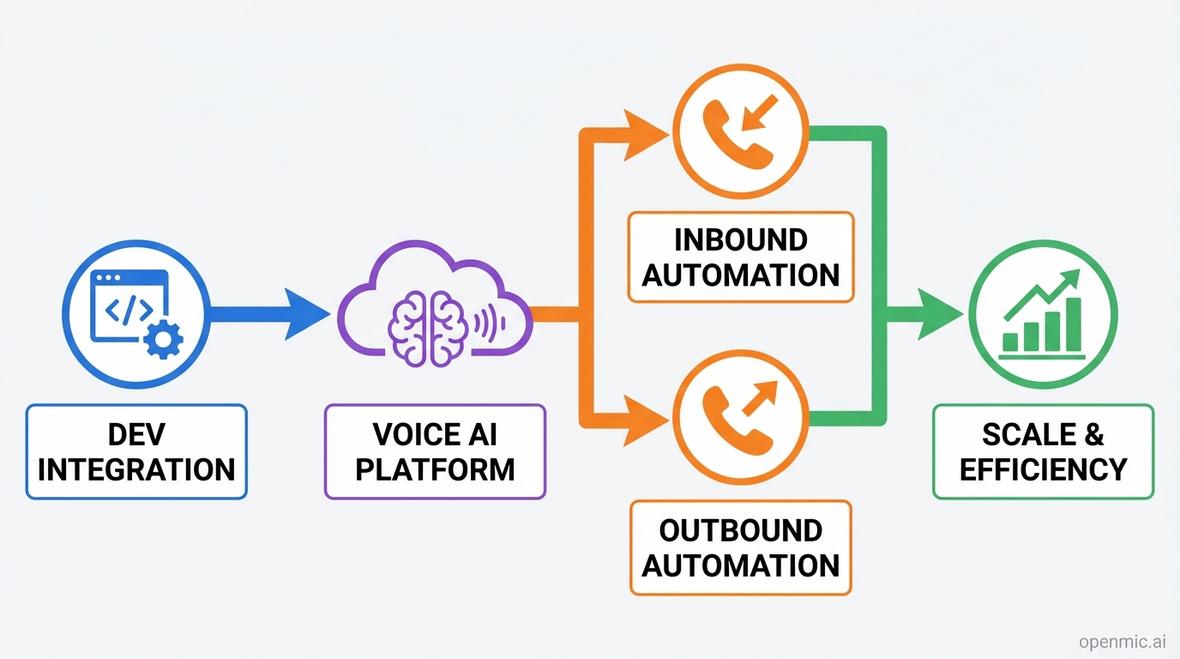
Why Developers Choose Voice AI Platforms
Developers are increasingly adopting voice AI platforms because they drastically reduce the time and complexity involved in building conversational interfaces from scratch. Instead of investing months in training custom NLP models, managing telephony infrastructure, and ensuring compliance with regulatory standards, developers can leverage pre-built, enterprise-grade voice AI solutions that are production-ready out of the box.
Modern voice AI platforms offer several compelling advantages for developers:
- Rapid Prototyping: Quickly build and test voice workflows without deep expertise in machine learning or linguistics.
- Scalability: Handle thousands of concurrent calls without worrying about infrastructure bottlenecks.
- Customization: Fine-tune voice agents with custom prompts, logic, and integrations tailored to specific business processes.
- Security and Compliance: Built-in support for GDPR, HIPAA, and other regulatory frameworks, essential for industries like healthcare and finance. The FTC Voice Cloning Challenge emphasizes monitoring, evaluation, and policy controls for enterprise-grade reliability in regulated industries.
- Cost Efficiency: Eliminate the need for 24/7 human support staff while maintaining high-quality customer interactions.
For developers working in SMEs and enterprises, these benefits translate directly into faster go-to-market timelines, lower operational costs, and the ability to deliver innovative customer experiences that differentiate their businesses from competitors.
Technical Architecture of Voice AI for Developers
Understanding the technical architecture of voice AI platforms is crucial for developers tasked with integrating these solutions into existing systems. A robust voice AI architecture typically consists of several layers, each responsible for specific functions that enable real-time, intelligent voice interactions.
Speech Processing Layer
The speech processing layer handles the conversion of audio signals into text (STT) and text back into speech (TTS). Modern voice AI platforms use deep learning models trained on vast datasets to achieve high accuracy across different languages, accents, and acoustic conditions. Developers can leverage APIs to send audio streams and receive transcriptions in near real-time, with latency as low as 200-300 milliseconds for optimized systems.
According to Activant Capital research, GPT-Realtime achieved 82.8% accuracy on the Big Bench Audio benchmark by August 2025, enabling enterprise deployments in customer support with low-latency speech-to-speech models. This level of performance is critical for use cases like debt collection, where agents must respond immediately to customer objections.
NLU and Dialogue Management
The NLU engine interprets user intent and extracts entities (such as names, dates, and account numbers) from transcribed speech. Dialogue management systems then use this information to determine the next best action, whether that's asking a follow-up question, executing a function call, or transferring the call to a human agent.
Developers can customize dialogue flows using visual builders or code-based configurations, allowing for complex branching logic and conditional responses. For example, a voice agent handling appointment scheduling might check calendar availability via API, confirm details with the user, and send a confirmation email all within a single conversation.
Integration and Orchestration Layer
The integration layer is where voice AI platforms connect with external systems like CRMs, ERPs, payment gateways, and databases. Developers use RESTful APIs, webhooks, and pre-built connectors to synchronize data in real-time. Platforms like OpenMic.ai provide extensive integration options, including native support for Zapier, enabling connections to over 8,000 apps.
This layer also handles orchestration tasks such as routing calls, managing call queues, and triggering automated workflows based on specific events or conditions. For developers, this means less custom code and faster deployment of end-to-end automation solutions.
Best Practices for Integrating Voice AI
Integrating voice AI into existing business processes requires careful planning and adherence to best practices to ensure reliability, security, and user satisfaction. Here are key considerations for developers:
Define Clear Use Cases
Start by identifying specific use cases where voice AI can deliver the most value, such as lead qualification, FAQ handling, or invoice reminders. Avoid trying to automate every interaction at once; instead, focus on high-volume, repetitive tasks that consume significant human resources.
Prioritize Latency and Performance
Latency is a critical factor in voice AI success. Conversations must feel natural and responsive, with delays kept under 500 milliseconds for optimal user experience. Developers should choose platforms that offer low-latency speech processing and optimize their integration code to minimize network overhead. For more on latency standards, see our guide on acceptable latency for VoIP.
Ensure Data Security and Privacy
Voice interactions often involve sensitive customer information, so security and compliance must be top priorities. Developers should implement encryption for data in transit and at rest, use secure API authentication mechanisms, and ensure the platform complies with relevant regulations like GDPR and HIPAA. The FTC's voice cloning challenge underscores the importance of monitoring and policy controls to prevent misuse of AI-generated voices.
Test Extensively Across Scenarios
Before launching voice AI agents in production, conduct extensive testing across a wide range of scenarios, including edge cases and failure modes. Simulate different accents, background noise levels, and conversational styles to ensure the agent performs reliably. Automated testing tools and real-world pilot programs can help identify and address issues early.
Voice AI Platforms Comparison
Choosing the right voice AI platform is a critical decision for developers. The market offers several options, each with distinct strengths and trade-offs. Below is a comparison of leading platforms based on key criteria:
| Platform | Ease of Integration | Customization | Latency | Pricing Model | Best For |
|---|---|---|---|---|---|
| OpenMic.ai | High (API-first, Zapier, native CRM connectors) | Extensive (custom prompts, logic, workflows) | Low (<300ms) | Usage-based | Enterprises, SMEs, developers needing flexibility |
| Vapi.ai | Medium (API-focused) | Moderate | Medium | Subscription + usage | Mid-sized businesses |
| Bland AI | Medium | Limited | Medium | Subscription | Small businesses |
| Retell AI | Medium | Moderate | Medium | Usage-based | Call centers |
| Synthflow | Medium | Moderate | Medium | Subscription | Marketing agencies |
For a detailed comparison of alternative platforms, explore our guides on Bland AI alternatives, Retell AI alternatives, and Synthflow alternatives.
Use Cases for Voice AI in 2026
Voice AI for developers is being deployed across a wide range of industries and use cases, each with unique requirements and benefits. Here are some of the most impactful applications in 2026:
Customer Support Automation
Voice AI agents can handle common customer inquiries, troubleshoot issues, and escalate complex cases to human agents, reducing wait times and operational costs. Platforms like OpenMic.ai enable businesses to deploy AI contact centers that operate 24/7 without compromising quality.
Sales and Lead Qualification
Outbound voice agents can reach out to prospects, qualify leads based on predefined criteria, and schedule appointments for sales teams. This use case is particularly valuable for industries like real estate and car dealerships, where timely follow-up is critical.
Appointment Scheduling and Reminders
Voice AI can automate the entire appointment lifecycle, from booking to reminders to rescheduling. This is especially useful for healthcare providers and service-based businesses that manage high volumes of appointments daily.
Debt Collection and Payment Reminders
Voice agents can conduct sensitive conversations around outstanding balances, negotiate payment plans, and send follow-up communications, all while adhering to regulatory guidelines. Discover more about debt collection automation.
Surveys and Feedback Collection
Automated voice surveys enable businesses to collect customer feedback at scale, improving response rates compared to email or SMS surveys.
Building Your First Voice AI Agent
For developers new to voice AI, building a first agent can seem daunting. However, modern platforms simplify the process significantly. Here's a step-by-step overview:
- Sign Up and API Access: Create an account with a voice AI platform and obtain API credentials.
- Define the Conversation Flow: Map out the dialogue structure, including greetings, questions, responses, and fallback scenarios.
- Configure Integrations: Connect the voice agent to your CRM, database, or other systems using APIs or pre-built connectors.
- Test and Iterate: Use sandbox environments to test the agent with sample calls, refining prompts and logic based on results.
- Deploy and Monitor: Launch the agent in production and monitor performance metrics like call duration, completion rate, and customer satisfaction.
For detailed instructions, refer to our guide on how to make an AI voice assistant.
Future Trends in Voice AI for Developers
As voice AI technology continues to evolve, several trends are shaping the future landscape for developers:
- Multimodal AI: Integration of voice with visual and text-based interactions for richer user experiences.
- Real-Time Translation: Voice agents capable of conducting conversations in multiple languages simultaneously.
- Emotion Detection: Advanced NLP models that detect customer sentiment and adjust tone or escalation strategies accordingly. Research from Harvard Business Review highlights how AI voice sound shapes customer trust and compliance perceptions.
- Edge Processing: Moving voice processing to edge devices for lower latency and enhanced privacy.
- No-Code/Low-Code Tools: Empowering non-technical users to build and manage voice agents with minimal developer intervention.
Frequently Asked Questions
What is the best voice AI platform for developers?
The best platform depends on your specific needs, but OpenMic.ai stands out for its API-first architecture, extensive integration options, low latency, and flexibility for custom workflows. It's ideal for developers in SMEs and enterprises who need a scalable, secure solution.
How long does it take to integrate voice AI?
Integration timelines vary based on complexity, but simple use cases like FAQ handling can be deployed in days using pre-built templates and APIs. More complex workflows involving multiple systems may take weeks to fully customize and test.
Is voice AI secure for handling sensitive data?
Yes, reputable voice AI platforms implement robust security measures including encryption, secure authentication, and compliance with regulations like GDPR and HIPAA. Always verify the platform's security certifications before deployment.
Can voice AI replace human agents entirely?
While voice AI can automate many routine tasks, human agents remain essential for complex, empathetic, or high-stakes interactions. The best approach is a hybrid model where AI handles repetitive tasks and escalates when necessary. Learn more in our article on whether AI will replace call center agents.
What industries benefit most from voice AI?
Industries with high call volumes and repetitive interactions see the greatest ROI, including healthcare, retail, real estate, automotive, and legal services.
Conclusion
Voice AI for developers represents a paradigm shift in how businesses automate customer interactions and scale operations efficiently. With platforms offering robust APIs, low-latency processing, and extensive customization options, developers can rapidly deploy intelligent voice agents that deliver measurable business value. As the market continues to grow projected to reach $54.54 billion by 2033 now is the time for technical teams to invest in voice AI capabilities. By following best practices for integration, prioritizing security and performance, and choosing the right platform like OpenMic.ai, developers can unlock new opportunities for innovation and competitive advantage in 2026 and beyond.