

Introduction
Voice AI conversation design has emerged as a critical discipline for businesses deploying intelligent voice agents in 2026. As companies seek to automate customer interactions without sacrificing quality, the way voice AI systems communicate the flow, tone, and structure of conversations determines success or failure. For tech-savvy business leaders and developers working with platforms like OpenMic.ai, mastering conversation design isn't optional; it's essential for creating voice agents that customers actually want to engage with.
This comprehensive guide explores the principles, best practices, and strategic approaches to voice AI conversation design that transform basic automated responses into sophisticated, empathetic interactions. Whether you're building inbound customer support agents, outbound sales callers, or appointment booking systems, understanding conversation design will dramatically improve your deployment outcomes.
What Is Voice AI Conversation Design?
Voice AI conversation design is the practice of crafting dialogue flows, response patterns, and interaction structures that enable AI-powered voice agents to communicate naturally and effectively with humans. Unlike traditional IVR systems that rely on rigid menu trees, modern voice AI conversation design leverages Natural Language Understanding (NLU) and dialogue management to create fluid, context-aware exchanges.
The discipline combines elements of linguistics, psychology, user experience design, and technical implementation. According to the Conversation Design Institute, the structured conversation design process bridges empathy and AI efficiency through audience understanding, persona definition, dialogue mapping, and iterative testing to ensure the right response, tone, and timing for seamless customer experiences.
Core Components of Voice AI Conversation Design
Effective voice AI conversation design encompasses several interconnected elements:
- Dialogue Flow Architecture: The structural pathways conversations can take, including happy paths, error handling, and edge cases
- Persona Development: Defining the voice agent's personality, tone, and communication style to align with brand identity
- Turn-Taking Mechanics: Managing the back-and-forth rhythm of conversation, including pauses, interruptions, and confirmation patterns
- Context Management: Tracking conversation history and user intent across multiple exchanges
- Error Recovery Strategies: Gracefully handling misunderstandings and clarification requests
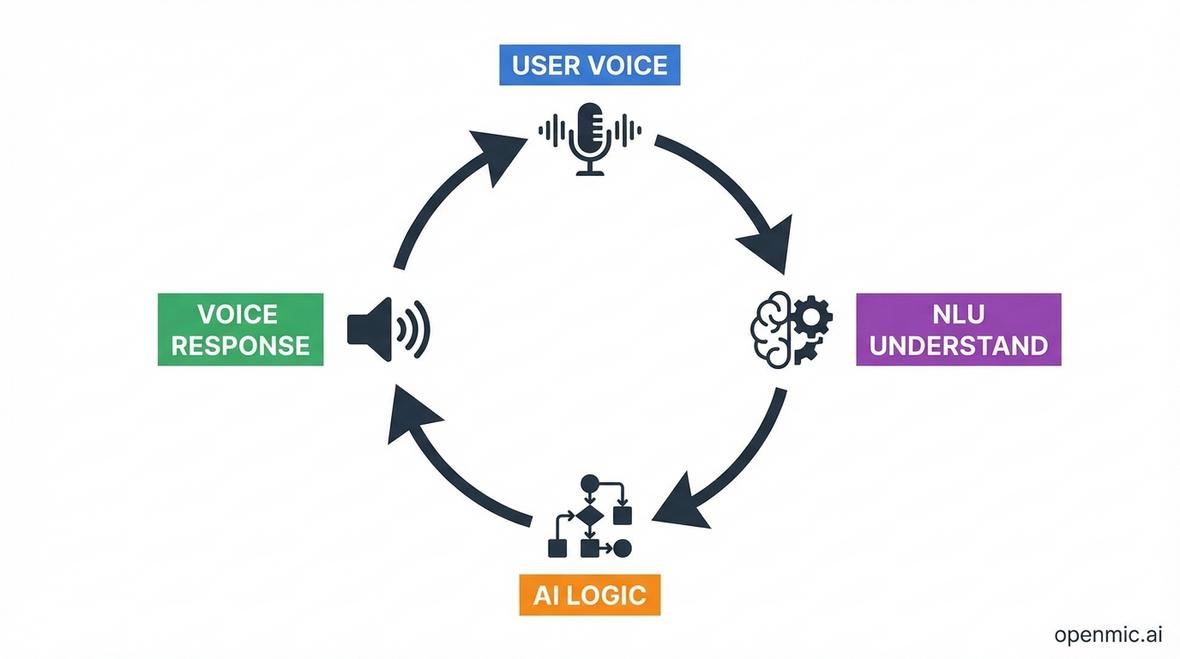
The cyclical process illustrated above shows how voice AI systems continuously process user input through NLU, apply AI logic, and generate appropriate voice responses a loop that conversation designers must optimize at every stage.
Why Voice AI Conversation Design Matters for Business
The quality of conversation design directly impacts business outcomes across multiple dimensions. Poor conversation design leads to frustrated customers, abandoned calls, and negative brand perception. Exceptional design creates seamless experiences that customers prefer over human agents for certain tasks.
Impact on User Satisfaction and Engagement
Research from Cognizant demonstrates that conversation design improves user satisfaction in conversational AI over traditional IVR by applying user-centered principles that align with natural communication patterns. By incorporating emotional intelligence through NLP and sentiment analysis, well-designed voice agents deliver empathetic responses that enhance engagement.
The market validates this approach: Juniper Research projected voice assistants would triple from 2.5 billion devices in 2018 to 8 billion by 2023, driving unprecedented demand for conversation design expertise across products like Google Assistant, Amazon Alexa, and enterprise voice agents.
Reducing Cognitive Load
Unlike visual interfaces where users can scan options simultaneously, voice interactions are sequential and ephemeral. According to UX Psychology research, voice UI design reduces cognitive load with natural conversational flows by implementing turn-taking, feedback mechanisms, repair strategies, and hands-free optimization for multitasking scenarios.
For businesses deploying AI receptionists or appointment booking agents, minimizing cognitive load means customers can accomplish tasks while driving, cooking, or managing other activities significantly expanding the contexts where your service remains accessible.
Fundamental Principles of Effective Voice AI Conversation Design
Successful voice AI conversation design follows established principles that have been refined through years of research and real-world deployment. These principles guide designers toward creating interactions that feel natural rather than mechanical.
The Cooperative Principle
Linguist Paul Grice's Cooperative Principle states that conversational participants inherently cooperate by providing information that is truthful, relevant, clear, and appropriately detailed. Voice AI agents must embody these maxims:
- Quality: Provide accurate information without speculation
- Quantity: Share enough detail to be helpful without overwhelming
- Relevance: Stay on topic and address the user's actual needs
- Manner: Communicate clearly, avoiding ambiguity and unnecessary complexity
Progressive Disclosure
Rather than presenting all options upfront, effective voice conversation design reveals information progressively based on user responses. This approach prevents overwhelming users with choices while maintaining flexibility for different paths.
For example, a healthcare voice agent might first ask about the general nature of an inquiry before offering specific appointment times, insurance verification, or prescription refill options.
Confirmation Strategies
Voice AI conversation design must balance efficiency with accuracy through strategic confirmation:
- Explicit Confirmation: Directly asking users to verify critical information ('You said March 15th at 2 PM, is that correct?')
- Implicit Confirmation: Acknowledging information while moving forward ('Great, I'll book you for March 15th. What's the best callback number?')
- No Confirmation: Proceeding without verification for low-risk, easily correctable information
Designing Dialogue Flows for Voice AI Agents
The dialogue flow represents the skeleton of voice AI conversation design the structural framework that determines how conversations unfold across different scenarios and user intents.
Mapping User Journeys
Effective dialogue flow design begins with comprehensive user journey mapping that identifies:
- Entry points and common triggering events
- Primary user goals and success criteria
- Information the system needs to collect
- Decision points and branching logic
- Possible error states and recovery paths
- Natural exit points and handoff scenarios
For real estate voice agents, the journey might include lead capture, property inquiry, showing scheduling, and qualification each requiring distinct dialogue patterns while maintaining conversational continuity.
Handling Interruptions and Multi-Intent Utterances
Real conversations rarely follow linear paths. Users interrupt, change topics mid-sentence, or express multiple intents simultaneously. Advanced voice AI conversation design accommodates these patterns:
- Maintaining context stacks to return to interrupted topics
- Disambiguating when multiple intents are detected
- Gracefully handling topic switches without losing progress
- Supporting 'mixed-initiative' conversations where control shifts between user and agent
Error Handling and Repair
How voice AI agents handle misunderstandings defines user perception of intelligence and reliability. Effective error handling strategies include:
- Escalating Clarification: Starting with minimal prompts ('Sorry, could you repeat that?') and becoming more specific if confusion persists
- Offering Examples: Providing sample responses to guide users toward expected formats
- Graceful Degradation: Simplifying to yes/no questions or offering human handoff when automated resolution fails
- Learning from Errors: Logging misrecognitions to improve models and dialogue paths
Developing Voice AI Persona and Tone
The persona you design for voice AI agents shapes every word choice, response pattern, and interaction style. This persona should align with brand identity while remaining appropriate for the specific use case.
Key Persona Dimensions
When defining a voice AI persona, consider these characteristics:
- Formality Level: From casual and friendly to professional and reserved
- Enthusiasm: Energetic and expressive versus calm and measured
- Expertise Display: Authoritative expert versus helpful guide
- Humor Usage: Whether and how to incorporate lightheartedness
- Empathy Expression: Methods for acknowledging user emotions and frustrations
A debt collection voice agent requires a very different persona respectful, professional, and solutions-focused compared to a restaurant reservation agent that might be warmer and more conversational.
Maintaining Consistency Across Contexts
Voice AI conversation design must maintain persona consistency even as conversation context shifts. The agent's core personality should remain stable whether handling routine inquiries, addressing complaints, or escalating to human agents.
Technical Implementation of Voice AI Conversation Design
Theory becomes reality through technical implementation. Modern voice AI platforms provide various tools and frameworks for bringing conversation designs to life.
NLP and NLU Integration
Natural Language Processing (NLP) and Natural Language Understanding (NLU) form the cognitive foundation of voice AI conversation design. These systems:
- Extract entities (names, dates, numbers, locations) from user utterances
- Classify intents to determine what users want to accomplish
- Perform sentiment analysis to detect emotional states
- Enable context-aware slot filling for gathering required information
Platforms like OpenMic.ai integrate advanced NLU capabilities that designers can leverage without building machine learning models from scratch, accelerating deployment of sophisticated conversation flows.
Dialogue Management Systems
Dialogue management orchestrates conversation flow based on NLU outputs, conversation history, and business logic. Modern approaches include:
- Rule-Based Systems: Explicit if-then logic defining conversation paths
- Statistical Models: Machine learning approaches that predict optimal responses
- Hybrid Architectures: Combining rules for critical paths with ML for flexibility
Integration with Business Systems
Effective voice AI conversation design extends beyond the conversation itself to encompass integrations with CRM systems, scheduling platforms, and business databases. OpenMic.ai's integration capabilities enable conversation designers to create agents that access real-time information and take concrete actions booking appointments, updating records, or triggering workflows.
Voice AI Conversation Design Across Industries
Different industries present unique conversation design challenges and opportunities. Understanding these variations helps designers create specialized agents optimized for specific contexts.
Healthcare and Medical Practices
Healthcare voice AI conversation design must balance efficiency with sensitivity. Agents handling appointment scheduling need to collect insurance information, understand urgency levels, and maintain HIPAA compliance all while demonstrating appropriate empathy for patients experiencing health concerns.
Automotive Dealerships
For car dealership voice agents, conversation design focuses on lead qualification, test drive scheduling, and service appointment booking. These agents must handle high-value transactions where building rapport and trust significantly impacts conversion rates.
Financial Services and Debt Collection
Voice AI conversation design for debt collection automation requires particular finesse maintaining compliance with regulations while encouraging payment arrangements through respectful, solution-oriented dialogue that acknowledges financial stress.
Testing and Optimizing Voice AI Conversations
Voice AI conversation design is never 'finished'—it requires continuous testing, measurement, and refinement based on real-world performance data.
Testing Methodologies
Comprehensive testing approaches include:
- Wizard of Oz Testing: Human operators simulate AI responses to test dialogue flows before full automation
- A/B Testing: Comparing different conversation variants to identify optimal approaches
- User Acceptance Testing: Gathering feedback from representative users across diverse scenarios
- Stress Testing: Deliberately introducing edge cases, interruptions, and challenging inputs
Key Performance Metrics
Measuring voice AI conversation design effectiveness requires tracking:
- Completion Rate: Percentage of conversations achieving their intended goal
- Average Handle Time: Duration from initiation to resolution
- Escalation Rate: How often conversations transfer to human agents
- Containment Rate: Percentage resolved without human intervention
- Customer Satisfaction: Post-interaction ratings and sentiment
- First-Call Resolution: Issues resolved in single interaction
Iterative Improvement Process
Voice AI conversation design follows an agile improvement cycle:
- Deploy initial conversation design based on research and best practices
- Collect interaction data and user feedback
- Analyze conversations for failure points and friction
- Identify specific dialogue improvements or additional training data needs
- Implement changes and measure impact
- Repeat continuously
Best Practices for Voice AI Conversation Design
Drawing from industry experience and research, these best practices guide successful voice AI conversation design implementation:
Conversational Best Practices
- Start with Clear Purpose: Open conversations by establishing what the agent can help with
- Use Natural Language: Write how people speak, not how they write
- Avoid Jargon: Unless addressing specialist audiences who expect technical terminology
- Provide Progress Indicators: Help users understand where they are in multi-step processes
- Offer Escape Hatches: Always provide ways to reach human help or start over
- Respect Time: Be concise while remaining helpful every second matters in voice interactions
Technical Best Practices
- Optimize for Latency: Minimize delays between user speech and agent response
- Handle Silence Gracefully: Distinguish between user thinking, technical issues, and disengagement
- Support Barge-In: Allow users to interrupt lengthy agent responses
- Maintain Context: Remember conversation history and user preferences
- Plan for Noise: Design for real-world environments with background sounds
Future Trends in Voice AI Conversation Design
Voice AI conversation design continues evolving rapidly as technology advances and user expectations shift.
Emerging Capabilities
Several trends are reshaping the field:
- Multimodal Conversations: Combining voice with visual elements on smart displays and mobile devices
- Emotional Intelligence: More sophisticated sentiment detection and empathetic response generation
- Personality Customization: Allowing users to select preferred agent personas
- Multilingual Fluency: Seamless conversation across languages within single interactions
- Proactive Engagement: Agents initiating conversations based on predictive analytics
Ethical Considerations
As voice AI becomes more sophisticated, conversation designers must address ethical dimensions:
- Transparency about AI identity versus human agents
- Privacy protection for sensitive information shared in conversations
- Accessibility for users with speech impairments or accents
- Bias mitigation in language models and response generation
Getting Started with Voice AI Conversation Design
For business leaders and developers ready to implement voice AI conversation design, a structured approach accelerates success:
Initial Steps
- Define Clear Use Cases: Identify specific customer interactions to automate
- Map Existing Conversations: Analyze current call recordings to understand real dialogue patterns
- Establish Success Metrics: Determine how you'll measure conversation design effectiveness
- Choose Appropriate Platform: Select technology supporting your conversation design requirements
- Develop Personas: Create consistent voice agent personalities aligned with brand
- Design Core Flows: Build happy path conversations for primary use cases
- Test Extensively: Validate designs before full deployment
Platforms like OpenMic.ai provide API-first architectures specifically designed for developers implementing sophisticated voice AI conversation design without building infrastructure from scratch.
Frequently Asked Questions
What is the difference between voice AI conversation design and chatbot design?
Voice AI conversation design addresses unique constraints of spoken interaction sequential information delivery, absence of visual cues, hands-free usage contexts, and acoustic challenges. Chatbots can display buttons, images, and persistent conversation history, while voice agents must convey everything through audio, requiring different design approaches for clarity, brevity, and error handling.
How long does it take to design an effective voice AI conversation?
Initial conversation design for a focused use case typically requires 2-4 weeks including research, flow mapping, script development, and initial testing. However, optimization is ongoing most successful deployments continuously refine conversations based on real interaction data for months after launch.
Do I need coding skills to design voice AI conversations?
Basic conversation design focuses on dialogue structure, user psychology, and communication principles no coding required. However, implementing designs on voice AI platforms involves technical integration, requiring either development resources or user-friendly platforms with visual conversation builders.
How do you handle accents and speech variations in voice AI conversation design?
Robust voice AI conversation design includes confirmation strategies for critical information, tolerance for varied phrasing of the same intent, and graceful error handling when recognition fails. The underlying speech recognition and NLU systems must be trained on diverse speech patterns, while conversation flows should avoid penalizing users for non-standard pronunciations.
What's the ROI of investing in quality voice AI conversation design?
Quality conversation design dramatically impacts containment rates (conversations resolved without human escalation), customer satisfaction scores, and task completion rates. Businesses typically see 30-50% higher automation success rates with professionally designed conversations compared to basic implementations, directly translating to cost savings and improved customer experience.
Conclusion
Voice AI conversation design has evolved from a niche specialization to a core competency for businesses deploying automated communication systems. By understanding the principles of natural dialogue, applying user-centered design methodologies, and leveraging modern platforms that support sophisticated conversation flows, organizations can create voice agents that customers genuinely prefer for specific interactions. The investment in thoughtful conversation design considering dialogue structure, persona development, error handling, and continuous optimization directly determines whether voice AI deployments succeed or fail. As the technology continues advancing and user expectations rise, mastering voice AI conversation design becomes increasingly critical for businesses seeking to scale operations while maintaining exceptional customer experiences.