

Introduction
As businesses rapidly embrace automation, learning how to make AI voice assistant technology has become essential for staying competitive. Voice AI agents are transforming customer communication across industries, from healthcare to retail, offering 24/7 availability and reducing operational costs by up to 40%. According to Forrester: State of Customer Service Automation, companies deploying AI voice assistants report significant ROI improvements and enhanced first-call resolution rates. This comprehensive guide will walk you through every step of building an AI voice assistant, from selecting the right AI model to deployment and integration with existing business systems.
Understanding AI Voice Assistant Technology
An AI voice assistant is a software application powered by artificial intelligence that can understand, process, and respond to human speech in real-time. These intelligent agents leverage natural language processing (NLP), machine learning, and speech recognition technologies to facilitate seamless voice interactions. Unlike traditional IVR systems that rely on rigid menu structures, modern AI voice assistants understand context, intent, and even emotional nuances in conversation.
The core components of an AI voice assistant include speech-to-text engines that convert spoken words into digital text, NLP models that interpret meaning and intent, decision logic that determines appropriate responses, and text-to-speech systems that generate natural-sounding voice output. Together, these elements create conversational experiences that rival human interactions while operating at scale and without fatigue.
Why Businesses Need Voice AI in 2026
The demand for how to make AI voice assistant solutions stems from critical business pain points. According to NIST: AI Voice Assistant Standards and Performance Metrics, enterprises implementing voice AI report measurable improvements in accuracy, security protocols, and overall customer satisfaction. Missed calls translate directly into lost revenue, with studies showing that 85% of customers won't call back after reaching voicemail. Additionally, maintaining 24/7 human support teams incurs substantial labor costs, often exceeding budget constraints for small to mid-sized businesses.
AI voice assistants address these challenges by providing consistent, always-available customer service that handles inbound inquiries, qualifies leads, schedules appointments, and even processes transactions. For tech-savvy business leaders and developers within SMEs and enterprises, deploying an AI-powered voice solution represents a strategic investment in scalability and customer experience enhancement.
How to Make AI Voice Assistant: Step-by-Step Process
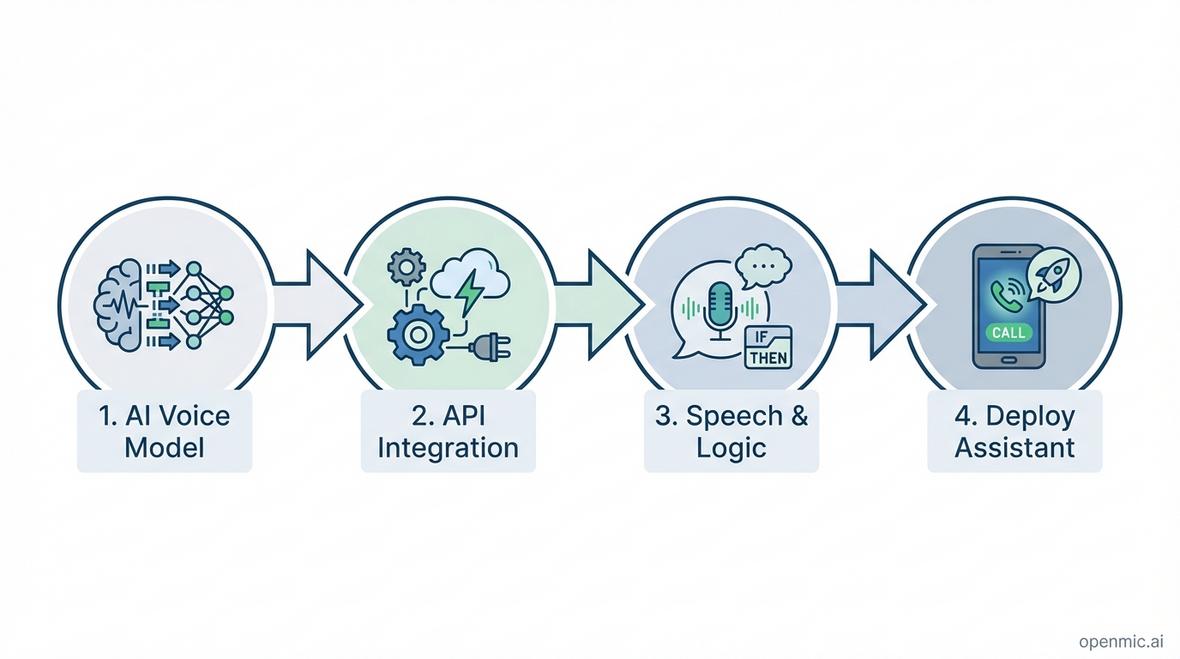
Building a functional AI voice assistant requires careful planning and execution across four primary phases: selecting your AI voice model, integrating with business systems via APIs, programming speech recognition and conditional logic, and finally deploying the assistant to production environments. Each phase demands attention to technical specifications, security considerations, and user experience optimization.
Step 1: Selecting the Right AI Voice Model
The foundation of any voice assistant lies in its AI model. When determining how to make AI voice assistant technology work for your organization, you must first evaluate available voice models based on accuracy, latency, language support, and customization capabilities. Leading options include OpenAI's Whisper for speech recognition, Google's Speech-to-Text API, Microsoft Azure Cognitive Services, and specialized providers like Deepgram that offer real-time transcription with impressive accuracy rates.
Your choice should align with your specific use case. For customer service applications requiring multi-turn conversations, select models optimized for dialogue management with context retention capabilities. For appointment scheduling or lead qualification, prioritize models with strong intent recognition and slot-filling abilities. Consider factors like supported languages if you operate internationally, accent recognition for diverse customer bases, and background noise handling for real-world calling environments.
Enterprises focused on data sovereignty should evaluate on-premise deployment options, while startups may prefer cloud-based solutions that minimize infrastructure overhead. Testing multiple models with your actual use cases before committing to one platform is essential, as performance can vary significantly based on industry-specific terminology and conversational patterns.
Step 2: API Integration and System Connectivity
Once you've selected your AI voice model, the next critical phase in learning how to make AI voice assistant solutions operational involves integration with your existing technology stack. Modern voice AI platforms operate primarily through APIs, enabling seamless connectivity with CRM systems, scheduling tools, payment processors, and data warehouses.
Start by mapping your integration requirements. Identify which systems your voice assistant needs to access customer databases for personalization, inventory management for product availability, or calendar systems for appointment booking. OpenMic.ai offers extensive integration capabilities with major platforms, reducing development time and complexity.
API integration typically involves three components: authentication mechanisms to secure data access, endpoint configurations that define how systems communicate, and webhook implementations for real-time data synchronization. For businesses using platforms like Salesforce, HubSpot, or Zoho CRM, pre-built connectors can dramatically accelerate deployment. The integration with Zapier enables connectivity to over 8,000 applications without custom coding, making it accessible even for teams with limited technical resources.
Security considerations during API integration cannot be overstated. Implement OAuth 2.0 for authentication, encrypt data in transit using TLS/SSL protocols, and establish rate limiting to prevent abuse. Compliance with regulations like GDPR, HIPAA, or PCI-DSS may require additional security measures depending on your industry and the data your voice assistant handles.
Step 3: Programming Speech Recognition and Conditional Logic
The intelligence of your AI voice assistant resides in its ability to understand speech inputs and execute appropriate actions based on conditional logic. This phase of how to make AI voice assistant technology truly conversational involves designing dialogue flows, training NLP models, and programming business rules that govern assistant behavior.
Begin with conversation design mapping out potential user intents and the optimal paths to resolution. Common intents in business applications include appointment scheduling, order status inquiries, payment processing, and general FAQs. For each intent, define the required information slots (customer name, appointment date, service type) and create prompts that guide users toward providing necessary information naturally.
Conditional logic operates on 'if-then' statements that determine assistant responses based on user inputs and system states. For example: 'If the customer requests an appointment AND their preferred time is available, THEN confirm the booking and send a calendar invitation. If NOT available, THEN offer alternative time slots.' These rules can be simple or complex, incorporating multiple variables and external data sources.
No-code platforms have emerged to democratize this process, allowing business users to design conversational flows visually without programming expertise. However, for complex use cases requiring custom integrations or advanced logic, working with developers experienced in Python, JavaScript, or platform-specific SDKs remains valuable. Regularly testing your dialogue flows with real users and iterating based on feedback ensures your assistant handles edge cases and maintains conversational quality.
Step 4: Deploying Your AI Voice Assistant
The final phase of how to make AI voice assistant solutions operational involves deployment to production environments and ongoing optimization. Deployment strategies vary based on your infrastructure preferences and business requirements. Cloud-based deployments offer rapid scaling and minimal maintenance, while on-premise solutions provide greater control over data and customization.
Before full deployment, conduct thorough testing across multiple dimensions. Functional testing verifies that all features work as intended calls connect properly, integrations transfer data accurately, and responses align with programmed logic. Performance testing evaluates latency, ensuring voice responses occur within acceptable timeframes (typically under 2 seconds). Load testing confirms your system can handle expected call volumes without degradation.
User acceptance testing with actual customers or employees provides invaluable insights into real-world performance. Monitor metrics like task completion rates, average handling time, customer satisfaction scores, and escalation rates to human agents. These indicators reveal optimization opportunities and guide iterative improvements.
Once testing validates readiness, implement a phased rollout strategy. Start with a subset of calls or a specific use case, closely monitoring performance and gathering feedback. Gradually increase coverage as confidence grows, keeping human backup available during early stages. Scheduling dial patterns for AI voice agents allows controlled deployment that minimizes risk while maximizing learning opportunities.
Essential Features of Effective AI Voice Assistants
Understanding how to make AI voice assistant technology deliver business value requires implementing key features that differentiate exceptional voice experiences from mediocre ones. These capabilities determine whether customers embrace or resist interacting with your voice AI.
Advanced Natural Language Understanding
The ability to comprehend diverse phrasings, accents, and conversational styles separates enterprise-grade voice assistants from basic implementations. Advanced NLU enables your assistant to recognize synonyms, handle grammatical variations, and extract intent even from ambiguous statements. Training your models on industry-specific vocabulary and actual customer conversations dramatically improves accuracy and reduces frustrating misunderstandings.
Context Awareness and Memory
Effective voice assistants maintain conversational context across multiple exchanges, remembering previous statements and using that information to inform subsequent responses. This context awareness prevents repetitive questioning and creates more natural interactions. For example, if a customer mentions they're calling about 'my recent order,' the assistant should remember this context throughout the conversation without requiring repeated clarification.
Emotion Detection and Sentiment Analysis
Modern AI voice assistants incorporate sentiment analysis to detect customer emotions through vocal cues like tone, pace, and word choice. When frustration or anger is detected, the assistant can adjust its approach offering escalation to human agents, expressing empathy, or prioritizing resolution paths. This emotional intelligence significantly impacts customer satisfaction and brand perception.
Multilingual and Multi-accent Support
Global businesses require voice assistants that accommodate linguistic diversity. Implementing multilingual capabilities ensures all customers receive quality service regardless of their preferred language. Equally important is accent recognition, as poor performance with regional accents creates accessibility barriers and customer frustration. Testing across diverse speaker populations during development prevents these issues in production.
Seamless Human Handoff
Despite AI capabilities, some situations require human intervention. Well-designed voice assistants recognize these scenarios and execute smooth transfers, providing human agents with conversation context and customer information to avoid redundant questioning. AI contact centers that blend automated and human assistance deliver superior outcomes compared to purely automated or manual approaches.
Industry-Specific Applications of AI Voice Assistants
Learning how to make AI voice assistant solutions requires understanding industry-specific requirements and use cases. Voice AI delivers unique value across sectors, with tailored implementations addressing distinct operational challenges.
Healthcare and Medical Practices
Healthcare organizations deploy AI voice assistants for medical practices to manage appointment scheduling, patient intake, prescription refill requests, and post-visit follow-ups. These implementations must comply with HIPAA regulations, ensuring patient data security and confidentiality. Voice assistants reduce administrative burden on medical staff, allowing them to focus on patient care while maintaining 24/7 accessibility for scheduling and routine inquiries.
Real Estate Lead Management
Real estate professionals leverage voice AI for lead screening and qualification, instantly responding to property inquiries, scheduling showings, and capturing buyer preferences. The technology excels at handling high inquiry volumes during listing launches and providing immediate responses that capture interested buyers before they contact competing agents. Voice assistants can also conduct follow-up calls to nurture leads through extended sales cycles.
Automotive Dealerships
Car dealerships implement voice AI to handle service appointment scheduling, sales inquiries, trade-in evaluations, and test drive coordination. Voice AI for automotive dealerships addresses the challenge of after-hours lead capture, ensuring no potential customer goes unattended. The technology integrates with dealership management systems to access inventory, pricing, and service scheduling in real-time.
Restaurant and Hospitality
Restaurants deploy voice assistants for reservation management, takeout orders, and customer inquiries about menus, hours, and special events. These implementations handle peak call volumes without requiring additional staff, ensuring consistent service quality even during rushes. Voice AI can also conduct satisfaction surveys and gather feedback to inform operational improvements.
Legal Practices
Law firms utilize AI answering services for client intake, appointment scheduling, and initial case qualification. These assistants ensure no potential client goes unanswered while protecting attorney time for billable activities. Compliance with attorney-client privilege and data security standards remains paramount in legal implementations.
Technical Considerations and Best Practices
Successfully implementing how to make AI voice assistant technology requires attention to technical details that significantly impact performance and user satisfaction.
Latency and Response Time Optimization
Voice conversation quality depends heavily on response latency. Users expect responses within 1-2 seconds, with delays beyond 3 seconds creating perceptions of system failure. Optimize latency through strategic component placement (edge computing for speech processing), efficient API calls (batching requests where possible), and pre-computation of common responses. Monitoring latency metrics continuously and addressing degradation immediately maintains conversation quality.
Security and Compliance Framework
Voice assistants handling sensitive information must implement robust security measures. Encrypt all voice data in transit and at rest, implement multi-factor authentication for administrative access, conduct regular security audits, and maintain detailed access logs. Industry-specific compliance requirements HIPAA for healthcare, PCI-DSS for payment processing, GDPR for European customers may mandate additional controls. Working with platforms that maintain relevant certifications reduces compliance burden.
Scalability and Infrastructure Planning
Design your voice assistant infrastructure to accommodate growth. Cloud-based architectures automatically scale computing resources during peak demand, while containerization enables efficient resource utilization. Plan for geographic distribution if serving global audiences, positioning voice processing resources closer to users to minimize latency. Load testing reveals infrastructure limitations before they impact production users.
Continuous Monitoring and Analytics
Implement comprehensive monitoring to track system health, conversation quality, and business outcomes. Key metrics include call completion rates, average handling time, customer satisfaction scores, containment rates (calls resolved without human assistance), and conversation abandonment rates. Analytics reveal optimization opportunities frequently misunderstood intents require dialogue refinement, while high abandonment at specific points indicates user experience issues.
Cost Analysis: Building vs. Buying Voice AI Solutions
When evaluating how to make AI voice assistant solutions, businesses face the fundamental decision between building custom solutions or adopting existing platforms. Each approach involves distinct cost structures and trade-offs.
Building Custom Solutions
Custom development provides maximum flexibility and control but requires significant investment. Development costs include hiring specialized AI/ML engineers, voice UX designers, and backend developers, typically ranging from $150,000 to $500,000+ for enterprise-grade solutions. Ongoing expenses include infrastructure hosting, model training and refinement, security maintenance, and feature enhancement. This approach makes sense for organizations with unique requirements that existing platforms cannot accommodate or those viewing voice AI as a competitive differentiator requiring proprietary technology.
Adopting Existing Platforms
Platform adoption dramatically reduces time-to-market and upfront investment. Solutions like OpenMic.ai provide production-ready voice AI infrastructure with transparent pricing models, typically charging per-minute usage fees or subscription tiers based on call volume. This approach eliminates infrastructure management overhead and provides immediate access to continuously improving AI models and features. For most businesses, platform adoption delivers faster ROI and lower total cost of ownership compared to custom development.
Future Trends in AI Voice Assistant Technology
The voice AI landscape continues evolving rapidly, with emerging trends shaping how businesses will leverage this technology in coming years. Emotion AI is advancing beyond basic sentiment detection toward nuanced emotional understanding, enabling assistants to respond with appropriate empathy and adapt conversation strategies based on detected emotional states. Multimodal interactions are blending voice with visual elements, allowing assistants to send images, videos, or documents during voice conversations for enhanced communication.
Proactive assistance represents a paradigm shift from reactive response to anticipatory action, with voice assistants initiating outbound calls based on customer behavior patterns or business triggers. Hyper-personalization leverages customer data and conversation history to tailor every interaction, creating experiences that feel individually crafted rather than generically scripted. Finally, improved dialect and accent recognition continues removing accessibility barriers, ensuring quality experiences for all users regardless of linguistic background.
Frequently Asked Questions
How long does it take to build an AI voice assistant?
Development timelines vary based on complexity and approach. Using existing platforms like OpenMic.ai, basic implementations can be deployed in days to weeks. Custom development typically requires 3-6 months for initial deployment, with ongoing refinement continuing indefinitely. Factors affecting timeline include integration complexity, dialogue sophistication, compliance requirements, and testing thoroughness.
What programming languages are used to create voice assistants?
Common languages include Python (for AI/ML model development and integration), JavaScript/Node.js (for backend services and API development), and platform-specific SDKs. However, many modern platforms offer no-code or low-code builders that eliminate programming requirements for standard implementations, making voice AI accessible to non-technical users.
How much does it cost to implement an AI voice assistant?
Platform-based solutions typically charge $0.05-$0.15 per minute of conversation, with enterprise pricing offering volume discounts. Monthly subscriptions range from $500-$5,000+ depending on call volume and feature requirements. Custom development costs $150,000-$500,000+ upfront plus ongoing maintenance. Total cost of ownership depends on call volume, complexity, and internal vs. outsourced management approaches.
Can AI voice assistants integrate with existing business systems?
Yes, modern voice AI platforms offer extensive integration capabilities through REST APIs, webhooks, and pre-built connectors to popular CRM, ERP, and communication platforms. Integration with systems like Salesforce, HubSpot, Zoho, and thousands of other applications is standard, enabling voice assistants to access customer data, update records, and trigger workflows across your technology stack.
What industries benefit most from AI voice assistants?
Healthcare, real estate, automotive, legal services, financial services, retail, and hospitality see significant value from voice AI implementations. Any industry handling high call volumes, operating extended hours, or requiring rapid response to inquiries benefits from voice assistant deployment. The technology adapts to diverse use cases across virtually all sectors.
How do AI voice assistants handle multiple languages?
Advanced voice assistants support multilingual conversations through language detection and appropriate model routing. They can detect the language being spoken and switch processing to language-specific models automatically. Some implementations require users to specify their language preference, while others detect and adapt dynamically during conversation.
Conclusion
Understanding how to make AI voice assistant technology work for your business represents a strategic investment in operational efficiency and customer experience. From selecting appropriate AI models and integrating with existing systems to programming conversational logic and deploying to production, each phase requires careful planning and execution. Modern platforms like OpenMic.ai democratize access to sophisticated voice AI capabilities, enabling businesses of all sizes to deploy intelligent voice agents without extensive technical resources or prohibitive costs. As voice AI technology continues advancing, early adopters gain competitive advantages through enhanced customer responsiveness, reduced operational costs, and scalable communication infrastructure that grows with their business.