

Introduction
As businesses worldwide shift toward automated customer communication, finding the best conversational AI platforms has become critical for scaling operations, reducing costs, and improving customer satisfaction. Whether you're a tech-savvy business leader, developer, or operations manager within an SME or enterprise, implementing the right conversational AI solution can transform how you handle inbound and outbound calls, manage customer support, and drive revenue growth.
In 2026, the landscape of conversational AI is rapidly evolving. Companies are no longer satisfied with traditional IVR systems that frustrate customers with rigid menu trees and limited functionality. Instead, they're turning to advanced voice AI agents capable of understanding natural language, resolving queries autonomously, and integrating seamlessly with existing business systems. Forrester research shows AI-driven voice agents achieve 85% First Contact Resolution (FCR) vs 60% for traditional IVR, directly addressing the primary pain points of missed calls, high support costs, and poor customer responsiveness.
This comprehensive guide examines the best conversational AI platforms available today, evaluating them across key criteria including integration capabilities, scalability, security, pricing, and real-world performance. We'll explore how these platforms address common business challenges and help you choose the solution that best fits your organizational needs.
What Are Conversational AI Platforms?
Conversational AI platforms are sophisticated software solutions that enable machines to understand, process, and respond to human language in natural, contextually appropriate ways. These platforms combine multiple technologies including natural language processing (NLP), machine learning, speech recognition, and text-to-speech synthesis to create intelligent agents capable of conducting human-like conversations across voice and text channels.
Unlike traditional automated systems that rely on keyword matching or rigid decision trees, modern conversational AI platforms leverage advanced neural networks and large language models to comprehend intent, context, and sentiment. This allows them to handle complex queries, adapt to conversational nuances, and provide personalized responses that feel natural to customers.
Core Components of Conversational AI Platforms
The best conversational AI platforms typically include several essential components working together:
- Natural Language Understanding (NLU): Interprets user intent from spoken or written input, identifying key entities and contextual meaning
- Dialog Management: Maintains conversation context, manages multi-turn interactions, and determines appropriate response strategies
- Natural Language Generation (NLG): Creates human-like responses that are contextually relevant and conversationally natural
- Speech Recognition & Synthesis: Converts speech to text and text to speech for voice-based interactions
- Integration Layer: Connects with CRM systems, databases, and business applications to access and update information
- Analytics & Reporting: Tracks performance metrics, conversation quality, and business outcomes
For businesses seeking to implement voice AI solutions, understanding these components helps evaluate platform capabilities and match them to specific use cases.
Why Businesses Need Conversational AI in 2026
The business case for conversational AI has never been stronger. Organizations across industries face mounting pressure to deliver exceptional customer experiences while controlling operational costs. Traditional approaches to customer service relying primarily on human agents create significant challenges in scalability, consistency, and availability.
Addressing Critical Business Pain Points
Missed Calls and Lost Revenue: Every missed call represents a potential lost customer or unresolved issue. Forrester case studies show 45% reduction in missed calls after implementing advanced voice AI, ensuring businesses capture every opportunity and maintain customer satisfaction even during peak periods or after-hours.
High Cost of 24/7 Human Support: Maintaining round-the-clock human staffing is prohibitively expensive for most businesses. Conversational AI platforms enable true 24/7 availability at a fraction of the cost, handling routine inquiries autonomously while escalating complex issues to human agents when necessary.
Traditional IVR Limitations: Legacy interactive voice response systems frustrate customers with limited menu options, inability to handle natural language, and poor error recovery. Modern conversational AI platforms replace these outdated systems with intelligent agents that understand natural speech, adapt to user needs, and resolve issues efficiently.
Scalability Challenges: As businesses grow, customer communication demands increase exponentially. Conversational AI platforms scale effortlessly, handling thousands of simultaneous conversations without degradation in quality or response time.
Top Conversational AI Platforms: Comprehensive Comparison
Selecting from the best conversational AI platforms requires careful evaluation of features, pricing, integration capabilities, and industry fit. Below, we examine leading solutions across these dimensions.
OpenMic.ai: API-First Voice AI for Enterprise
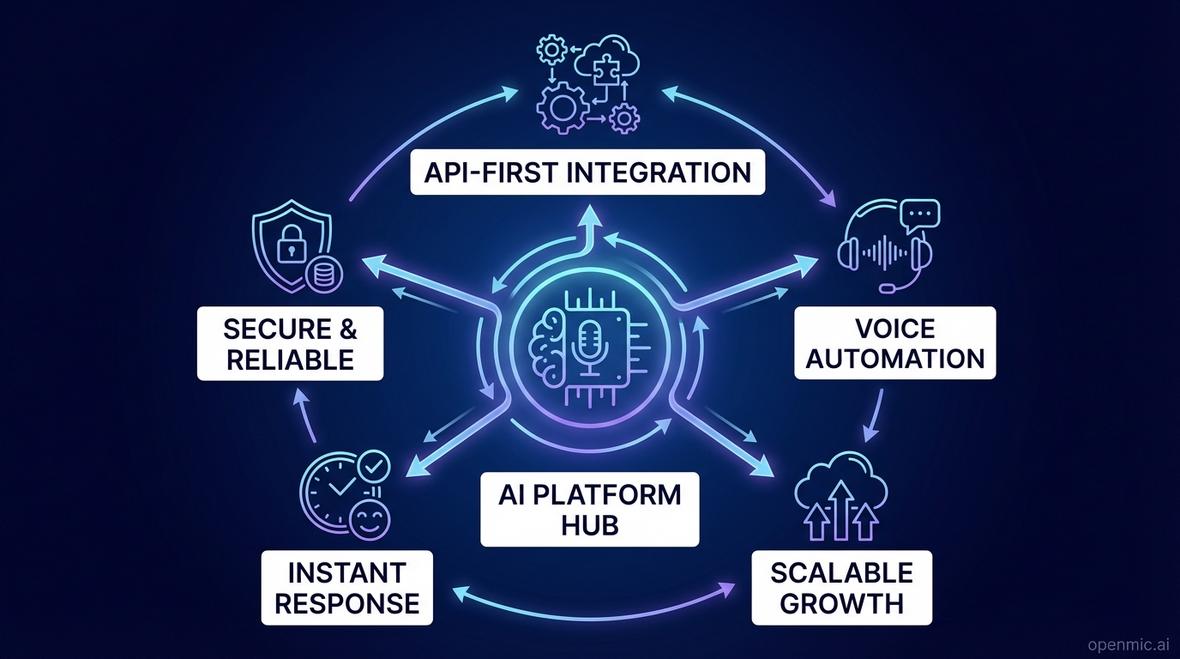
OpenMic.ai stands out as a comprehensive, API-first conversational AI platform specifically designed for businesses requiring advanced voice automation with deep system integration. Built for developers and technical teams, OpenMic.ai offers unparalleled flexibility in creating custom voice AI agents for both inbound and outbound call automation.
Key Strengths:
- API-First Architecture: Complete programmatic control over voice agent behavior, enabling custom workflows and business logic integration
- Enterprise-Grade Security: SOC 2 Type II compliance, end-to-end encryption, and robust data protection measures
- Deep CRM Integration: Native connectors for HubSpot, Pipedrive, Zoho, and thousands of applications via Zapier integration
- Industry-Specific Solutions: Pre-built agents optimized for healthcare, real estate, automotive dealerships, and legal services
- Transparent Pricing: Usage-based model with no hidden fees, detailed in pricing documentation
Ideal For: SMEs and enterprises seeking full control over voice AI deployment, requiring extensive integrations, or operating in regulated industries with strict security requirements.
VAPI: Developer-Focused Voice AI Platform
VAPI offers a developer-centric approach to voice AI, providing tools for building custom voice assistants. However, organizations comparing solutions should review detailed feature comparisons between OpenMic and VAPI to understand capability differences, particularly around enterprise features and industry-specific optimizations.
Synthflow: Low-Code Voice Automation
Synthflow emphasizes ease of use through visual workflow builders, appealing to non-technical users. For agencies considering white-label options, exploring Synthflow white-label alternatives provides valuable context on deployment flexibility and customization capabilities.
Retell AI: Specialized Voice Solutions
Retell AI focuses on specific voice automation use cases with pre-built templates. Businesses evaluating multiple platforms benefit from understanding Retell AI alternatives to ensure comprehensive feature coverage for their specific requirements.
Key Features to Evaluate in Conversational AI Platforms
When assessing the best conversational AI platforms, certain features directly impact implementation success and long-term value.
Integration Capabilities
The ability to connect seamlessly with existing business systems is non-negotiable. Leading platforms offer native integrations with popular CRM systems, helpdesk software, payment processors, and analytics tools. API availability enables custom integrations for proprietary systems or specialized workflows.
OpenMic.ai's integration ecosystem supports thousands of applications, ensuring voice AI agents access real-time data and update records automatically during conversations.
Scalability and Performance
Platforms must handle varying call volumes without performance degradation. Evaluate concurrent conversation capacity, response latency, and infrastructure redundancy. Cloud-native architectures typically offer superior scalability compared to on-premise solutions.
Security and Compliance
For industries handling sensitive information healthcare, finance, legal security features and compliance certifications are critical. Look for SOC 2 Type II compliance, HIPAA readiness, GDPR compliance, and robust encryption. Review platform privacy policies and terms of service carefully.
Customization and Flexibility
Business requirements vary significantly across industries and use cases. The best platforms balance ease of use with deep customization capabilities. API-first platforms provide maximum flexibility, while low-code solutions offer faster deployment with some limitation in custom logic.
Analytics and Insights
Comprehensive analytics reveal conversation performance, customer sentiment, common issues, and automation effectiveness. Advanced platforms provide real-time dashboards, custom reporting, and conversation intelligence that identifies improvement opportunities.
Industry-Specific Use Cases for Conversational AI
The best conversational AI platforms demonstrate versatility across diverse industry applications.
Healthcare: Patient Communication and Scheduling
Healthcare organizations leverage conversational AI for appointment scheduling, prescription refill requests, insurance verification, and post-visit follow-ups. Voice AI agents handle routine inquiries 24/7, reducing administrative burden on clinical staff while improving patient access to information.
Real Estate: Lead Qualification and Property Information
Real estate professionals use conversational AI for initial lead qualification, property information delivery, showing scheduling, and follow-up nurturing. Agents can handle hundreds of inquiries simultaneously, ensuring no potential buyer or seller goes unattended.
Automotive: Service Scheduling and Sales Support
Car dealerships deploy voice AI for service appointment booking, parts inquiries, sales lead capture, and customer satisfaction surveys. The technology addresses the unique challenges of automotive retail, as explored in discussions of voice AI versus traditional BDC operations.
Legal: Client Intake and Case Updates
Law firms implement conversational AI for initial client intake, appointment scheduling, case status updates, and document collection. This enables firms to capture leads 24/7 while ensuring consistent information gathering across all potential clients.
Implementation Considerations and Best Practices
Successfully deploying conversational AI requires thoughtful planning beyond platform selection.
Defining Clear Use Cases
Begin with specific, well-defined use cases rather than attempting comprehensive automation immediately. Identify high-volume, routine interactions where automation delivers immediate value. Expand gradually based on performance data and user feedback.
Conversation Design and Testing
Effective voice AI agents require careful conversation design. Map user journeys, anticipate variations in phrasing, design graceful error handling, and create natural escalation paths to human agents. Extensive testing with real users reveals issues before full deployment.
Human Agent Collaboration
The most successful implementations position AI agents as augmentation rather than replacement for human staff. Define clear handoff criteria, ensure seamless transition with full context transfer, and empower human agents to focus on complex, high-value interactions.
Continuous Optimization
Conversational AI performance improves through ongoing refinement. Monitor key metrics including conversation completion rate, customer satisfaction, escalation frequency, and business outcomes. Use conversation analytics to identify improvement opportunities and adjust agent behavior accordingly.
Pricing Models and Total Cost of Ownership
Understanding the economic implications of conversational AI platforms requires looking beyond headline pricing to total cost of ownership.
Common Pricing Structures
Conversational AI platforms typically employ usage-based pricing (per conversation or per minute), subscription models (monthly or annual fees with included volume), or hybrid approaches combining base fees with usage charges. Evaluate pricing against expected volume, considering peak usage scenarios.
Hidden Costs to Consider
Beyond platform fees, account for implementation costs, custom development, ongoing maintenance, training, and potential integration expenses. Some platforms charge separately for premium features, advanced analytics, or priority support.
Calculating Return on Investment
Quantify value through multiple dimensions: reduced labor costs from automation, increased revenue from captured leads, improved customer satisfaction driving retention, and operational efficiency gains. Most businesses see positive ROI within 3-6 months when implementing conversational AI for high-volume use cases.
Future Trends in Conversational AI
The conversational AI landscape continues evolving rapidly. Emerging trends shaping the future include multimodal interactions combining voice, text, and visual elements; enhanced emotional intelligence enabling sentiment-aware responses; improved multilingual capabilities supporting global operations; and deeper integration with business intelligence systems for predictive insights.
Agentic AI architectures, which enable autonomous decision-making and complex task completion, represent the next frontier in conversational automation. Understanding the distinction between agentic AI and AGI helps businesses prepare for upcoming capabilities while maintaining realistic expectations.
Frequently Asked Questions
What makes a conversational AI platform the 'best' choice?
The best conversational AI platform depends on your specific requirements. Key factors include integration capabilities with your existing systems, scalability to handle your call volumes, security and compliance certifications for your industry, customization flexibility for unique workflows, and pricing alignment with your budget. Platforms like OpenMic.ai excel in API-first architecture and enterprise integration, while others prioritize ease of use or specific industry applications.
How long does it take to implement conversational AI?
Implementation timelines vary based on complexity. Simple use cases like appointment scheduling or FAQ handling can be deployed in 1-2 weeks with pre-built templates. Custom implementations requiring extensive integrations, complex workflows, or specialized training may take 4-8 weeks. API-first platforms typically offer faster deployment for technical teams comfortable with programmatic configuration.
What accuracy rates should I expect?
Modern conversational AI platforms achieve 85-95% accuracy in intent recognition under optimal conditions with proper training. Voice recognition accuracy exceeds 95% in clear audio environments. However, real-world performance depends on conversation complexity, background noise, accent variations, and domain-specific terminology. Continuous optimization and training improve accuracy over time.
Will conversational AI replace human agents?
Conversational AI augments rather than replaces human agents in most scenarios. AI handles routine, high-volume interactions, freeing human agents to focus on complex issues requiring empathy, judgment, or creative problem-solving. The optimal approach combines AI efficiency for routine tasks with human expertise for exceptional situations, as discussed in analyses of AI's impact on call center employment.
Do conversational AI platforms support multiple languages?
Leading platforms support dozens of languages with varying degrees of proficiency. English, Spanish, French, German, and Mandarin typically receive the most development attention and achieve highest accuracy. When evaluating multilingual capabilities, test platforms with your specific language requirements and consider regional accent variations that may affect performance.
How difficult is integration with existing systems?
Integration complexity depends on platform architecture and your existing technology stack. API-first platforms like OpenMic.ai offer the most flexibility, with RESTful APIs, webhooks, and native connectors for popular business applications. No-code platforms may have limited integration options but easier initial setup. Evaluate integration requirements early and ensure platform capabilities match your technical needs.
Conclusion
Selecting from the best conversational AI platforms in 2026 requires careful evaluation of your specific business needs, technical requirements, and growth objectives. While multiple solutions offer voice and chat automation capabilities, platforms differ significantly in integration depth, customization flexibility, security features, and industry optimization.
For businesses prioritizing API-first architecture, enterprise-grade security, and extensive integration capabilities, OpenMic.ai delivers comprehensive voice AI solutions tailored to demanding business environments. Whether you're addressing missed calls, reducing support costs, or scaling customer communication, the right conversational AI platform transforms these challenges into competitive advantages.
Begin your evaluation by clearly defining use cases, testing platforms with real-world scenarios, and calculating total cost of ownership beyond headline pricing. The investment in conversational AI delivers measurable returns through improved customer satisfaction, operational efficiency, and revenue growth.