

What Is Autocaller AI and Why It Matters in 2025
An autocaller AI is an advanced voice automation platform that leverages artificial intelligence to autonomously place outbound calls or intelligently handle inbound communications. Unlike traditional Interactive Voice Response (IVR) systems or predictive dialers, modern autocaller AI solutions integrate natural language processing, machine learning, and conversational AI to simulate human-like interactions at scale.
For tech-savvy business leaders, sales managers, and developers working within SMEs or enterprises, the rise of autocaller AI addresses critical operational pain points: missed calls, prohibitive costs of 24/7 human support, and the rigidity of legacy telephony infrastructure. According to research, AI resolves 65% of tier-1 customer service issues autonomously, reducing escalations by 45% compared to rule-based systems.
This guide explores how autocaller AI platforms like OpenMic.ai empower organizations to deploy intelligent voice agents that scale operations, reduce costs, and deliver instant, personalized customer experiences across industries including healthcare, real estate, automotive, debt collection, and financial services.
How Autocaller AI Technology Works
Modern autocaller AI systems are built on a sophisticated tech stack combining several key components:
Natural Language Understanding (NLU)
NLU enables the AI to comprehend customer intent, context, and sentiment during live conversations. This goes beyond simple keyword matching to understand nuanced requests, questions, and objections in real time.
Text-to-Speech (TTS) and Voice Synthesis
High-quality TTS engines generate natural, human-like voices that can be customized by tone, speed, and accent. Leading platforms support multiple languages and regional dialects to ensure cultural relevance.
Automatic Speech Recognition (ASR)
ASR converts spoken words into text with remarkable accuracy, even in noisy environments or with varied accents. This forms the listening layer of the autocaller AI system.
Dialogue Management and Workflow Orchestration
Intelligent routing logic determines conversation flow, handles interruptions, and seamlessly transfers calls to human agents when necessary. Workflow engines integrate with CRMs, scheduling tools, and databases to retrieve or update information dynamically.
API-First Architecture
For developers and IT teams, API-first autocaller AI platforms like OpenMic.ai offer RESTful APIs, webhooks, and SDKs for seamless integration with existing tech stacks, enabling rapid deployment and customization.
Key Benefits of Autocaller AI for Modern Businesses
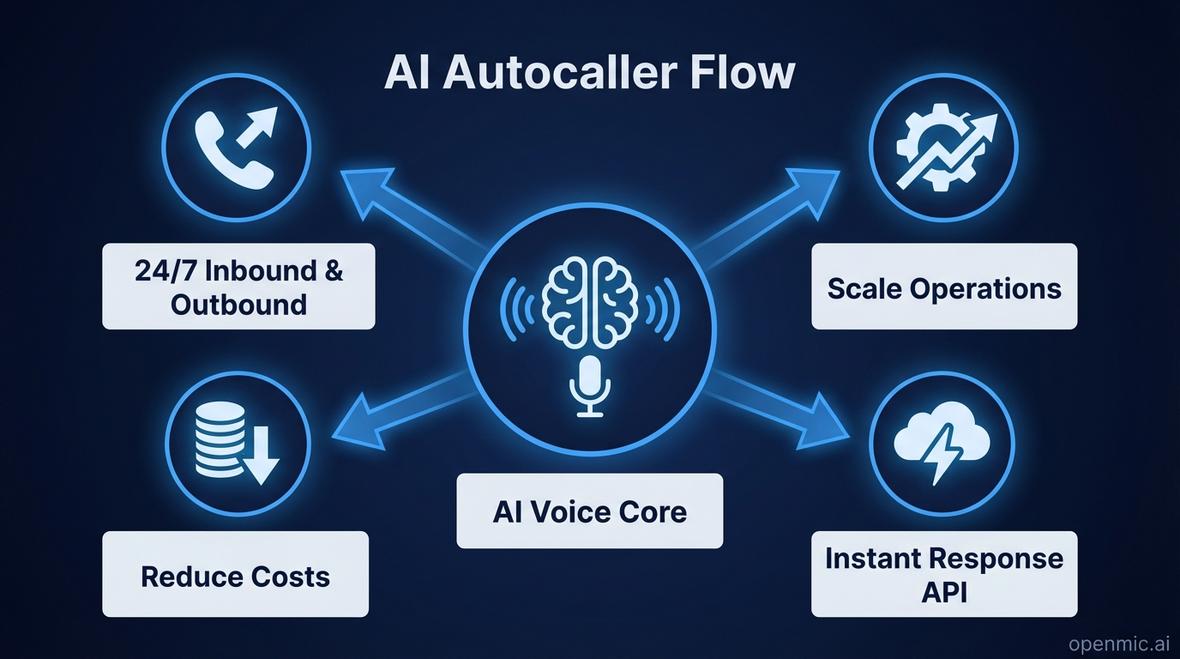
Deploying an autocaller AI solution delivers transformative advantages across customer engagement, operational efficiency, and revenue growth.
24/7 Availability Without Human Overhead
Voice AI agents operate around the clock, handling inbound inquiries and placing outbound calls regardless of time zones or holidays. This eliminates missed opportunities and ensures consistent customer responsiveness.
Massive Scalability at Marginal Cost
Unlike human call centers that require hiring, training, and infrastructure expansion, autocaller AI scales instantly. A single platform can manage thousands of simultaneous calls, making it ideal for high-volume campaigns such as debt collection automation or lead qualification.
Significant Cost Reduction
By automating tier-1 support, appointment reminders, payment notifications, and follow-ups, businesses reduce labor costs by up to 70% while improving call handling speed. This ROI is especially pronounced in industries with high call volumes like healthcare, real estate, and automotive.
Enhanced Customer Experience
Modern autocaller AI delivers personalized, context-aware interactions. Systems can access customer history, preferences, and prior interactions to tailor conversations, improving satisfaction and conversion rates.
Data-Driven Insights and Analytics
Every call generates rich data: sentiment analysis, call duration, resolution rates, and conversion metrics. These insights enable continuous optimization of scripts, workflows, and agent performance.
Common Use Cases for Autocaller AI Across Industries
Autocaller AI is versatile, serving diverse business functions and verticals. Here are the most impactful applications:
Inbound Call Handling and Virtual Receptionists
AI receptionists answer calls, route inquiries, schedule appointments, and provide FAQs instantly. This is particularly valuable for AI receptionist services in healthcare clinics, law firms, and home services.
Outbound Sales and Lead Qualification
Autocaller AI can cold-call prospect lists, qualify leads based on predefined criteria, and schedule demos or meetings with sales reps. This is a game-changer for B2B sales teams and conversational AI for sales teams.
Appointment Reminders and Confirmation
Reduce no-shows by automating appointment confirmations and reminders. Appointment booking agents can reschedule calls if a customer is unavailable, optimizing scheduling efficiency.
Debt Collection and Payment Reminders
Voice AI can handle sensitive conversations with empathy and compliance, sending payment reminders, negotiating plans, and documenting interactions. Explore more on debt collection automation.
Customer Support and FAQ Handling
Autocaller AI answers common questions, troubleshoots issues, and escalates complex cases to human agents. This reduces wait times and improves first-call resolution rates.
Surveys and Feedback Collection
Conduct voice surveys at scale to gather customer feedback, conduct market research, or measure satisfaction post-purchase.
Cart Abandonment and Re-Engagement
E-commerce businesses use autocaller AI to contact customers who abandoned their carts, offering assistance or incentives to complete purchases. Learn more about cart abandonment management.
Autocaller AI vs. Traditional IVR and Predictive Dialers
Understanding how autocaller AI compares to legacy systems clarifies its value proposition.
| Feature | Traditional IVR | Predictive Dialer | Autocaller AI |
|---|---|---|---|
| Interaction Style | Menu-based (press 1 for...) | Human agent required | Conversational, natural language |
| Scalability | Limited by menu complexity | Scales with agent capacity | Unlimited concurrent calls |
| Cost | Moderate setup, low variable cost | High (agent salaries) | Low variable cost per call |
| Customer Experience | Frustrating, rigid | Depends on agent skill | Personalized, context-aware |
| Integration | Limited API support | CRM integration available | API-first, full integration |
| Analytics | Basic call logs | Agent-level metrics | Deep sentiment, NLP insights |
Autocaller AI represents a quantum leap in both customer experience and operational efficiency, making it the preferred choice for forward-thinking businesses.
How to Select the Right Autocaller AI Platform
Choosing an autocaller AI solution requires evaluating several critical factors:
Integration Capabilities
Ensure the platform integrates seamlessly with your CRM (HubSpot, Salesforce, Zoho), scheduling tools (Calendly), and communication channels (Slack, Teams). Check out how OpenMic.ai integrations support 8000+ apps via Zapier and MCP.
Customization and Flexibility
Look for platforms offering no-code workflow builders, customizable scripts, and voice options. Developer-friendly APIs enable advanced customizations.
Compliance and Security
Verify GDPR, HIPAA, and TCPA compliance if operating in regulated industries. Data encryption, call recording policies, and consent management are non-negotiable.
Pricing Transparency
Avoid platforms with hidden fees. Evaluate cost per call, monthly minimums, and overage charges. Visit OpenMic.ai pricing for transparent, scalable plans.
Vendor Reputation and Support
Review case studies, customer testimonials, and third-party comparisons. Platforms like OpenMic.ai are frequently compared against competitors such as Vapi, Retell AI, and Bland AI, often excelling in reliability, feature richness, and customer support.
Trial and Pilot Program
Test the platform with a pilot campaign before committing. Evaluate call quality, accuracy, latency, and user experience firsthand.
Best Practices for Implementing Autocaller AI
Successful deployment of autocaller AI hinges on strategic planning and iterative optimization.
Define Clear Objectives
Identify specific use cases (e.g., appointment reminders, lead qualification) and KPIs (e.g., call completion rate, conversion rate) before launch.
Design Intuitive Conversation Flows
Map out conversation paths, anticipate customer objections, and script fallback responses. Avoid overly complex dialogues that confuse users.
Train with Real Data
Use historical call recordings and transcripts to train the AI on industry-specific terminology, accents, and customer behavior patterns.
Enable Seamless Human Handoff
Configure escalation triggers so complex or sensitive issues are transferred to human agents without friction or data loss.
Monitor and Iterate
Continuously analyze call logs, sentiment scores, and customer feedback. Refine scripts, retrain models, and update workflows to improve performance.
Ensure Transparency with Customers
Disclose that customers are interacting with AI. Transparency builds trust and complies with regulations in many jurisdictions.
OpenMic.ai: A Leading Autocaller AI Solution
OpenMic.ai is an API-first, enterprise-grade voice AI platform designed for developers, sales teams, and customer support managers seeking powerful, secure, and highly integrable autocaller AI capabilities.
Key Features of OpenMic.ai
- Inbound and Outbound Call Automation: Handle customer inquiries and proactively reach out to leads or customers.
- 24/7 Availability: Never miss a call, regardless of time zone or holiday.
- Advanced NLU and ASR: Supports multiple languages and dialects with industry-leading accuracy.
- CRM Integrations: Seamlessly connects with HubSpot, Salesforce, Zoho, Pipedrive, and more.
- Custom Workflows: Build tailored call flows using no-code builders or APIs.
- Real-Time Analytics: Monitor call performance, sentiment, and outcomes via intuitive dashboards.
- Compliance-First: GDPR, HIPAA, and TCPA compliant architecture.
- White-Label Options: Agencies can rebrand and resell OpenMic.ai under their own label.
Industry Applications
OpenMic.ai serves diverse verticals including healthcare, real estate, car dealerships, legal services, and restaurants, offering tailored voice agents for each sector.
Frequently Asked Questions About Autocaller AI
Is autocaller AI legal and compliant?
Yes, when configured correctly. Autocaller AI platforms must comply with regulations like the TCPA (Telephone Consumer Protection Act) in the U.S., GDPR in Europe, and industry-specific rules like HIPAA for healthcare. Always obtain proper consent, disclose AI usage, and honor do-not-call lists.
Will autocaller AI replace human agents entirely?
Not entirely. Autocaller AI excels at handling routine, high-volume tasks, but human agents remain essential for complex, emotionally sensitive, or high-value interactions. The future lies in hybrid models where AI and humans collaborate seamlessly.
How accurate is autocaller AI?
Leading autocaller AI platforms achieve 90-95% accuracy in speech recognition and intent classification under optimal conditions. Performance improves with training data, proper microphone input, and continuous optimization.
What cost savings can I expect?
Businesses typically see 50-70% reductions in call handling costs, faster response times, and higher customer satisfaction. ROI varies by industry, call volume, and deployment scope.
How long does it take to set up autocaller AI?
With platforms like OpenMic.ai, basic setups can be deployed in days using pre-built templates. Custom workflows and integrations may take 2-4 weeks depending on complexity.
Which industries benefit most from autocaller AI?
Healthcare (appointment reminders), real estate (lead follow-up), automotive (service booking), debt collection (payment reminders), retail (order status), and financial services (account inquiries) see the highest impact.
Conclusion
Autocaller AI is reshaping how businesses engage customers, automate workflows, and scale operations in 2025. By combining natural language understanding, real-time decision-making, and seamless integrations, platforms like OpenMic.ai empower tech-savvy leaders and developers to deploy intelligent voice agents that reduce costs, eliminate missed calls, and deliver superior customer experiences. Whether you are automating inbound support, qualifying leads, or conducting outbound campaigns, autocaller AI offers a powerful, secure, and future-proof solution. Explore how OpenMic.ai can transform your customer communication strategy today.