

Introduction: The Communication Crisis in Modern Legal Practice
Law firms today face an unprecedented challenge: balancing high-quality client service with operational efficiency. Every missed call represents a potential client lost to a competitor, while the cost of maintaining 24/7 human reception continues to escalate. According to Accenture's AI Implementation & Business Value Research, professional services firms implementing AI automation have achieved operational cost reductions of up to 40% while simultaneously improving client satisfaction scores. This is where an AI voice agent for legal firms becomes not just advantageous, but essential for competitive survival in 2026.
Legal practices from solo practitioners to large firms are discovering that intelligent voice automation isn't about replacing the human touch; it's about amplifying it. By handling routine inquiries, scheduling consultations, and qualifying leads around the clock, AI voice agents free attorneys and staff to focus on what truly matters: delivering exceptional legal counsel and building lasting client relationships.
What Is an AI Voice Agent for Legal Firms?
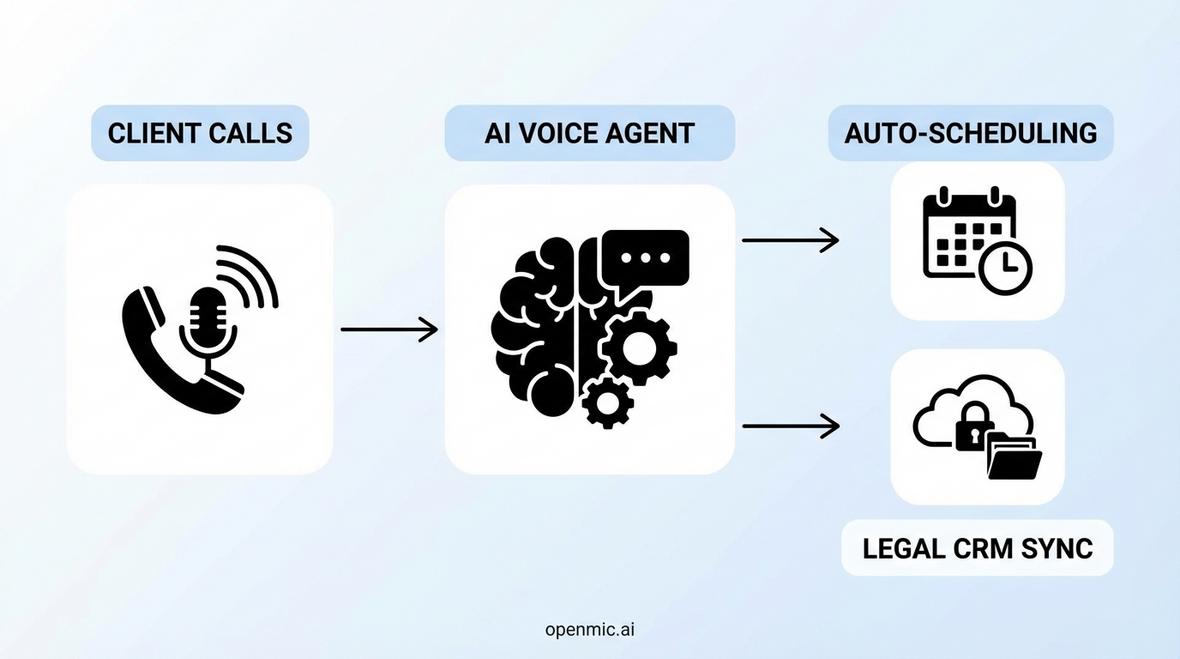
An AI voice agent for legal firms is a sophisticated conversational AI system designed to handle phone-based client interactions autonomously. Unlike traditional Interactive Voice Response (IVR) systems that rely on rigid menu trees, modern AI voice agents leverage natural language processing, machine learning, and real-time integrations to conduct human-like conversations.
Core Capabilities of Legal AI Voice Agents
These intelligent systems can perform a wide range of tasks critical to legal practice management:
- 24/7 Client Intake: Capture new client information, case details, and urgency assessments at any hour
- Appointment Scheduling: Coordinate consultation bookings directly with your calendar systems
- Lead Qualification: Ask targeted questions to determine case viability and practice area fit
- FAQ Handling: Answer common questions about your services, fees, and processes
- CRM Synchronization: Automatically log call details, transcripts, and client data into your legal CRM
- Follow-up Coordination: Schedule callbacks and send confirmation communications
Modern platforms like OpenMic.ai deliver API-first architectures that integrate seamlessly with legal practice management software, ensuring every client interaction is captured and actionable.
Why Legal Firms Need AI Voice Agents in 2026
The legal industry operates in an increasingly competitive landscape where client expectations have fundamentally shifted. Prospective clients expect immediate responses, convenient scheduling, and professional communication regardless of time zones or business hours.
The Hidden Cost of Missed Calls
Research from Forrester's State of Customer Service Technology & AI Automation reveals that professional services firms lose an estimated 25-35% of potential revenue opportunities due to missed or poorly handled initial client contacts. For a mid-sized law firm, this can translate to hundreds of thousands in lost annual revenue.
Consider this scenario: A potential client calls after hours about a time-sensitive legal matter. Without an AI voice agent, they reach voicemail, grow frustrated, and call the next firm on their list. With an intelligent voice system, they receive immediate attention, have their urgency acknowledged, and schedule a consultation all while your team sleeps.
Operational Efficiency and Cost Management
According to Contact Center Industry Benchmarks, AI voice agents handle routine inquiries at approximately 80% lower cost than human agents, while maintaining first-contact resolution rates exceeding 70% for standard queries. For legal practices, this means reallocating expensive paralegal and administrative time toward billable activities rather than phone screening.
An AI voice agent for legal firms doesn't require benefits, never calls in sick, and scales instantly during peak periods such as following a major legal development or marketing campaign. This operational flexibility represents a fundamental competitive advantage.
Enhanced Client Experience
Today's legal clients expect responsiveness. They've grown accustomed to instant digital interactions in other aspects of their lives and bring those expectations to legal services. AI voice agents deliver consistent, professional interactions that reflect your firm's brand values while providing the immediate engagement modern clients demand.
Moreover, these systems can be programmed with your specific intake protocols, ensuring compliance with ethical guidelines and capturing all necessary conflict-check information from the first interaction.
Key Features to Look for in Legal AI Voice Agents
Not all AI voice solutions are created equal, especially when it comes to the specialized requirements of legal practice. When evaluating an AI voice agent for legal firms, prioritize these critical capabilities:
Natural Conversational Ability
The system should engage in fluid, context-aware conversations that feel natural to callers. It must handle interruptions, clarifying questions, and emotional nuances particularly important when dealing with clients facing legal challenges.
Legal CRM and Practice Management Integration
Seamless integration with platforms like Clio, MyCase, Smokeball, or custom legal CRM systems ensures that every interaction is automatically documented. The OpenMic.ai integrations ecosystem demonstrates this approach, connecting with thousands of business applications through native APIs and platforms like Zapier.
Compliance and Security
Legal communications often involve privileged information. Your AI voice agent must maintain strict security protocols, including encrypted communications, secure data storage, and compliance with relevant privacy regulations. For firms handling sensitive client data, this isn't optional it's mandatory.
Intelligent Call Routing and Escalation
While AI handles routine matters, complex or sensitive issues require human expertise. Advanced systems recognize escalation triggers and seamlessly transfer calls to appropriate team members with full context, ensuring no information is lost in transition.
Appointment Scheduling and Calendar Management
Direct integration with your calendar systems allows the AI to book consultations, hearings, and client meetings without human intervention. This eliminates scheduling friction and reduces no-show rates through automated confirmations and reminders.
Multilingual Capabilities
For firms serving diverse communities, multilingual support expands your potential client base significantly. Advanced AI voice agents can conduct conversations in multiple languages, breaking down communication barriers that traditional reception models struggle to address.
Implementation Strategies for Legal Practices
Successfully deploying an AI voice agent for legal firms requires thoughtful planning and phased implementation. Here's how forward-thinking practices approach the transition:
Start with Specific Use Cases
Rather than attempting to automate everything immediately, identify high-volume, routine interactions that consume disproportionate staff time. Common starting points include:
- After-hours call handling and emergency triage
- Initial consultation scheduling for specific practice areas
- General information requests about services and fees
- Status update inquiries for existing cases
The appointments booking agent use case demonstrates how focused implementation delivers immediate value while building organizational confidence in the technology.
Customize Conversation Scripts for Your Practice
Generic AI responses won't reflect your firm's unique approach and values. Work with your AI provider to develop conversation flows that incorporate your specific intake questions, practice area qualifications, and brand voice. This customization ensures the AI truly represents your firm's standards.
Train Your Team
Staff members need to understand how the AI system works, when it will escalate calls to them, and how to access the information it captures. This isn't about replacing jobs it's about enhancing them. Frame the implementation as a tool that frees your team from repetitive tasks so they can focus on higher-value client service.
Monitor, Analyze, and Optimize
Modern AI voice platforms provide detailed analytics on call volumes, conversation outcomes, common inquiries, and system performance. Regularly review these insights to identify optimization opportunities and ensure the system continues meeting your firm's evolving needs.
Industry-Specific Applications Beyond General Practice
While general practice firms benefit substantially from AI voice agents, specialized legal fields see particular advantages:
Personal Injury and Mass Tort
Time-sensitive case intakes require immediate response. An AI voice agent can capture critical details about incidents, injuries, and potential liability while cases are fresh dramatically improving case quality and conversion rates. Learn more about specialized applications in voice AI for mass tort lawyers.
Family Law
Clients facing divorce, custody, or domestic issues often call during emotional moments outside business hours. An empathetic AI voice agent can provide immediate acknowledgment, schedule consultations, and ensure no potential client falls through the cracks during vulnerable times.
Real Estate and Transactional Law
These practice areas involve numerous deadline-driven inquiries about document status, closing schedules, and procedural questions. AI voice agents excel at providing status updates and scheduling signings, freeing attorneys to focus on complex contract negotiations.
Criminal Defense
Urgent calls from individuals facing charges or their family members require immediate attention. An AI system can triage urgency, capture essential case details, and ensure the attorney receives critical information even when court appearances prevent direct availability.
ROI and Cost Considerations
Implementing an AI voice agent for legal firms represents an investment, but one with measurable returns across multiple dimensions:
Direct Cost Savings
Replacing or augmenting traditional reception staff with AI voice agents typically reduces per-interaction costs by 70-85%. For a firm handling 200+ calls weekly, this translates to annual savings of $30,000-$60,000 or more, depending on current staffing models.
Revenue Capture
More significant than cost savings is revenue capture. By ensuring every call receives professional attention regardless of timing, firms typically see 15-30% increases in consultation bookings and case acquisitions. For practices with average case values of $5,000+, capturing even a handful of additional clients monthly generates substantial ROI.
Staff Productivity Gains
When administrative staff aren't constantly interrupted by phone calls, their productivity on substantive tasks increases dramatically. Paralegals can focus on case preparation, legal assistants can handle complex client communications, and attorneys can maintain uninterrupted focus during critical work.
Pricing Models
AI voice agent pricing typically follows usage-based models, with costs determined by call volume, conversation complexity, and integration requirements. Platforms like OpenMic.ai pricing offer transparent, scalable pricing that grows with your practice rather than imposing rigid seat-based licensing.
Security, Privacy, and Ethical Considerations
Legal practices operate under strict ethical obligations regarding client confidentiality and data security. When implementing an AI voice agent for legal firms, these considerations are paramount:
Attorney-Client Privilege
Ensure your AI provider maintains appropriate safeguards to protect privileged communications. While initial intake conversations may not always establish attorney-client relationships, your systems should operate as if they do, implementing encryption, access controls, and retention policies that exceed minimum requirements.
Data Residency and Compliance
Understand where conversation data is stored and processed. For firms subject to specific jurisdictional requirements, data residency matters. Review your provider's privacy policy and terms of service carefully to ensure alignment with your ethical obligations.
Conflict Checking
Configure your AI intake workflows to capture all necessary information for conflict checking before scheduling consultations. This proactive approach prevents embarrassing and ethically problematic situations where conflicts are discovered late in the engagement process.
Transparency with Clients
Some jurisdictions or ethical guidelines may require disclosure that clients are interacting with an AI system rather than a human. Ensure your implementation includes appropriate disclosures while maintaining a professional, confidence-inspiring experience.
Future Trends: What's Next for Legal AI Voice Technology
The AI voice agent for legal firms landscape continues evolving rapidly. Forward-looking practices should watch these emerging trends:
Predictive Case Analytics
Future systems will analyze intake conversations to predict case viability, potential value, and likely outcomes based on historical data helping firms make more informed decisions about case acceptance.
Advanced Sentiment Analysis
AI will increasingly detect emotional states and adjust conversation approaches accordingly, providing empathetic responses during stressful situations while flagging high-urgency or high-distress calls for immediate human follow-up.
Proactive Client Communication
Beyond inbound calls, AI voice agents will handle proactive outreach for appointment reminders, case status updates, document collection, and client satisfaction surveys further reducing administrative burden.
Document Assembly Integration
Expect tighter integration between voice interactions and document automation, where information captured during intake calls automatically populates engagement letters, retainer agreements, and case management systems.
Comparing AI Voice Solutions for Legal Practices
The market for AI voice technology has expanded significantly, with numerous providers targeting legal practices. When evaluating options, consider these differentiation factors:
API-First Architecture
Platforms built with API-first design principles offer superior flexibility and integration capabilities compared to closed, proprietary systems. This architectural approach ensures your investment remains valuable as your technology stack evolves.
Customization Depth
Assess how deeply you can customize conversation flows, voice characteristics, escalation logic, and integration behaviors. Template-based systems may launch quickly but often lack the flexibility specialized legal practices require.
Scalability and Reliability
Your AI voice agent must handle call volume spikes without degradation. Evaluate provider infrastructure, uptime guarantees, and redundancy measures. Missing calls during a marketing campaign or news event defeats the entire purpose.
White-Label Capabilities
For legal marketing agencies or firms seeking additional revenue streams, white-label voice AI platforms enable reselling voice automation services under your own brand.
Why Legal Firms Choose OpenMic.ai
When selecting an AI voice agent for legal firms, OpenMic.ai stands out for several compelling reasons tailored to professional services requirements:
Legal-Specific Workflow Templates
Rather than building from scratch, legal practices can leverage pre-configured workflows for common scenarios like consultation scheduling, case intake, and client follow-up, dramatically reducing implementation time.
Enterprise-Grade Security
OpenMic.ai implements bank-level encryption, SOC 2 compliance, and rigorous access controls that meet the stringent security requirements legal practices demand for client communications.
Unlimited Integration Possibilities
With native connections to major legal practice management platforms and integration with Zapier supporting 8000+ apps, OpenMic.ai connects seamlessly with your existing technology ecosystem.
Transparent, Scalable Pricing
Usage-based pricing ensures you pay only for what you use, making AI voice technology accessible to solo practitioners and large firms alike, with predictable costs that scale with your practice growth.
Dedicated Implementation Support
Legal implementations receive dedicated technical support and consultation to ensure conversation flows reflect best practices for client intake, ethical compliance, and conversion optimization.
Getting Started: Your Implementation Roadmap
Ready to implement an AI voice agent for legal firms? Follow this practical roadmap:
Step 1: Audit Your Current Call Handling
Document your existing call volume, peak periods, common inquiry types, and conversion rates from call to consultation. This baseline data enables meaningful ROI measurement post-implementation.
Step 2: Define Success Metrics
Establish clear objectives: Are you primarily focused on after-hours coverage? Reducing missed calls? Improving lead qualification? Decreasing administrative costs? Different goals may influence configuration priorities.
Step 3: Select Your Initial Use Case
Choose a specific, high-value scenario for your pilot implementation typically after-hours intake or consultation scheduling for a particular practice area.
Step 4: Configure and Customize
Work with your AI provider to develop conversation scripts that reflect your firm's intake protocols, brand voice, and qualification criteria. Integrate with your core systems.
Step 5: Test Thoroughly
Before going live, conduct extensive testing with internal team members playing various client scenarios. Refine conversation flows based on real interactions.
Step 6: Launch and Monitor
Deploy your AI voice agent and closely monitor initial performance. Review call transcripts, track conversion rates, and gather feedback from both staff and clients.
Step 7: Expand and Optimize
Based on pilot results, expand to additional use cases and practice areas. Continuously refine conversation flows based on performance data and evolving needs.
Real-World Success: Legal Firms Transforming Client Intake
While specific client names remain confidential due to legal industry sensitivities, the pattern of results across legal practices implementing AI voice agents demonstrates compelling value:
Solo Practitioner Family Law
A solo family law attorney implemented AI voice handling for after-hours calls. Within three months, she captured 12 additional consultations that would have otherwise gone to competitors, generating approximately $48,000 in new revenue while maintaining her existing work-life balance.
Mid-Size Personal Injury Firm
A seven-attorney personal injury practice deployed AI voice agents for initial case screening. The system handled 60% of incoming calls autonomously, reduced administrative payroll by $42,000 annually, and improved case quality by ensuring consistent qualification questions across all intakes.
Estate Planning Practice
An estate planning firm used AI voice technology to handle routine inquiries about services, pricing, and document requirements. This freed their paralegal team to focus on complex client needs while improving response time from hours to seconds dramatically enhancing client satisfaction scores.
Overcoming Common Objections and Concerns
Legal professionals often express reservations about AI voice technology. Here's how forward-thinking firms address these concerns:
'It Will Feel Impersonal to Clients'
Modern AI voice agents deliver remarkably natural conversations that most callers don't immediately recognize as automated. More importantly, immediate professional attention even from AI provides a better client experience than voicemail or endless ringing.
'Legal Matters Are Too Complex for AI'
Absolutely correct which is why effective implementations focus on routine, high-volume interactions rather than legal advice. AI handles scheduling, information gathering, and qualification, while complex legal discussions remain with attorneys.
'The Technology Is Too Expensive'
Usage-based pricing models make AI voice agents remarkably affordable, particularly compared to hiring additional reception staff or missing valuable client opportunities due to limited availability.
'I'm Concerned About Security and Ethics'
Legitimate concern which is why selecting providers with robust security credentials, legal-industry experience, and clear data governance policies is essential. The right provider will be eager to discuss these considerations in detail.
Additional Resources for Legal Professionals
For legal practices exploring AI voice technology, these resources provide valuable additional perspectives:
- Top 5 AI Answering Services for Law Firms in 2026 comprehensive comparison of leading solutions
- Legal Industry AI Voice Solutions specialized applications for law practice
- OpenMic.ai Blog ongoing insights about voice AI implementation and optimization
- Implementation Guides step-by-step technical documentation for deployment
Frequently Asked Questions
How accurate are AI voice agents for legal intake?
Modern AI voice agents achieve 95%+ accuracy in capturing structured information during legal intake conversations when properly configured. They excel at consistency asking the same qualification questions every time which often exceeds human performance for routine interactions.
Can AI voice agents handle multiple languages?
Yes, advanced platforms support dozens of languages, enabling legal practices to serve diverse communities without multilingual reception staff. The AI seamlessly detects the caller's language and responds appropriately.
Will this work with my existing phone system?
Most AI voice platforms integrate with standard business phone systems through various methods including direct SIP trunking, phone number forwarding, or API connections to VoIP providers. Technical compatibility is rarely a barrier.
How long does implementation take?
Basic implementations can be operational within days for standard use cases. Custom conversation flows and complex integrations may require 2-4 weeks. The timeline depends primarily on how quickly you can provide intake protocols and integration access.
What happens when the AI can't handle a call?
Well-designed systems recognize their limitations and seamlessly transfer calls to human team members with full context of the conversation so far. This escalation process is configurable based on your specific triggers and availability.
Conclusion
The AI voice agent for legal firms has evolved from experimental technology to essential infrastructure for competitive legal practice in 2026. By delivering 24/7 availability, consistent client experiences, and operational efficiency, AI voice automation addresses the core challenges facing modern law firms: missed opportunities, rising costs, and escalating client expectations.
The question is no longer whether to implement AI voice technology, but how quickly you can deploy it before competitors gain irreversible advantages in client acquisition and satisfaction. Legal practices that embrace this transformation position themselves not just to survive, but to thrive in an increasingly competitive marketplace. Explore how OpenMic.ai can transform your legal practice communication today.