
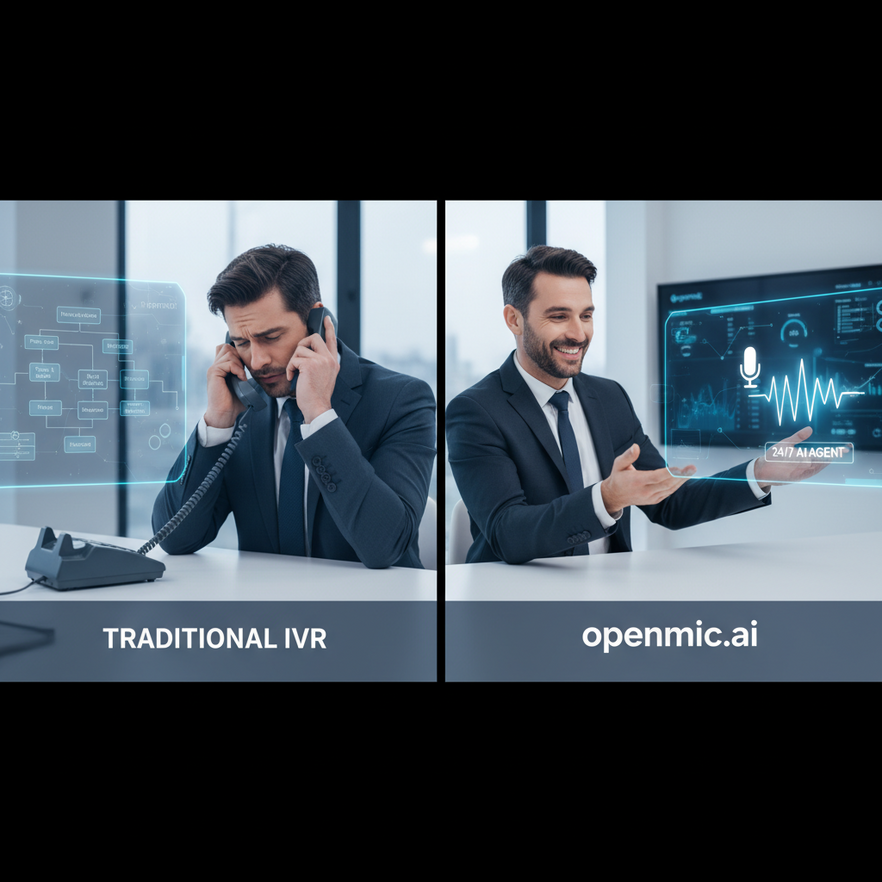
Introduction to AI Voice Agent Agencies
The rise of AI voice agent agency services has transformed how businesses handle customer interactions, lead qualification, and operational workflows. As companies seek to automate repetitive tasks while maintaining high-quality customer experiences, AI voice agents have emerged as a critical solution. An ai voice agent agency specializes in creating, deploying, and managing intelligent voice systems that can handle calls, schedule appointments, qualify leads, and even process transactions with minimal human intervention.
According to recent industry research, businesses implementing AI voice solutions report up to 40% reduction in operational costs and 60% improvement in response times. These statistics underscore why organizations across healthcare, real estate, automotive, and financial services are partnering with specialized agencies to implement voice AI infrastructure.
This comprehensive guide explores what an ai voice agent agency does, how to select the right partner, implementation best practices, industry-specific applications, and future trends shaping this rapidly evolving space.
What Is an AI Voice Agent Agency?
An ai voice agent agency is a specialized service provider that designs, develops, and deploys conversational AI systems capable of handling voice-based interactions. These agencies combine expertise in natural language processing, machine learning, telephony systems, and business process automation to create intelligent agents that can engage in human-like conversations.
Core Services Provided
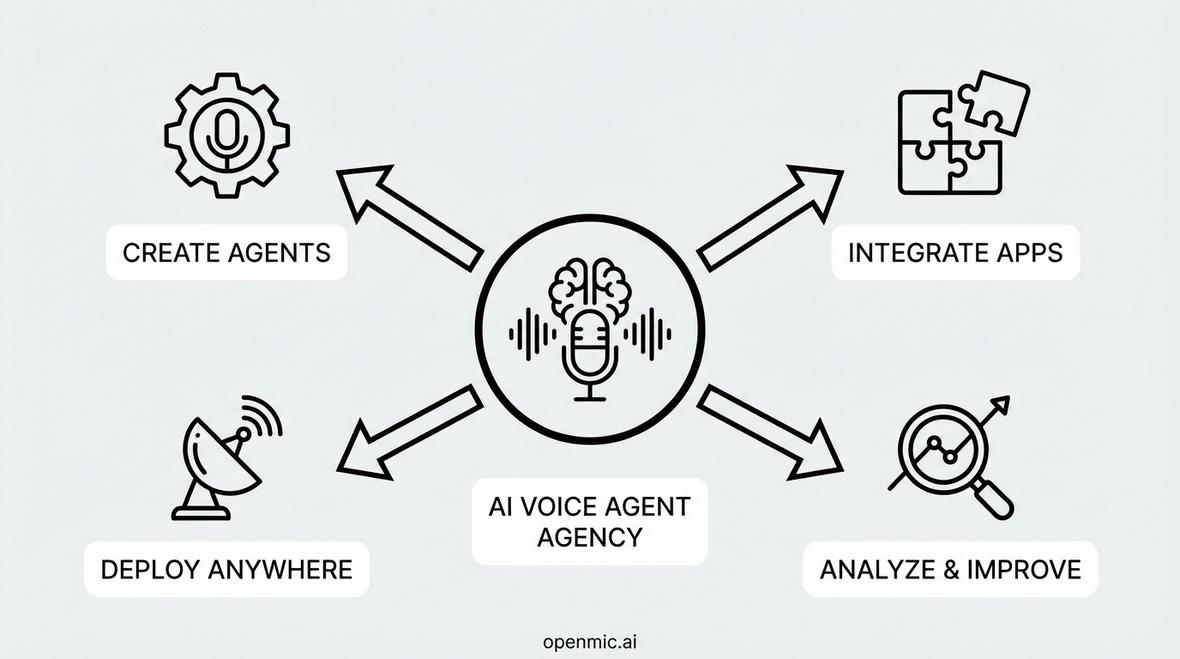
A full-service ai voice agent agency typically offers four fundamental capabilities:
- Agent Creation: Developing custom AI voice agents tailored to specific business needs, industry requirements, and customer interaction patterns
- Application Integration: Connecting voice agents with existing business systems including CRMs, scheduling platforms, payment processors, and databases
- Performance Analytics: Monitoring conversation quality, tracking key performance indicators, and implementing continuous improvement protocols
- Multi-Channel Deployment: Implementing voice agents across phone systems, web applications, mobile platforms, and emerging communication channels
Agencies like OpenMic.ai provide end-to-end solutions that handle everything from initial consultation through ongoing optimization, ensuring businesses can focus on strategy while the technical implementation is managed by specialists.
Technology Stack and Infrastructure
Modern AI voice agent agencies leverage sophisticated technology stacks that include:
- Speech Recognition: Advanced automatic speech recognition (ASR) systems that accurately transcribe spoken words into text
- Natural Language Understanding: NLU engines that interpret intent, context, and sentiment from conversational input
- Dialog Management: Systems that maintain conversation context and guide interactions toward desired outcomes
- Text-to-Speech: High-quality voice synthesis that produces natural-sounding responses
- Telephony Integration: Connections with traditional phone systems, VoIP platforms, and mobile networks
Research from Forrester indicates that businesses investing in integrated voice AI platforms experience significantly higher customer satisfaction scores compared to those using fragmented solutions.
Benefits of Partnering with an AI Voice Agent Agency
Organizations that engage with a specialized ai voice agent agency gain numerous strategic and operational advantages that would be difficult to achieve through in-house development alone.
Accelerated Time-to-Market
Building voice AI capabilities internally requires assembling specialized teams, acquiring technology licenses, and developing domain expertise a process that typically takes 12-18 months. Partnering with an established ai voice agent agency reduces this timeline to 4-8 weeks for most implementations. Agencies bring pre-built frameworks, industry templates, and proven methodologies that dramatically accelerate deployment.
Cost Efficiency and Scalability
The total cost of ownership for voice AI systems includes initial development, ongoing maintenance, infrastructure expenses, and continuous optimization. According to industry analyses, businesses working with agencies typically spend 60-70% less than those building comparable systems in-house. This cost advantage stems from shared infrastructure, amortized development costs, and economies of scale.
Furthermore, agencies provide flexible scaling options. During peak periods, voice agent capacity can be increased without capital investment in additional hardware or staff. For businesses exploring industry-specific solutions, this flexibility proves especially valuable during seasonal fluctuations or unexpected demand spikes.
Access to Specialized Expertise
AI voice agent agencies employ teams with diverse skill sets including conversation designers, machine learning engineers, telephony specialists, and industry consultants. This multidisciplinary expertise ensures implementations follow best practices across all dimensions technical performance, user experience, compliance requirements, and business outcomes.
Agencies also maintain relationships with leading technology providers, giving clients access to cutting-edge capabilities and preferential commercial terms that individual businesses could not negotiate independently.
Ongoing Optimization and Innovation
Voice AI systems require continuous refinement based on real-world performance data. A quality ai voice agent agency provides ongoing monitoring, analysis, and optimization services. They identify conversation patterns that indicate friction points, test variations to improve outcomes, and implement updates that enhance performance over time.
This commitment to continuous improvement ensures that voice agents evolve alongside business needs and customer expectations, maintaining competitive advantage throughout the partnership lifecycle.
Industry-Specific Applications of AI Voice Agents
Different industries leverage AI voice agents to address unique operational challenges and customer service requirements. Understanding these sector-specific applications helps organizations identify the most impactful use cases for their particular context.
Healthcare and Medical Practices
Healthcare organizations face persistent challenges with appointment scheduling, prescription refills, insurance verification, and patient follow-up. AI voice agents address these pain points by providing 24/7 availability, reducing administrative burden on clinical staff, and improving patient access to services.
Specialized healthcare voice AI solutions handle HIPAA compliance requirements, integrate with electronic health record systems, and support medical terminology recognition. According to healthcare technology research, practices implementing voice AI for appointment management report 35-40% reduction in no-show rates and 50% decrease in administrative time spent on scheduling tasks.
Real Estate and Property Management
Real estate professionals struggle with lead qualification, property information requests, showing scheduling, and follow-up communications. Voice AI agents excel at these high-volume, repetitive interactions, allowing agents to focus on high-value activities like property tours and negotiation.
The real estate industry has particularly benefited from AI voice solutions for after-hours lead capture and initial qualification. Studies indicate that response time is the single most important factor in real estate lead conversion, with leads contacted within 5 minutes being 21 times more likely to convert than those contacted after 30 minutes. Voice AI ensures instant response regardless of time or day.
Automotive Dealerships
Car dealerships handle thousands of inquiries related to inventory availability, test drive scheduling, service appointments, and financing options. An ai voice agent agency can deploy specialized systems that integrate with dealer management systems, providing real-time information about vehicle availability, pricing, and appointment slots.
For automotive dealerships, voice AI has proven particularly effective for service department operations. Dealerships report 45-50% reduction in phone abandonment rates and 30% increase in service appointment bookings after implementing AI voice solutions.
Financial Services and Debt Collection
Banks, lenders, and collection agencies handle high volumes of routine inquiries, payment reminders, and account verification calls. Voice AI agents provide consistent, compliant communication while reducing the need for large call center operations.
The debt collection industry has found voice AI particularly valuable for initial contact attempts and payment reminders. These systems follow regulatory requirements precisely, document all interactions automatically, and scale communication efforts without proportional increases in staffing costs.
Home Services and HVAC
Contractors, plumbers, electricians, and HVAC companies face significant challenges managing inbound calls during peak seasons. Many potential customers call outside business hours or during times when technicians are in the field and unable to answer.
Voice AI solutions for home services providers capture these opportunities by providing instant response, gathering service details, checking technician availability, and scheduling appointments all without human intervention. Businesses in this sector report 60-70% improvement in call capture rates and 25-30% increase in booked appointments after implementing voice AI.
How to Select the Right AI Voice Agent Agency
Choosing the appropriate ai voice agent agency partner requires careful evaluation across multiple dimensions. The wrong choice can result in implementation delays, suboptimal performance, and wasted resources, while the right partnership delivers transformational business outcomes.
Key Evaluation Criteria
When assessing potential agency partners, organizations should consider the following factors:
Industry Experience: Does the agency have demonstrated success in your specific industry? Vertical expertise ensures understanding of regulatory requirements, industry terminology, and sector-specific use cases. Agencies with deep experience in your field can implement solutions faster and with fewer iterations.
Technology Platform: What underlying technology does the agency use? Some agencies build proprietary platforms, while others integrate best-of-breed components. Understanding the technology foundation helps assess scalability, flexibility, and long-term viability.
Integration Capabilities: How easily does the solution integrate with your existing technology stack? The ability to connect seamlessly with your CRM, scheduling system, payment processor, and other business applications is critical for operational efficiency.
Customization Flexibility: Can the solution be tailored to your specific requirements, or are you limited to pre-built templates? While templates accelerate deployment, most businesses eventually require customization to address unique processes or competitive differentiators.
Pricing Model: Does the pricing structure align with your business model and growth expectations? Some agencies charge per-call fees, others use monthly subscriptions, and some combine both approaches. Understanding total cost of ownership across different usage scenarios helps identify the most economically advantageous option.
Proof of Concept Approach
Before committing to a full implementation, consider requesting a proof of concept that demonstrates the agency's capabilities in your specific context. A well-designed POC should:
- Address a specific, high-value use case relevant to your business
- Include integration with at least one critical business system
- Generate measurable performance data over a defined period
- Provide clear success criteria established before the POC begins
Quality agencies welcome POC engagements because they provide mutual validation confirming that the solution meets business requirements while demonstrating the client's commitment and organizational readiness.
Partnership and Support Model
The relationship with your ai voice agent agency extends far beyond initial implementation. Evaluate the ongoing support model including:
- Response times for technical issues or performance problems
- Frequency and depth of performance reviews and optimization sessions
- Account management structure and escalation paths
- Training and knowledge transfer for internal teams
- Roadmap transparency and input opportunities for future capabilities
The most successful implementations occur when agencies function as true partners, invested in client success and responsive to evolving business needs.
Implementation Process and Best Practices
Successful deployment of AI voice agents requires structured planning and execution. While specific steps vary by agency and use case, the following framework represents industry best practices for implementation.
Discovery and Requirements Definition
The implementation process begins with comprehensive discovery to understand business objectives, current processes, pain points, and success criteria. During this phase, the ai voice agent agency should:
- Map existing conversation flows and identify optimization opportunities
- Document integration requirements with current systems
- Define key performance indicators and measurement methodology
- Establish realistic timelines and resource requirements
- Identify potential risks and mitigation strategies
Thorough discovery prevents scope creep, aligns expectations, and establishes the foundation for successful implementation.
Design and Development
Based on discovery findings, the agency develops conversation flows, integrations, and system configurations. This phase includes:
- Conversation design that maps to customer journeys and business processes
- Voice selection and personality development that reflects brand identity
- Integration development connecting voice agents to business systems
- Testing protocols covering functional requirements and edge cases
- Security and compliance verification ensuring regulatory adherence
For organizations implementing appointment booking agents or lead qualification systems, this phase typically requires 3-6 weeks depending on complexity and integration requirements.
Pilot Deployment and Optimization
Before full-scale launch, deploy the voice agent in a controlled pilot environment. This approach allows:
- Real-world performance validation with actual customers
- Identification of conversation patterns requiring refinement
- Staff familiarization with new workflows and handoff protocols
- Data collection informing optimization priorities
Pilot periods typically run 2-4 weeks and generate invaluable insights that prevent issues during full deployment.
Full-Scale Launch and Continuous Improvement
After successful pilot validation, proceed with full deployment while implementing continuous monitoring and optimization processes. Effective agencies provide:
- Real-time performance dashboards tracking key metrics
- Regular review sessions analyzing trends and identifying opportunities
- Proactive recommendations for conversation improvements
- Rapid response to emerging issues or performance degradation
The most successful implementations treat launch as the beginning of an ongoing optimization journey rather than a final destination.
Advanced Capabilities of Modern AI Voice Agents
Leading ai voice agent agency providers now offer sophisticated capabilities that extend far beyond simple call answering and routing. Understanding these advanced features helps organizations identify opportunities for competitive differentiation.
Emotion Detection and Sentiment Analysis
Modern voice AI systems can detect emotional states from vocal characteristics including tone, pace, and emphasis. This capability enables dynamic conversation adjustment escalating frustrated callers to human agents, expressing empathy during difficult situations, or matching customer energy levels to build rapport.
Multilingual and Accent Recognition
Advanced platforms support dozens of languages and can accurately recognize diverse accents within each language. For businesses serving multilingual markets, this capability eliminates the need for separate systems or extensive agent training. Platforms like OpenMic.ai's multilingual solutions support over 60 languages with native-level fluency.
Predictive Analytics and Intent Prediction
By analyzing conversation patterns across thousands of interactions, AI systems can predict customer intent early in conversations and proactively address needs. This predictive capability reduces conversation duration while improving satisfaction by anticipating requirements before customers explicitly state them.
Voice Biometrics and Authentication
Voice biometric systems verify caller identity through vocal characteristics, providing secure authentication without passwords or security questions. Financial services organizations particularly value this capability for account access and transaction authorization.
Measuring Success and ROI
Quantifying the business impact of AI voice agents requires establishing clear metrics and measurement methodologies before implementation begins.
Operational Performance Metrics
Track these operational indicators to assess system performance:
- Call Handling Rate: Percentage of calls successfully resolved without human transfer
- Average Handle Time: Duration of typical interactions compared to human-handled equivalents
- Call Abandonment Rate: Percentage of callers who disconnect before interaction completion
- First Call Resolution: Percentage of issues resolved during initial contact
- System Uptime: Availability and reliability of the voice AI platform
Business Outcome Metrics
Beyond operational efficiency, measure business impact including:
- Lead Conversion Rate: Percentage of voice interactions resulting in qualified leads or appointments
- Customer Satisfaction: Survey scores and sentiment analysis from voice interactions
- Cost per Interaction: Total system costs divided by interaction volume
- Revenue Attribution: Sales or bookings directly traceable to voice agent interactions
- Employee Productivity: Time freed for high-value activities due to automated routine tasks
Comprehensive measurement demonstrates clear ROI and identifies continuous improvement opportunities.
Future Trends in AI Voice Agent Technology
The voice AI landscape continues evolving rapidly, with several emerging trends poised to reshape how businesses leverage these capabilities.
Generative AI Integration
The integration of large language models with voice AI platforms enables more natural, context-aware conversations. These systems can generate nuanced responses, adapt communication styles mid-conversation, and handle complex, multi-turn dialogues that previously required human intervention.
Proactive Outreach and Campaigns
Beyond reactive call handling, voice AI increasingly supports proactive outreach for appointment reminders, payment notifications, survey collection, and promotional campaigns. This bidirectional capability transforms voice agents from cost centers into revenue generation tools.
Omnichannel Coordination
Future systems will seamlessly coordinate across voice, text, email, and chat channels maintaining conversation context regardless of channel. Customers will start interactions via voice, continue through text, and complete transactions on web platforms without repetition or loss of context.
Industry-Specific Vertical Solutions
Expect continued development of highly specialized solutions optimized for specific industries. Rather than general-purpose platforms requiring extensive customization, vertical solutions will offer pre-built capabilities addressing industry-specific requirements and compliance standards.
Common Implementation Challenges and Solutions
While AI voice agents deliver substantial benefits, implementations sometimes encounter predictable challenges. Understanding these obstacles and proven mitigation strategies increases success probability.
Integration Complexity
Connecting voice AI with legacy systems can present technical challenges. Mitigation strategies include:
- Phased integration approaches starting with simpler connections
- Middleware platforms that bridge modern and legacy systems
- API-first architectures that standardize integration patterns
Organizational Change Management
Staff may resist automation perceived as threatening job security. Address this through:
- Transparent communication about automation objectives and impacts
- Retraining programs developing skills for higher-value activities
- Pilot programs demonstrating complementary human-AI collaboration
Maintaining Conversation Quality
Ensuring consistent, high-quality interactions requires ongoing effort. Best practices include:
- Comprehensive testing covering diverse scenarios and edge cases
- Regular conversation reviews identifying improvement opportunities
- A/B testing different approaches to optimize outcomes
Frequently Asked Questions
What does an AI voice agent agency actually do?
An ai voice agent agency designs, builds, and manages intelligent voice systems that handle phone calls and voice interactions for businesses. Services typically include custom agent development, integration with existing business systems, performance monitoring, and ongoing optimization to ensure agents deliver desired business outcomes.
How long does it take to implement an AI voice agent?
Implementation timelines vary based on complexity and integration requirements. Simple use cases with minimal integrations can be deployed in 2-4 weeks. More complex implementations involving multiple system integrations and custom conversation flows typically require 6-10 weeks from project initiation to full deployment.
What does AI voice agent implementation cost?
Pricing models vary by agency and deployment scope. Some agencies charge setup fees ranging from $2,000 to $10,000 plus monthly fees based on call volume or minutes consumed. Others use pure subscription models with tiered pricing based on feature requirements. Request detailed proposals from multiple agencies to compare total cost of ownership for your specific use case.
Will AI voice agents replace human employees?
AI voice agents typically augment rather than replace human staff. They handle repetitive, high-volume interactions freeing employees to focus on complex situations requiring empathy, judgment, or specialized expertise. Most organizations redeploy staff to higher-value activities rather than reducing headcount.
How accurate are AI voice agents?
Modern voice AI systems achieve 85-95% accuracy for intent recognition in well-defined use cases. Accuracy improves continuously through machine learning as systems process more conversations. Critical factors affecting accuracy include audio quality, accent diversity in training data, and conversation complexity.
What systems can AI voice agents integrate with?
Leading platforms integrate with CRM systems (Salesforce, HubSpot, Zoho), scheduling platforms (Calendly, Acuity), payment processors, ticketing systems, and custom databases. Most agencies provide pre-built connectors for popular platforms and custom integration services for proprietary systems.
How do AI voice agents handle compliance and data security?
Reputable agencies implement comprehensive security measures including encryption, access controls, audit logging, and compliance frameworks for regulations like HIPAA, PCI-DSS, and GDPR. Always verify specific compliance certifications relevant to your industry before implementation.
Can AI voice agents handle calls 24/7?
Yes, one of the primary benefits of voice AI is round-the-clock availability without staffing night shifts or weekends. This capability particularly benefits businesses with customers across multiple time zones or those seeking to capture after-hours leads.
Conclusion
The emergence of specialized ai voice agent agency providers has democratized access to sophisticated voice AI capabilities that were previously available only to large enterprises with substantial technology budgets. By partnering with experienced agencies, businesses of all sizes can now implement intelligent voice systems that improve customer experience, reduce operational costs, and drive revenue growth.
Success requires careful agency selection, structured implementation, and commitment to continuous optimization. Organizations that approach voice AI as a strategic capability rather than a tactical tool consistently achieve superior outcomes. As the technology continues advancing, early adopters will establish competitive advantages that become increasingly difficult for laggards to overcome. Whether you operate in healthcare, real estate, or any other sector, now is the time to explore how an ai voice agent agency can transform your customer interactions and operational efficiency.