

Introduction to AI Phone Call Assistants
In today's fast-paced business environment, missing a customer call can mean losing a valuable opportunity. An AI phone call assistant represents a revolutionary solution that combines artificial intelligence, natural language processing, and voice recognition to handle inbound and outbound calls automatically. These intelligent systems work 24/7, ensuring no call goes unanswered while significantly reducing operational costs and improving customer satisfaction.
Unlike traditional IVR systems with rigid menu options, modern AI phone call assistants engage in natural, conversational interactions. They can schedule appointments, answer FAQs, qualify leads, and even process transactions all while learning from each interaction to improve performance. For tech-savvy business leaders in SMEs and enterprises, implementing an AI phone call assistant isn't just about automation; it's about scaling operations intelligently without compromising service quality.
According to Forrester's State of AI 2024 with customer experience benchmarks, AI voice solutions improve customer satisfaction scores by 15-25 points and deliver a 35% average reduction in average handle time compared to traditional systems. This dramatic improvement in efficiency and customer experience makes AI phone call assistants an essential tool for businesses looking to remain competitive in 2026.
What is an AI Phone Call Assistant?
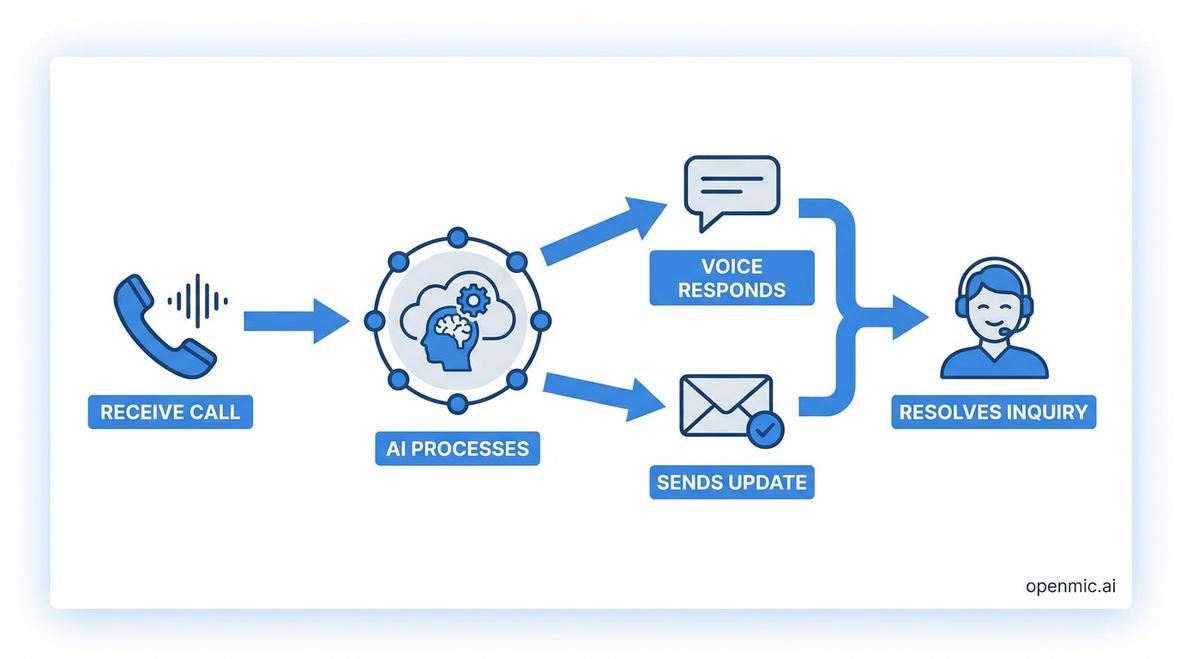
An ai phone call assistant is an intelligent software application powered by artificial intelligence that manages phone conversations on behalf of businesses. These systems utilize advanced technologies including natural language understanding (NLU), speech recognition, text-to-speech synthesis, and machine learning to create human-like interactions over the phone.
The core components of an effective AI phone call assistant include:
- Speech Recognition: Converts spoken words into text data that the system can process and understand
- Natural Language Processing: Analyzes the intent and context behind customer queries to provide relevant responses
- Dialog Management: Maintains conversation flow and context throughout multi-turn interactions
- Voice Synthesis: Generates natural-sounding speech responses using text-to-speech technology
- Integration Capabilities: Connects with CRM systems, calendars, databases, and other business tools
Modern AI phone call assistants can handle complex scenarios including appointment scheduling, lead qualification, customer support inquiries, payment collection, and follow-up calls. The technology has evolved significantly from early automated systems, now offering conversational experiences that many customers can't distinguish from human agents.
Key Benefits of AI Phone Call Assistants for Businesses
Implementing an AI phone call assistant delivers transformative benefits across multiple business dimensions. Here are the primary advantages that make these systems indispensable for modern organizations:
24/7 Availability and Zero Missed Calls
Unlike human staff who require breaks, shifts, and time off, an AI phone call assistant operates continuously without interruption. This means customers in different time zones can reach your business at their convenience, and urgent inquiries receive immediate attention regardless of the hour. This constant availability directly translates to increased lead capture and improved customer satisfaction.
Significant Cost Reduction
Traditional call centers require substantial investments in hiring, training, infrastructure, and ongoing salaries. An AI phone call assistant dramatically reduces these expenses often by 60-80%—while handling higher call volumes. Businesses can redirect human agents to complex, high-value interactions while AI manages routine inquiries efficiently.
Instant Scalability
During peak seasons, product launches, or marketing campaigns, call volumes can surge unexpectedly. An AI phone call assistant scales instantly to handle hundreds or thousands of simultaneous calls without additional hiring or infrastructure costs. This elasticity ensures consistent service quality regardless of demand fluctuations.
Consistency and Quality Assurance
Human agents may have off days, forget protocols, or provide inconsistent information. AI phone call assistants deliver standardized, accurate responses every time, ensuring brand consistency and compliance with company policies. Every interaction follows best practices, reducing errors and improving overall service quality.
Rich Data and Analytics
Every conversation handled by an AI phone call assistant generates valuable data customer preferences, common pain points, conversion patterns, and more. These insights enable data-driven decision-making, help refine marketing strategies, and identify opportunities for product or service improvements. Businesses gain unprecedented visibility into customer communication patterns.
Organizations implementing OpenMic.ai's intelligent voice automation platform report significant improvements in operational efficiency and customer engagement metrics within weeks of deployment.
Top Use Cases and Industries for AI Phone Call Assistants
The versatility of AI phone call assistants makes them valuable across numerous industries and business functions. Here are the most impactful applications:
Appointment Scheduling and Management
Healthcare providers, salons, automotive service centers, and professional services firms use AI phone call assistants to automate appointment booking, send reminders, and handle rescheduling requests. This eliminates phone tag and reduces no-show rates significantly. Explore appointment booking automation solutions for seamless calendar management.
Lead Qualification and Sales
Real estate agencies, automotive dealerships, and B2B companies deploy AI phone call assistants to contact leads immediately, qualify their interest level, answer initial questions, and schedule appointments with sales representatives. This ensures hot leads receive instant attention while sales teams focus on closing deals. Learn more about intelligent lead qualification strategies.
Customer Support and FAQ Handling
Retail businesses, software companies, and service providers use AI phone call assistants to handle common customer inquiries about product information, order status, account management, and troubleshooting. This reduces support ticket volume and provides customers with instant answers. Implement automated FAQ agents to enhance customer service efficiency.
Debt Collection and Payment Reminders
Financial institutions, healthcare billing departments, and subscription services employ AI phone call assistants for gentle payment reminders, payment plan negotiations, and account updates. The consistent, non-confrontational approach often improves collection rates while maintaining customer relationships. Discover AI-powered debt collection solutions that balance effectiveness with empathy.
Healthcare and Patient Engagement
Medical practices, dental offices, and healthcare networks utilize AI phone call assistants for appointment reminders, prescription refill coordination, post-visit follow-ups, and basic symptom triage. This improves patient outcomes while reducing administrative burden on clinical staff. Explore healthcare-specific voice AI applications designed for HIPAA compliance.
Restaurants and Hospitality
Restaurants leverage AI phone call assistants to take reservations, answer menu questions, provide directions, and handle takeout orders during peak hours. Hotels use them for booking inquiries, guest services, and check-in coordination. Review restaurant voice automation for enhanced dining experiences.
Real Estate and Property Management
Real estate professionals deploy AI phone call assistants to screen buyer inquiries, schedule property showings, provide listing information, and follow up with prospects. Property managers use them for maintenance requests and tenant communication. Check out real estate AI voice agents transforming property transactions.
Automotive Dealerships
Car dealerships implement AI phone call assistants for service appointment scheduling, test drive coordination, sales inquiry handling, and follow-up with service customers. This ensures every potential buyer receives immediate attention. Discover automotive-specific voice AI solutions driving dealership success.
How to Choose the Right AI Phone Call Assistant Platform
Selecting the appropriate AI phone call assistant platform requires careful evaluation of several critical factors:
Integration Capabilities
The platform must seamlessly integrate with your existing technology stack CRM systems like HubSpot, Salesforce, Pipedrive, or Zoho, scheduling tools, payment processors, and databases. API-first architecture ensures smooth data flow and reduces implementation complexity. Explore comprehensive integration options that connect with thousands of business applications.
Customization and Flexibility
Every business has unique workflows and communication styles. Look for platforms offering extensive customization options including conversation design, voice selection, response logic, and call routing rules. The ability to train the AI on industry-specific terminology and company policies ensures authentic interactions.
Natural Language Understanding
Advanced NLU capabilities separate mediocre AI phone call assistants from exceptional ones. The system should understand context, handle interruptions gracefully, recognize multiple intents, and manage complex multi-turn conversations without frustrating callers.
Scalability and Reliability
Evaluate the platform's ability to handle your current call volume and scale as your business grows. Uptime guarantees, redundancy measures, and performance during peak loads are critical considerations. Enterprise-grade infrastructure ensures consistent service delivery.
Analytics and Reporting
Comprehensive analytics dashboards providing insights into call volume, conversation outcomes, customer sentiment, conversion rates, and performance metrics enable continuous optimization. The platform should offer both real-time monitoring and historical trend analysis.
Security and Compliance
Especially critical for healthcare, financial services, and legal industries, the platform must meet relevant compliance standards (HIPAA, PCI-DSS, GDPR) and implement robust security measures including encryption, access controls, and audit trails.
Pricing Transparency
Understand the pricing model per-minute charges, monthly subscriptions, setup fees, and additional costs for premium features. Calculate total cost of ownership and compare against the value delivered. Review transparent pricing structures that align with business outcomes.
Implementation Best Practices for AI Phone Call Assistants
Successfully deploying an AI phone call assistant requires strategic planning and thoughtful execution. Follow these best practices to maximize results:
Start with a Focused Use Case
Rather than attempting to automate all phone interactions immediately, begin with a specific, high-impact use case such as appointment scheduling or lead qualification. This allows you to refine the system, gather learnings, and demonstrate ROI before expanding to additional scenarios.
Design Natural Conversation Flows
Map out typical customer conversations, identify common questions and responses, and design dialog flows that feel natural rather than robotic. Include appropriate pauses, acknowledgments, and conversational markers. Test extensively with real users and iterate based on feedback.
Establish Clear Human Handoff Protocols
Define criteria for when conversations should transfer to human agents complex issues, frustrated customers, or high-value opportunities. Ensure smooth handoffs with context preservation so customers don't need to repeat information. Hybrid approaches combining AI efficiency with human empathy often deliver optimal results.
Continuous Training and Optimization
Regularly review conversation transcripts, identify areas where the AI struggled or misunderstood, and refine responses. Update the knowledge base as products, policies, or services change. Machine learning models improve with data, so ongoing optimization is essential for maintaining performance.
Transparent Communication with Customers
Research from Gallup's research on AI phone interviewing scalability highlights the importance of transparency in AI interactions. Consider disclosing that customers are speaking with an AI assistant at appropriate points in the conversation, particularly for sensitive interactions. Transparency builds trust while still delivering efficient service.
Measure and Monitor Performance
Establish key performance indicators (KPIs) including call resolution rate, customer satisfaction scores, conversion rates, average handle time, and cost per interaction. Regular monitoring identifies trends, validates ROI, and highlights opportunities for improvement.
Future Trends in AI Phone Call Assistant Technology
The AI phone call assistant landscape continues evolving rapidly with several emerging trends shaping the future:
Emotion Recognition and Sentiment Analysis
Next-generation systems will detect emotional states through voice tone, pace, and word choice, adapting responses accordingly. Frustrated customers receive empathetic responses and priority escalation, while satisfied customers might receive upsell opportunities.
Advanced Multilingual Capabilities
AI phone call assistants are expanding language support with real-time translation, enabling businesses to serve global customer bases without hiring multilingual staff. Accent recognition and dialect understanding continue improving, ensuring inclusive service delivery.
Predictive and Proactive Calling
Rather than only responding to inbound calls, AI systems will proactively reach out to customers appointment reminders, order status updates, renewal notifications, or personalized offers based on predictive analytics and customer lifecycle stages.
Voice Biometrics for Security
Voice authentication provides secure, frictionless identity verification without passwords or security questions. Financial institutions and healthcare providers are increasingly adopting voice biometrics for account access and sensitive transactions.
Hyper-Personalization
By integrating with comprehensive customer data platforms, AI phone call assistants will deliver deeply personalized interactions referencing past purchases, preferences, and interaction history to create seamless, contextual experiences that feel genuinely tailored.
Frequently Asked Questions About AI Phone Call Assistants
How much does an AI phone call assistant cost?
Pricing varies significantly based on features, call volume, and customization requirements. Basic solutions start around $50-200 per month for small businesses, while enterprise implementations can range from $500-5,000+ monthly depending on scale. Most platforms charge per-minute fees (typically $0.05-0.25 per minute) or offer tiered subscription models. Calculate costs against the alternative of hiring human agents to determine ROI.
Will AI phone call assistants replace human agents entirely?
Rather than complete replacement, the most successful implementations use AI phone call assistants to handle routine, high-volume interactions while human agents focus on complex issues, relationship building, and situations requiring emotional intelligence or creative problem-solving. This hybrid approach optimizes both efficiency and customer satisfaction.
How long does it take to implement an AI phone call assistant?
Implementation timelines range from a few days for simple use cases using pre-built templates to several weeks for custom enterprise deployments. Factors affecting timeline include integration complexity, conversation design requirements, training data preparation, and testing cycles. Many platforms offer rapid deployment options for standard scenarios.
How accurate are AI phone call assistants?
Modern AI phone call assistants achieve 90-95%+ accuracy in speech recognition and intent understanding under normal conditions. Accuracy depends on factors including audio quality, accent diversity in training data, conversation complexity, and ongoing optimization. Leading platforms continuously improve through machine learning and regular updates.
Can AI phone call assistants handle multiple languages?
Yes, most advanced platforms support multiple languages, with leading solutions offering 50+ language options. Multilingual capabilities enable businesses to serve diverse customer bases without hiring multilingual staff. Some systems can even detect the caller's language automatically and switch accordingly.
Which industries benefit most from AI phone call assistants?
While virtually any industry with phone-based customer interactions can benefit, the highest-impact sectors include healthcare, automotive, real estate, financial services, legal, hospitality, and home services. These industries typically handle high call volumes with many routine inquiries perfectly suited for automation.
Conclusion
An AI phone call assistant represents more than just automation it's a strategic asset that transforms customer communication, reduces operational costs, and enables businesses to scale efficiently. From 24/7 availability and instant scalability to rich analytics and consistent service quality, these intelligent systems deliver measurable value across industries and use cases. As technology continues advancing with emotion recognition, hyper-personalization, and predictive capabilities, early adopters will gain significant competitive advantages. Whether you're a tech-savvy business leader seeking to reduce costs or a developer building next-generation customer communication solutions, implementing an AI phone call assistant is no longer optional it's essential for remaining competitive in 2026 and beyond. Explore how OpenMic.ai can help you deploy intelligent voice automation tailored to your specific business needs and start transforming your customer communication today.