
In an era where customer engagement defines competitive advantage, businesses are turning to AI outbound calling bots to automate, scale, and personalize their outreach efforts. Whether you're a sales team looking to multiply touchpoints, a customer support manager aiming to re-engage churned users, or a developer integrating voice automation into your stack, AI-powered outbound calling represents a transformative shift in how organizations communicate at scale.
This comprehensive guide explores what AI outbound calling bots are, how they work, their key benefits, implementation strategies, and why platforms like OpenMic.ai are leading the charge in intelligent voice automation.
What Is an AI Outbound Calling Bot?
An AI outbound calling bot is an intelligent voice agent that autonomously initiates phone calls to customers, prospects, or leads based on predefined triggers, data inputs, or scheduled workflows. Unlike traditional autodialers that simply play pre-recorded messages, modern AI outbound calling bots leverage natural language processing (NLP), conversational AI, and machine learning to conduct dynamic, human-like conversations.
These bots can handle a wide range of tasks including lead qualification, appointment scheduling, payment reminders, customer surveys, retention calls, and follow-ups all without human intervention. They listen, understand context, respond intelligently, and adapt based on the conversation flow.
Key Components of an AI Outbound Calling Bot
- Trigger Management: Activation based on CRM events, time schedules, or behavioral signals
- Voice Synthesis: Natural-sounding text-to-speech engines that mimic human intonation
- Speech Recognition: Real-time transcription and understanding of customer responses
- Dialogue Management: Context-aware conversation flows that handle objections, questions, and dynamic paths
- Integration Layer: Seamless connectivity with CRMs, databases, calendars, and business tools
- Analytics & Reporting: Comprehensive logs, sentiment analysis, and performance metrics
How AI Outbound Calling Bots Work
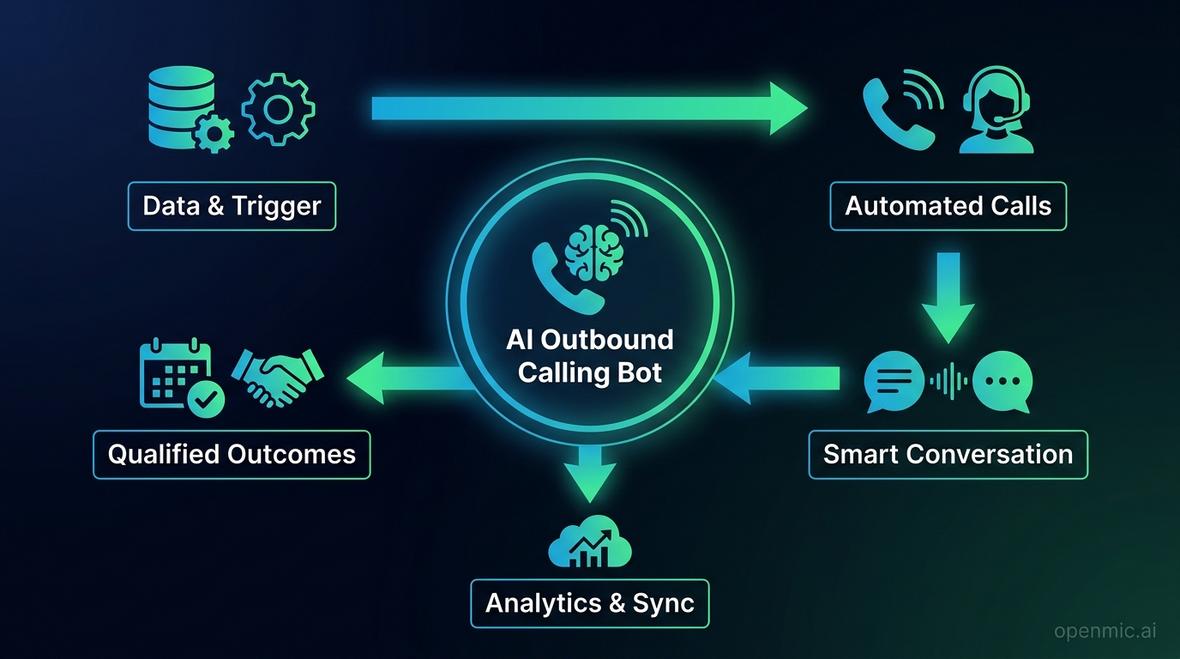
Understanding the workflow of an AI outbound calling bot is essential for businesses considering implementation. The process typically follows a structured pipeline from data ingestion to outcome recording.
1. Data & Trigger Activation
The bot receives input from various sources: CRM records, marketing automation platforms, databases, or manual CSV uploads. Triggers can be time-based (call at 10 AM daily), event-based (user abandoned cart), or condition-based (payment overdue by 15 days). This ensures outreach is timely and contextually relevant.
2. Automated Call Initiation
Once triggered, the bot dials the target number using VoIP infrastructure. Advanced systems use local caller IDs to improve answer rates and employ intelligent retry logic to optimize contact success.
3. Smart Conversation
When the call is answered, the AI agent introduces itself, explains the purpose, and begins a natural dialogue. It uses conversational AI to understand intent, handle interruptions, answer questions, and navigate complex decision trees. For instance, if calling to schedule an appointment, the bot can check real-time calendar availability, propose times, and confirm bookings instantly.
4. Qualified Outcomes
The bot categorizes each interaction based on the outcome: interested lead, appointment scheduled, payment confirmed, callback requested, or not interested. These outcomes are tagged and fed back into your CRM or workflow system for further action.
5. Analytics & Sync
Every call is logged with detailed metadata: duration, sentiment score, key phrases, objections, and next steps. This data syncs with your business systems, enabling continuous optimization and reporting. According to a Harvard Business School study, AI assistance led to a 22% drop in response times with AI assistance, demonstrating the measurable efficiency gains AI brings to customer interactions.
Benefits of Using an AI Outbound Calling Bot
Deploying an AI outbound calling bot delivers tangible operational and financial benefits, particularly for businesses scaling their customer engagement efforts.
Scalability and Reach
Human sales or support teams are limited by time and capacity. An AI bot can make hundreds or thousands of calls simultaneously, reaching more prospects in a single day than a full team could in a week. This is especially valuable for campaigns like AI cold calling, where volume is critical to success.
Cost Efficiency
Hiring, training, and managing outbound call teams is expensive. AI bots reduce labor costs while maintaining consistent quality. Businesses can redirect human agents to high-value tasks like closing deals or handling escalations, while bots manage routine outreach.
24/7 Availability
AI outbound calling bots operate around the clock, enabling businesses to reach customers across time zones and during off-hours. This is particularly beneficial for global operations and industries like healthcare, real estate, and e-commerce.
Personalization at Scale
Modern bots can dynamically insert customer names, reference past interactions, and tailor messaging based on CRM data. This level of personalization, previously achievable only through one-on-one human contact, is now automated and scalable.
Data-Driven Insights
Every conversation generates actionable data. AI bots provide real-time analytics on call success rates, objection patterns, sentiment trends, and conversion metrics, empowering teams to refine scripts, targeting, and timing continuously.
Compliance and Consistency
AI bots follow scripts exactly, ensuring regulatory compliance (TCPA, GDPR) and brand consistency. They never deviate, get fatigued, or make unauthorized promises, reducing legal and reputational risk.
Use Cases for AI Outbound Calling Bots
AI outbound calling bots are versatile tools applicable across numerous industries and functions. Here are some of the most impactful use cases:
Lead Qualification and Nurturing
Bots can automatically call leads captured from web forms, ads, or events to qualify interest, ask discovery questions, and route hot leads to sales reps. This ensures no lead goes cold and maximizes conversion rates. Learn more about lead qualification automation.
Appointment Scheduling
From medical appointments to sales demos, AI bots can handle scheduling end-to-end: proposing times, confirming availability, sending reminders, and rescheduling if needed. This is a game-changer for industries like healthcare and real estate.
Payment and Invoice Reminders
AI bots can politely remind customers of overdue invoices, upcoming payment deadlines, or subscription renewals, improving cash flow and reducing churn. Explore invoice reminder automation for more details.
Customer Retention and Win-Back Campaigns
Re-engaging lapsed customers or preventing churn is critical. AI bots can reach out with personalized offers, gather feedback on why customers left, and attempt to win them back with incentives or solutions.
Surveys and Feedback Collection
Post-purchase surveys, NPS scoring, and feedback collection can be fully automated via voice. AI bots ask questions, record responses, and analyze sentiment, providing richer insights than email surveys. Check out voice survey automation.
Event Reminders and Confirmations
For webinars, conferences, or appointments, bots can call attendees to confirm participation, answer questions, and reduce no-show rates.
Debt Collection
AI bots can conduct compliant, empathetic outreach to customers with overdue accounts, offering payment plans and collecting commitments. This is especially relevant in debt collection automation.
Choosing the Right AI Outbound Calling Platform
Not all AI outbound calling bots are created equal. Selecting the right platform requires evaluating capabilities, integrations, scalability, and support. Here are the critical factors to consider:
API-First Architecture
For tech-savvy teams and developers, an API-first platform offers maximum flexibility and control. You can programmatically trigger calls, customize conversation flows, and integrate deeply with existing systems. OpenMic.ai is built as an API-first voice AI platform, enabling seamless integration into any tech stack.
Natural Language Understanding (NLU)
The bot must accurately understand diverse accents, dialects, and phrasing. Look for platforms with robust NLU models trained on large, diverse datasets.
Conversation Design Flexibility
The ability to design complex, branching conversation flows without extensive coding is crucial. No-code or low-code builders empower non-technical users to create and iterate quickly.
Integration Ecosystem
Your bot should integrate natively with your CRM (Salesforce, HubSpot, Zoho), marketing automation tools, calendars, and other business systems. OpenMic.ai supports extensive integrations, including Zapier for connecting to thousands of apps.
Analytics and Reporting
Comprehensive dashboards, call recordings, transcripts, sentiment analysis, and exportable reports are essential for measuring ROI and optimizing campaigns.
Compliance and Security
Ensure the platform adheres to TCPA, GDPR, HIPAA (if applicable), and other regulations. Data encryption, secure API access, and consent management are non-negotiable.
Scalability and Reliability
Can the platform handle your call volume during peak times? Look for proven uptime SLAs and infrastructure designed for enterprise-grade performance.
Why OpenMic.ai Is the Leading AI Outbound Calling Platform
OpenMic.ai stands out as a powerful, secure, and highly integrable solution for businesses serious about voice automation. Here's why:
Developer-Friendly API
OpenMic.ai is built for developers who want full control. With comprehensive API documentation, SDKs, and webhooks, you can trigger outbound calls programmatically, customize every interaction, and embed voice AI directly into your applications.
Enterprise-Grade Security
Security is paramount. OpenMic.ai ensures end-to-end encryption, complies with global regulations, and offers role-based access controls, making it suitable for industries with stringent compliance requirements like finance and healthcare.
Omnichannel Capabilities
While outbound calling is a core strength, OpenMic.ai also supports inbound calls, SMS, and integrations with messaging platforms, enabling a unified customer communication strategy.
Advanced Conversation AI
Powered by cutting-edge NLP and machine learning, OpenMic.ai bots understand context, handle interruptions gracefully, and adapt to dynamic conversation paths, delivering experiences that feel genuinely human.
Transparent Pricing
No hidden fees or surprise charges. OpenMic.ai offers clear, predictable pricing that scales with your usage, making it accessible for startups and enterprises alike.
Proven Results
Businesses using OpenMic.ai report significant improvements in lead conversion, appointment show rates, and customer satisfaction. The platform is trusted across industries including automotive, healthcare, real estate, and SaaS.
Implementing an AI Outbound Calling Bot: Best Practices
Successful deployment requires strategic planning and ongoing optimization. Follow these best practices to maximize ROI:
Define Clear Objectives
What do you want the bot to achieve? Lead qualification? Appointment booking? Payment collection? Clear goals guide conversation design and success metrics.
Start Simple, Then Iterate
Begin with a single, well-defined use case. Test, gather data, refine, and then expand to additional scenarios. Avoid overcomplicating initial implementations.
Craft Natural, Conversational Scripts
Avoid robotic, overly formal language. Write scripts as if a friendly, helpful human is making the call. Test with real users and iterate based on feedback.
Personalize with Context
Leverage CRM data to personalize greetings, reference past interactions, and tailor messaging. Personalization dramatically improves engagement and conversion.
Optimize Call Timing
Analyze when your audience is most likely to answer and engage. A/B test different times of day and days of the week to maximize contact and conversion rates.
Monitor and Optimize Continuously
Review call recordings, analyze transcripts, and track KPIs. Identify common objections, drop-off points, and opportunities to improve scripts or targeting.
Ensure Compliance
Always obtain proper consent, honor do-not-call lists, and provide clear opt-out mechanisms. Non-compliance can result in heavy fines and reputational damage.
The Future of AI Outbound Calling
As AI technology advances, outbound calling bots will become even more sophisticated. Expect deeper personalization powered by predictive analytics, multimodal interactions combining voice and visual data, and emotional intelligence that detects and responds to customer sentiment in real time. The integration of AI with CRM and business intelligence platforms will enable hyper-targeted, context-aware outreach that feels less like automation and more like a personalized concierge service.
Businesses that adopt AI outbound calling bots today position themselves at the forefront of customer engagement innovation, gaining competitive advantages in efficiency, reach, and customer satisfaction.
Frequently Asked Questions
What industries benefit most from AI outbound calling bots?
AI outbound calling bots deliver value across industries including automotive, healthcare, real estate, financial services, retail, education, and SaaS. Any business that relies on proactive customer outreach can benefit.
Are AI outbound calling bots compliant with regulations?
Yes, when deployed correctly. Reputable platforms like OpenMic.ai provide features to ensure compliance with TCPA, GDPR, and other regulations, including consent management and do-not-call list integration.
How do AI bots compare to human callers?
AI bots excel in scalability, consistency, and cost-efficiency. They handle high-volume, repetitive tasks with precision. However, complex negotiations and emotionally sensitive conversations may still require human involvement. The best approach is a hybrid model where bots handle routine tasks and escalate to humans when needed.
Can AI outbound calling bots integrate with my existing CRM?
Absolutely. Most modern AI outbound calling platforms, including OpenMic.ai, offer native integrations with popular CRMs like Salesforce, HubSpot, Zoho, and Pipedrive, as well as middleware solutions like Zapier for broader connectivity.
How quickly can I deploy an AI outbound calling bot?
Deployment timelines vary based on complexity. Simple use cases can be live within days, while more sophisticated implementations with custom integrations may take a few weeks. Platforms with no-code builders and robust documentation accelerate time-to-value.
Conclusion
AI outbound calling bots represent a paradigm shift in how businesses engage customers, prospects, and leads. By automating routine outreach, personalizing interactions at scale, and delivering actionable insights, these intelligent agents empower organizations to operate more efficiently and effectively. Whether you're looking to boost sales, improve customer retention, or streamline operations, an AI outbound calling bot is a strategic investment that pays dividends in productivity and growth. Platforms like OpenMic.ai provide the technology, flexibility, and support needed to succeed in this new era of intelligent voice automation.