

Introduction to AI Calling Services
The modern business landscape demands efficiency, responsiveness, and exceptional customer service often simultaneously. As companies struggle to manage high call volumes, after-hours inquiries, and lead qualification processes, AI calling services have emerged as a transformative solution. These intelligent systems leverage artificial intelligence, natural language processing, and machine learning to handle voice interactions with remarkable human-like quality.
An AI calling service automates phone conversations, enabling businesses to scale their communication infrastructure without proportionally increasing staffing costs. From appointment scheduling and lead qualification to customer support and payment reminders, these systems are revolutionizing how organizations engage with clients across industries including healthcare, real estate, automotive, and financial services.
According to MarketsandMarkets research, the AI for customer service market is experiencing exponential growth, with businesses increasingly recognizing the strategic advantage of automated voice solutions. This comprehensive guide explores everything you need to know about AI calling services in 2026, from core functionalities to implementation strategies.
What Is an AI Calling Service?
An AI calling service is a sophisticated technology platform that uses artificial intelligence to conduct phone conversations on behalf of businesses. Unlike traditional interactive voice response (IVR) systems that rely on rigid menu structures, modern AI calling services employ conversational AI to understand context, interpret intent, and respond naturally to customer queries.
These systems integrate multiple advanced technologies including speech recognition, natural language understanding (NLU), text-to-speech synthesis, and machine learning algorithms. The result is a voice agent capable of handling complex conversations, understanding accents and dialects, managing interruptions, and even detecting emotional cues in a caller's voice.
Core Components of AI Calling Services
Every effective AI calling service comprises several essential components working in harmony:
- Speech Recognition: Converts spoken words into text data that the system can process and analyze
- Natural Language Processing: Interprets the meaning and intent behind customer statements, going beyond literal transcription
- Dialogue Management: Maintains conversation context and determines appropriate responses based on the conversation flow
- Text-to-Speech Engine: Generates natural-sounding voice output with appropriate tone, pacing, and inflection
- Integration Layer: Connects with CRM systems, databases, and business applications to access and update information
- Analytics Engine: Tracks performance metrics, identifies patterns, and generates actionable insights
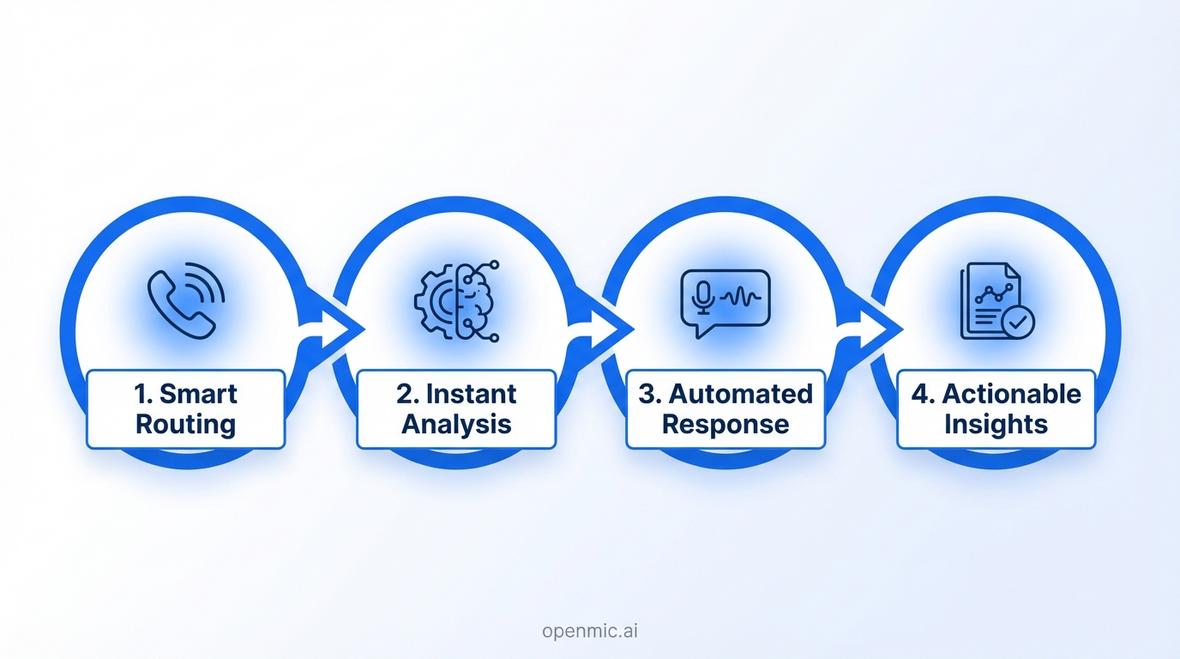
How AI Calling Services Work: The Complete Process
Understanding the operational workflow of an AI calling service helps businesses maximize the technology's potential. The process illustrated in the diagram above demonstrates the sophisticated four-stage workflow that powers modern voice AI solutions.
Stage 1: Smart Routing
When a call comes in or is initiated by the AI system, intelligent routing algorithms immediately assess multiple factors including caller history, business rules, time of day, and agent availability. The system determines whether the call should be handled entirely by AI, transferred to a human agent, or managed collaboratively. This smart routing capability ensures optimal resource allocation and customer experience.
Stage 2: Instant Analysis
During the conversation, the AI calling service performs real-time analysis of speech patterns, word choice, sentiment, and intent. Advanced natural language understanding algorithms process each statement, identifying the caller's needs, detecting urgency levels, and recognizing emotional states. This instantaneous processing enables the system to adapt its responses dynamically, providing contextually appropriate information and maintaining conversational flow.
Stage 3: Automated Response
Based on the analysis, the system generates and delivers intelligent responses through high-quality text-to-speech technology. Modern AI calling services like OpenMic.ai utilize neural voice synthesis to produce remarkably natural-sounding speech with appropriate emotional tone, pacing, and emphasis. The automated response phase can handle everything from simple information requests to complex multi-turn conversations involving appointment scheduling, payment processing, or technical troubleshooting.
Stage 4: Actionable Insights
Every interaction generates valuable data that the AI calling service transforms into actionable business intelligence. The system analyzes conversation patterns, identifies common customer concerns, tracks resolution rates, and measures satisfaction indicators. These insights feed into continuous improvement processes, helping businesses refine their voice AI strategies and optimize customer engagement approaches.
Key Benefits of Implementing an AI Calling Service
Organizations across industries are adopting AI calling services because of the substantial operational and strategic advantages they deliver.
24/7 Availability Without Staffing Costs
Unlike human call centers that require shift scheduling, breaks, and overtime pay, an AI calling service operates continuously without fatigue. This round-the-clock availability ensures no lead goes uncaptured and no customer inquiry goes unanswered, regardless of time zones or business hours. For businesses serving global markets or industries with after-hours urgency like healthcare, this constant availability represents a significant competitive advantage.
Infinite Scalability
Traditional call centers face capacity constraints determined by physical space and staffing levels. An AI calling service scales instantaneously to handle thousands of simultaneous conversations without quality degradation. During peak periods, promotional campaigns, or unexpected surges in call volume, the system maintains consistent performance without requiring temporary staff or overtime authorization.
Consistent Brand Experience
Human agents, despite best training efforts, exhibit natural variations in knowledge, communication style, and mood. An AI calling service delivers perfectly consistent messaging, tone, and information accuracy across every interaction. This consistency strengthens brand identity and ensures compliance with regulatory requirements and company policies.
Dramatic Cost Reduction
The financial case for AI calling services is compelling. Organizations typically reduce per-interaction costs by 60-80% compared to human-staffed operations when accounting for salaries, benefits, training, infrastructure, and turnover costs. The ROI often materializes within months of implementation, particularly for high-volume contact operations.
Rich Data and Analytics
Every conversation captured by an AI calling service becomes a data asset. Advanced analytics reveal customer sentiment trends, common pain points, frequently asked questions, and conversion factors. These insights inform product development, marketing strategies, and operational improvements in ways that manual call monitoring never could at scale.
Common Use Cases for AI Calling Services
The versatility of AI calling services enables application across numerous business functions and industries.
Appointment Scheduling and Management
Scheduling coordination represents one of the most time-consuming administrative tasks across industries. An AI appointment booking agent handles the entire process checking availability, proposing options, confirming selections, sending reminders, and managing rescheduling requests. Medical practices, salons, automotive service centers, and professional services firms achieve dramatic efficiency gains through automated scheduling.
Lead Qualification and Screening
Sales teams waste considerable time pursuing unqualified prospects. An AI calling service configured for lead qualification contacts incoming leads immediately, asks qualifying questions, assesses budget and timeline, and routes only sales-ready prospects to human representatives. This filtering process increases sales team productivity while ensuring faster response times that improve conversion rates.
Customer Support and FAQ Handling
A significant portion of customer service calls involve routine questions with straightforward answers. An AI FAQ agent resolves these inquiries instantly without human involvement, dramatically reducing support costs while maintaining high customer satisfaction. Complex issues seamlessly escalate to human agents with full conversation context preserved.
Payment Reminders and Collections
Collecting overdue payments requires persistent follow-up that strains staff resources and morale. An AI calling service specialized in debt collection conducts courteous, compliant reminder calls at optimal times, negotiates payment arrangements, and processes transactions all while maintaining detailed documentation. Organizations report significant improvements in collection rates and days sales outstanding (DSO) metrics.
Voice Surveys and Feedback Collection
Understanding customer sentiment requires systematic feedback collection. AI voice survey agents conduct structured interviews, ask follow-up questions based on responses, and compile results in real-time. The conversational approach yields higher completion rates and richer qualitative data compared to traditional survey methods.
AI Calling Services Across Industries
Different sectors leverage AI calling services to address industry-specific challenges and opportunities.
Real Estate
The real estate industry benefits enormously from AI voice automation. Agents spend less time on initial inquiry calls while AI systems qualify leads, schedule property showings, follow up on open houses, and even conduct preliminary needs assessments. The technology proves particularly valuable for capturing and nurturing leads from online listings and advertising campaigns.
Automotive Dealerships
Modern car dealerships deploy AI calling services for appointment scheduling, service reminders, sales follow-up, and inventory inquiries. The technology handles the high call volumes typical of automotive retail while providing the immediate response that today's car shoppers expect. AI agents successfully nurture leads through extended consideration cycles common in vehicle purchases.
Healthcare and Medical Practices
Healthcare organizations face unique communication challenges including appointment management, prescription refills, insurance verification, and patient intake. An AI receptionist for healthcare handles these tasks while maintaining HIPAA compliance, reducing administrative burden on clinical staff, and improving patient access. The technology proves especially valuable for managing after-hours calls and reducing no-show rates through intelligent reminder systems.
Home Services and HVAC
Service-based businesses in the HVAC and home services sectors deal with high seasonal call volumes and emergency service requests. An AI calling service captures every inquiry regardless of timing, schedules technician appointments, provides service estimates, and follows up on completed work. This responsiveness directly impacts customer acquisition and retention in competitive local markets.
Legal Services
Law firms implement AI solutions for legal practices to manage initial consultations, case intake, appointment scheduling, and client communication. The technology ensures no potential client goes uncontacted while freeing attorneys and paralegals to focus on billable work rather than administrative coordination.
Choosing the Right AI Calling Service for Your Business
Selecting an appropriate AI calling service requires careful evaluation of several critical factors.
Integration Capabilities
The most effective AI calling services integrate seamlessly with existing business systems including CRM platforms, scheduling software, payment processors, and communication tools. Solutions like OpenMic.ai offer native integrations with popular platforms and API access for custom connections, ensuring the voice AI becomes part of your unified technology ecosystem rather than an isolated tool.
Customization and Flexibility
Every business has unique processes, terminology, and requirements. Look for an AI calling service that allows extensive customization of conversation flows, response libraries, escalation rules, and integration behaviors. The ability to tailor the system to your specific needs directly impacts adoption success and ROI.
Voice Quality and Naturalness
The quality of the voice interface significantly affects customer perception and engagement. Advanced AI calling services utilize neural text-to-speech technology that produces remarkably natural-sounding voices with appropriate emotional expression. Test the voice quality thoroughly during evaluation, as robotic or unnatural-sounding systems may damage rather than enhance customer relationships.
Analytics and Reporting
Data-driven optimization requires comprehensive analytics. Evaluate the reporting capabilities of potential AI calling services, looking for detailed conversation transcripts, sentiment analysis, performance metrics, and trend identification. The insights generated should directly inform business decisions and continuous improvement efforts.
Support and Training
Implementation success depends significantly on vendor support quality. Assess the training resources, technical support responsiveness, and ongoing optimization assistance offered by AI calling service providers. Organizations with limited AI expertise particularly benefit from vendors offering hands-on implementation support and strategic consultation.
Implementation Best Practices for AI Calling Services
Successful deployment of an AI calling service requires strategic planning and thoughtful execution.
Start with Specific Use Cases
Rather than attempting to automate all call types simultaneously, identify high-volume, routine interactions that follow predictable patterns. Initial success with focused use cases builds organizational confidence and provides learning opportunities before expanding to more complex scenarios.
Design Conversations Carefully
Effective AI calling services rely on well-designed conversation flows that anticipate customer needs and guide interactions toward successful outcomes. Invest time in conversation design, incorporating actual customer language patterns and addressing common objections or questions. Iterative refinement based on real interaction data continuously improves performance.
Maintain the Human Option
Even the most sophisticated AI calling service encounters situations requiring human judgment or handling sensitive matters. Ensure your implementation includes clear escalation paths to human agents and makes this option easily accessible to callers who prefer or require human assistance.
Monitor and Optimize Continuously
AI performance improves through ongoing refinement based on actual usage data. Establish regular review processes to analyze conversation transcripts, identify misunderstandings or failures, and implement improvements. The most successful organizations treat their AI calling service as a continuously evolving asset rather than a set-it-and-forget-it solution.
Train Staff on AI Collaboration
Human team members need preparation for working alongside AI systems. Provide training on how escalated calls will be handled, how to access conversation history from AI interactions, and how the technology complements rather than replaces human expertise. Addressing concerns proactively and demonstrating how AI reduces mundane tasks while elevating human roles to more strategic work improves adoption.
The Future of AI Calling Services in 2026 and Beyond
The AI calling service landscape continues evolving rapidly with several emerging trends shaping the technology's future trajectory.
Advanced Multilingual Capabilities
Modern AI calling services increasingly support conversations in multiple languages with seamless language detection and switching. This capability enables businesses to serve diverse customer bases without maintaining multilingual staff for every supported language. Platforms like Spanish voice AI and French voice AI demonstrate the growing sophistication of multilingual voice technology.
Emotion Detection and Response
Next-generation AI calling services analyze vocal characteristics to detect caller emotions including frustration, confusion, satisfaction, or urgency. The system adapts its responses accordingly showing empathy when detecting frustration, providing additional explanation when sensing confusion, or expediting escalation when identifying high urgency.
Predictive Engagement
AI systems increasingly initiate proactive outreach based on predictive analytics. An AI calling service might contact customers predicted to have service needs, reach out to leads showing digital engagement signals, or conduct retention outreach to accounts exhibiting churn indicators all without human prompting.
Voice Biometrics and Security
Voice authentication technology enables AI calling services to verify caller identity through vocal characteristics, enhancing security while eliminating password friction. This capability proves particularly valuable for financial services, healthcare, and other industries handling sensitive information.
Comparing AI Calling Service Platforms
The market offers numerous AI calling service options, each with distinct strengths and positioning. Understanding key differentiators helps businesses select the optimal solution.
OpenMic.ai: Comprehensive Voice AI Platform
OpenMic.ai distinguishes itself through exceptional voice quality, extensive integration capabilities, and industry-specific customization. The platform supports diverse use cases from cart abandonment management to claims processing automation, with pre-built templates accelerating deployment across various industries.
Key Platform Considerations
When evaluating AI calling service alternatives, examine factors including pricing transparency, contract flexibility, technical support quality, customization depth, and integration ecosystem. Platforms like Vapi.ai and Bland.ai offer different approaches to voice automation, with varying strengths in developer tools, enterprise features, or industry specialization.
ROI and Cost Considerations for AI Calling Services
Understanding the financial impact of an AI calling service requires examining both direct costs and broader business value.
Typical Cost Structure
Most AI calling services employ usage-based pricing models charging per minute of conversation, per call, or per month with included volume tiers. Enterprise deployments may negotiate custom pricing based on anticipated volume and feature requirements. When evaluating costs, consider the total cost of ownership including implementation, training, ongoing optimization, and integration maintenance.
Calculating Business Value
The ROI calculation for an AI calling service should account for multiple value drivers including reduced staffing costs, increased lead capture and conversion, improved customer satisfaction, decreased response times, and enhanced data insights. Organizations typically achieve payback periods ranging from three to twelve months depending on call volumes and use case complexity.
Getting Started with AI Calling Services
Beginning your AI calling service journey requires a structured approach balancing ambition with pragmatism.
Phase 1: Assessment
Document your current call handling processes, volumes, costs, and pain points. Identify specific use cases where automation could deliver immediate value. Establish success metrics that will guide evaluation and optimization efforts.
Phase 2: Vendor Selection
Research available AI calling service platforms, request demonstrations, and conduct pilot tests with leading candidates. Evaluate not just current capabilities but vendor roadmaps, financial stability, and strategic fit with your organization's technology direction.
Phase 3: Pilot Implementation
Deploy your AI calling service initially to a limited use case or customer segment. This controlled rollout enables learning and refinement without risking large-scale disruption. Monitor performance closely, gather stakeholder feedback, and iterate on conversation design and integration configurations.
Phase 4: Scale and Optimization
Following successful pilot validation, expand the AI calling service to additional use cases and higher volumes. Establish ongoing optimization processes reviewing performance data, implementing improvements, and exploring new applications of the technology across your organization.
Frequently Asked Questions About AI Calling Services
How accurate are AI calling services compared to human agents?
Modern AI calling services achieve accuracy rates exceeding 90% for routine, structured interactions. Performance varies based on conversation complexity, audio quality, and accent diversity. For well-defined use cases with proper training data, AI systems often match or exceed human consistency while handling vastly higher volumes.
Can AI calling services understand different accents and dialects?
Yes, advanced AI calling services train on diverse speech datasets encompassing numerous accents, dialects, and speaking styles. Performance continues improving as systems process more real-world conversations. Leading platforms support dozens of languages and regional variations with high comprehension accuracy.
What happens when the AI cannot handle a caller's request?
Quality AI calling services include intelligent escalation mechanisms that transfer calls to human agents when confidence thresholds aren't met or callers explicitly request human assistance. The transition typically includes full conversation context, ensuring the human agent understands the situation without requiring customers to repeat information.
How long does it take to implement an AI calling service?
Implementation timelines range from days for simple use cases with pre-built templates to several weeks for complex, highly customized deployments. Factors affecting duration include integration complexity, conversation design requirements, testing scope, and organizational change management needs. Many businesses achieve initial deployment within 2-4 weeks.
Are AI calling services compliant with regulations like TCPA and GDPR?
Reputable AI calling service providers design their platforms with compliance capabilities including consent management, do-not-call list checking, call recording disclosures, and data privacy protections. However, compliance responsibility ultimately rests with the implementing organization, which must configure systems appropriately and maintain compliant operational practices.
Can AI calling services integrate with existing CRM and business systems?
Yes, modern AI calling services offer extensive integration capabilities through native connectors, APIs, and middleware platforms. Common integrations include Salesforce, HubSpot, Zoho, Microsoft Dynamics, and numerous industry-specific applications. The integration depth enables AI systems to access customer data, update records, trigger workflows, and synchronize information across your technology ecosystem.
Conclusion
The transformation of business communication through AI calling services represents one of the most significant operational innovations of the past decade. These intelligent systems deliver simultaneous improvements in cost efficiency, scalability, consistency, and customer experience benefits previously considered mutually exclusive. As the technology continues advancing with more natural voices, sophisticated understanding, and predictive capabilities, the competitive advantage for early adopters grows increasingly substantial. Whether you operate in healthcare, real estate, automotive, financial services, or any industry with significant voice communication needs, exploring how an AI calling service can transform your customer engagement strategy deserves immediate attention. The question is no longer whether to implement voice AI, but how quickly you can deploy it to capture the operational and strategic benefits your competitors are already realizing.