

Introduction
In today's hyper-competitive business landscape, customer communication remains the cornerstone of success. Yet, traditional call centers struggle with high costs, scalability challenges, and inconsistent service quality. Enter the ai call service—a revolutionary approach that leverages artificial intelligence to automate, enhance, and optimize voice interactions at scale.
An ai call service is an intelligent platform that uses voice AI agents to handle inbound and outbound calls autonomously. These systems understand natural language, respond contextually, and integrate seamlessly with existing business workflows. For tech-savvy business leaders, developers, and operations managers, adopting an ai call service means unlocking 24/7 availability, dramatic cost reductions, and superior customer experiences all while maintaining security and compliance standards.
This comprehensive guide explores everything you need to know about ai call services: how they work, their business applications, implementation strategies, and how to choose the right platform for your organization. Whether you're scaling a startup or optimizing enterprise operations, this article will equip you with actionable insights to transform your communication infrastructure.
What Is an AI Call Service?
An ai call service is a cloud-based solution that deploys intelligent voice agents to manage phone conversations without human intervention. Unlike traditional Interactive Voice Response (IVR) systems that rely on rigid menu trees, modern ai call services use natural language processing (NLP), machine learning, and conversational AI to understand intent, context, and sentiment.
These platforms can handle a wide range of tasks: answering customer inquiries, scheduling appointments, qualifying leads, processing orders, sending reminders, and even conducting surveys. The best ai call services integrate with CRM systems, payment gateways, calendars, and other business tools to deliver end-to-end automation.
Key Components of an AI Call Service
- Speech Recognition: Converts spoken language into text with high accuracy, even in noisy environments or with diverse accents.
- Natural Language Understanding (NLU): Interprets user intent and extracts relevant information from conversations.
- Dialog Management: Orchestrates multi-turn conversations, maintaining context across exchanges.
- Text-to-Speech (TTS): Generates human-like voice responses in real-time, often with customizable tone and accent.
- Integration APIs: Connects to databases, CRMs, and third-party services to retrieve and update information dynamically.
- Analytics and Reporting: Tracks performance metrics like call volume, resolution rates, and customer satisfaction.
Why Businesses Need an AI Call Service
The demand for always-on, responsive customer service has never been higher. According to research from Statista AI customer satisfaction scores, AI-powered voice agents achieve CSAT scores of 88% on average, compared to 75% for human-only support, with 30% better first contact resolution. This data underscores the tangible benefits of adopting an ai call service.
Primary Pain Points Addressed
- Missed Calls and Lost Revenue: Studies show that up to 40% of inbound calls go unanswered during peak hours or after business hours, resulting in lost opportunities.
- High Operational Costs: Maintaining a 24/7 human call center requires significant investment in staffing, training, infrastructure, and overhead.
- Inconsistent Service Quality: Human agents vary in performance, leading to inconsistent customer experiences and brand perception.
- Limited Scalability: Traditional call centers struggle to scale during demand spikes, such as seasonal promotions or product launches.
- IVR Frustration: Legacy IVR systems with rigid menus frustrate customers, leading to higher abandonment rates and negative sentiment.
An ai call service eliminates these challenges by providing instant, accurate, and scalable voice interactions. It ensures no call goes unanswered, reduces cost per interaction by up to 70%, and delivers consistent, high-quality service across every touchpoint.
How an AI Call Service Works
Understanding the technical workflow of an ai call service helps organizations appreciate its capabilities and plan effective implementations. Here's a step-by-step breakdown:
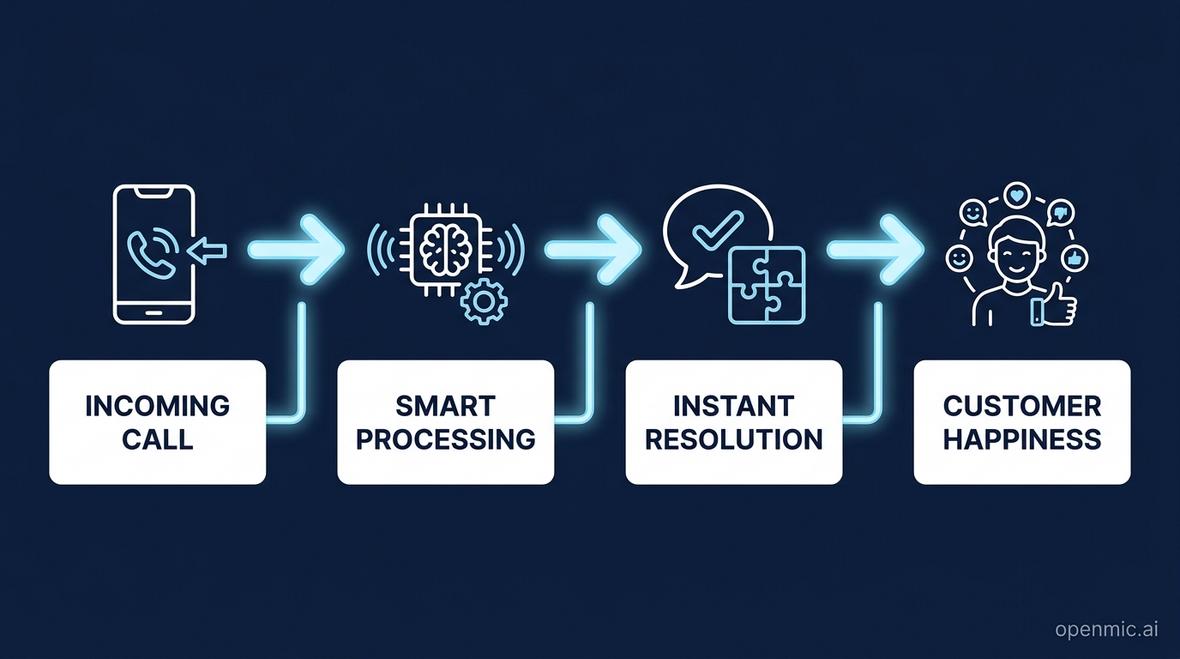
Step 1: Incoming Call
When a customer dials your business number, the call is routed to the AI platform's telephony infrastructure. This can be a dedicated AI phone number or an existing number integrated via SIP trunking or cloud telephony providers.
Step 2: Smart Processing
The AI voice agent greets the caller and uses advanced speech recognition to transcribe their spoken words. Natural language understanding algorithms then analyze the transcript to determine intent whether the caller wants to schedule an appointment, inquire about a product, or resolve a billing issue.
Step 3: Instant Resolution
Based on the detected intent, the AI agent retrieves relevant information from integrated systems (CRM, inventory, scheduling software) and responds appropriately. For example, if the caller wants to book an appointment, the agent checks calendar availability, confirms the slot, and sends a confirmation SMS all in real-time.
Step 4: Customer Happiness
The conversation concludes with a successful resolution, leaving the customer satisfied. The AI logs the interaction, updates records, and triggers any necessary follow-up actions. Analytics dashboards provide insights into call patterns, common issues, and performance metrics.
This streamlined process ensures faster resolution times, reduced wait periods, and higher customer satisfaction key benefits that position the ai call service as a strategic advantage.
Use Cases of AI Call Services Across Industries
The versatility of an ai call service makes it applicable across diverse sectors. Here are some of the most impactful use cases:
Healthcare
Healthcare providers use ai call services for appointment booking, prescription reminders, patient intake, and post-discharge follow-ups. AI agents can verify insurance, answer common health questions, and route urgent cases to human clinicians. This reduces no-shows, improves patient engagement, and frees up administrative staff. Learn more about voice AI for healthcare.
Real Estate
Real estate agencies leverage ai call services to qualify leads, schedule property viewings, and provide property information. AI agents can field inquiries 24/7, ensuring no lead is lost. Agents also conduct voice surveys to gauge buyer preferences and market trends. Explore more about AI voice agents for real estate.
Automotive and Car Dealerships
Car dealerships use ai call services to capture after-hours leads, schedule test drives, answer inventory questions, and follow up on financing inquiries. This automation significantly boosts conversion rates and enhances the buyer journey. Read about AI solutions for car dealerships.
Debt Collection
Financial institutions and collection agencies deploy ai call services to send invoice reminders, negotiate payment plans, and maintain compliance with regulatory standards. AI agents are empathetic, consistent, and available around the clock, improving recovery rates while reducing operational costs. Discover more about AI for debt collection.
Home Services and HVAC
HVAC companies, plumbers, and contractors use ai call services to handle service requests, provide quotes, schedule technicians, and send maintenance reminders. This improves customer satisfaction and optimizes field operations. Learn about AI for home services.
Legal Services
Law firms use ai call services for client intake, case status updates, appointment scheduling, and answering frequently asked questions. This allows attorneys to focus on casework while ensuring prospective clients receive timely responses. Explore AI voice agents for legal firms.
Restaurants
Restaurants deploy ai call services to take reservations, answer menu questions, handle delivery orders, and manage waitlists. This reduces order errors, improves table turnover, and enhances guest experiences. Check out AI voice agents for restaurants.
Retail and E-Commerce
Retailers use ai call services for order tracking, product recommendations, returns processing, and cart abandonment management. AI agents can upsell, cross-sell, and provide personalized shopping assistance. Learn more about AI for retail.
Key Benefits of Implementing an AI Call Service
Cost Reduction
Traditional call centers incur high costs for salaries, training, facilities, and technology. An ai call service reduces these expenses by automating routine interactions, allowing human agents to focus on complex cases. Organizations typically see cost reductions of 50-70% per interaction.
Scalability
AI voice agents can handle unlimited concurrent calls without degradation in quality. Whether you receive 10 calls or 10,000 calls per day, the system scales instantly to meet demand.
24/7 Availability
An ai call service never sleeps. It provides round-the-clock support, ensuring customers in different time zones or those with urgent needs can always reach your business.
Consistency and Accuracy
AI agents deliver uniform, on-brand messaging and adhere to scripts and compliance protocols without deviation. This eliminates the variability inherent in human agents and reduces errors.
Improved Customer Experience
With faster response times, accurate information retrieval, and empathetic conversation design, ai call services enhance customer satisfaction and loyalty. The ability to resolve issues on the first contact significantly boosts Net Promoter Scores (NPS).
Data-Driven Insights
Every interaction is logged and analyzed, providing valuable insights into customer behavior, common pain points, and service performance. These insights inform strategic decisions and continuous improvement.
Choosing the Right AI Call Service Platform
Selecting the right ai call service platform is critical to success. Here are the key factors to evaluate:
Integration Capabilities
Ensure the platform offers robust APIs and pre-built connectors for your CRM, ERP, helpdesk, and other business systems. Seamless integration enables real-time data exchange and automation. Platforms like OpenMic.ai offer extensive integrations.
Customization and Flexibility
Look for platforms that allow you to customize voice personas, conversation flows, and business logic without heavy coding. No-code or low-code builders accelerate deployment and iteration.
Voice Quality and Latency
Natural, human-like voice quality and low latency are essential for engaging conversations. Test the platform's TTS engines and ensure they support your desired languages and accents.
Security and Compliance
Verify that the platform complies with industry regulations such as HIPAA, PCI-DSS, and GDPR. Data encryption, secure APIs, and audit logs are non-negotiable for sensitive industries.
Scalability and Reliability
The platform should handle traffic spikes without downtime. Look for uptime SLAs, redundancy, and global infrastructure to ensure reliability.
Analytics and Reporting
Comprehensive dashboards, call transcripts, sentiment analysis, and performance metrics enable continuous optimization and ROI tracking.
Pricing Model
Evaluate the pricing structure pay-per-call, subscription, or usage-based. Ensure transparency and predictability to avoid unexpected costs. Explore OpenMic.ai pricing for competitive options.
Implementation Best Practices for AI Call Services
Define Clear Objectives
Start by identifying specific use cases and KPIs. Are you looking to reduce call volume, improve lead conversion, or enhance customer satisfaction? Clear goals guide design and measurement.
Design Conversations Thoughtfully
Map out conversation flows that reflect real customer interactions. Use empathy, brevity, and clarity. Avoid overly complex scripts that confuse users.
Test and Iterate
Launch pilot programs with controlled user groups. Gather feedback, analyze call recordings, and refine the AI agent's responses and logic.
Train Your Team
Educate your staff on how the ai call service works, when to escalate to humans, and how to interpret analytics. Change management is key to adoption.
Monitor and Optimize
Continuously review performance metrics, identify bottlenecks, and update conversation flows. AI improves with data, so ongoing optimization is essential.
Future Trends in AI Call Services
The evolution of ai call services is accelerating, driven by advances in machine learning, NLP, and telephony infrastructure. Here are emerging trends to watch:
Multimodal Interactions
Future ai call services will integrate voice, video, and text channels, enabling seamless omnichannel experiences. Customers will switch between channels without losing context.
Emotion Recognition
Advanced sentiment analysis and emotion detection will allow AI agents to adapt tone and responses based on customer mood, enhancing empathy and resolution rates.
Predictive Outreach
AI will proactively initiate calls based on predictive analytics such as reaching out to customers likely to churn or reminding them of upcoming renewals.
Hyper-Personalization
Leveraging customer data, AI agents will deliver personalized recommendations, offers, and support tailored to individual preferences and history.
Voice Biometrics
Voice-based authentication will replace passwords and security questions, enabling secure, frictionless customer verification.
How OpenMic.ai Stands Out as an AI Call Service
OpenMic.ai is a leading ai call service platform designed for businesses that demand flexibility, security, and performance. Here's what makes it exceptional:
- API-First Architecture: OpenMic.ai offers a robust API that integrates with over 8,000 apps via Zapier MCP integration, enabling seamless workflows.
- Industry-Specific Solutions: Pre-built templates and agents for healthcare, real estate, automotive, legal, and more accelerate deployment.
- Low Latency and High Voice Quality: Powered by advanced signal processing, OpenMic.ai delivers natural conversations with minimal lag.
- Enterprise-Grade Security: Full compliance with HIPAA, GDPR, and PCI-DSS ensures data protection and regulatory adherence.
- Flexible Pricing: Transparent, usage-based pricing models suit startups and enterprises alike.
- No-Code Builder: Design and deploy voice agents without coding expertise, empowering business users and developers.
Explore detailed guides and blog resources to learn how OpenMic.ai can transform your communication strategy.
Frequently Asked Questions
What is the difference between an AI call service and a traditional IVR?
Traditional IVR systems use pre-recorded menus and require users to press keys or speak specific commands. An ai call service uses natural language understanding to interpret open-ended speech, enabling fluid, human-like conversations.
How much does an AI call service cost?
Costs vary by provider and usage. Most platforms charge per minute of call time or per interaction. OpenMic.ai offers competitive pricing tailored to business size and call volume.
Can AI call services integrate with my existing CRM?
Yes. Leading platforms like OpenMic.ai offer native integrations with popular CRMs such as HubSpot, Salesforce, Zoho, and Pipedrive, as well as custom API connections.
How long does it take to deploy an AI call service?
Deployment timelines range from days to weeks, depending on complexity. With no-code platforms like OpenMic.ai, simple use cases can go live within hours.
Will AI replace human call center agents?
AI augments, not replaces, human agents. It handles routine, repetitive tasks, freeing humans to focus on complex, high-value interactions that require empathy and judgment.
Is an AI call service secure and compliant?
Reputable platforms prioritize security and compliance. OpenMic.ai is HIPAA, GDPR, and PCI-DSS compliant, with end-to-end encryption and robust access controls.
Conclusion
The adoption of an ai call service represents a strategic shift in how businesses communicate with customers. By automating voice interactions, organizations achieve unprecedented scalability, cost efficiency, and customer satisfaction. From healthcare and real estate to retail and debt collection, ai call services deliver tangible ROI across industries.
Choosing the right platform one that offers robust integrations, customization, security, and support is critical. OpenMic.ai stands out as a comprehensive, API-first solution designed for modern businesses. Whether you're a startup scaling rapidly or an enterprise optimizing operations, now is the time to embrace the future of business communication. Explore OpenMic.ai today and transform your customer engagement strategy.