

Introduction to AI Call Routing
In 2026, ai call routing has become the cornerstone of modern customer communication strategies. Traditional Interactive Voice Response (IVR) systems are rapidly being replaced by intelligent, AI-powered routing solutions that understand caller intent, analyze sentiment in real-time, and direct customers to the most appropriate resource whether that's a human agent, a voice AI assistant, or an automated resolution pathway.
For tech-savvy business leaders, founders, and customer support managers within SMEs and enterprises, the stakes have never been higher. Missed calls translate directly into lost revenue, while the cost of maintaining 24/7 human support teams continues to escalate. AI call routing offers a powerful solution: combining natural language processing, machine learning, and contextual analytics to deliver seamless, cost-effective customer experiences.
This comprehensive guide explores how ai call routing works, the proven benefits backed by industry data, implementation strategies, and how platforms like OpenMic.ai are transforming voice communication for businesses worldwide.
What Is AI Call Routing?
AI call routing leverages artificial intelligence technologies including natural language understanding (NLU), speech recognition, and predictive analytics to intelligently direct incoming and outgoing calls. Unlike legacy IVR systems that rely on rigid menu trees and touch-tone inputs, AI-native routing understands conversational language, detects caller emotions, and dynamically adjusts call paths based on real-time context.
Key Components of AI Call Routing
- Intent Recognition: AI analyzes the caller's words to determine their purpose (e.g., billing inquiry, technical support, appointment scheduling).
- Sentiment Analysis: The system detects frustration, urgency, or satisfaction levels, adjusting routing priority accordingly.
- Contextual Data Integration: Pulls information from CRM systems, previous interactions, and customer profiles to provide personalized routing.
- Predictive Routing: Uses historical data and machine learning models to predict which agent or resource will resolve the inquiry most effectively.
- Omnichannel Coordination: Integrates voice, chat, email, and SMS interactions into a unified routing strategy.
According to research from industry leaders, AI-native contact centers integrate intelligent routing based on intent and sentiment, enhancing operational efficiency over traditional systems. This shift represents a fundamental reimagining of how businesses handle voice communication.
Why AI Call Routing Matters in 2026
The business case for adopting ai call routing is compelling, backed by substantial ROI metrics and operational improvements. Organizations implementing intelligent routing report significant gains across multiple dimensions:
Dramatic Cost Reduction
Gartner predicts that conversational AI will cut agent labor costs by $80 billion by 2026, providing clear ROI for scaling operations in SMEs and enterprises. This cost reduction stems from decreased reliance on large human support teams, reduced training expenses, and improved first-contact resolution rates.
Significant Productivity Gains
AI-driven routing and agent-assist tools deliver a 20–30% boost in agent productivity by automating repetitive tasks and freeing agents for complex interactions. When AI handles routine inquiries like password resets, appointment confirmations, and FAQ responses, human agents can focus on high-value conversations requiring empathy and creative problem-solving.
Furthermore, GenAI-enabled agents achieved a 14% increase in issue resolution per hour and 9% reduction in handle time, boosting agent productivity and reducing operational costs.
Improved First-Contact Resolution
Companies using AI agents report 45% fewer escalations to human agents compared to rule-based chatbots, improving first-contact resolution. This metric is critical: every escalation represents additional cost, extended resolution time, and potential customer frustration.
Industry Adoption Momentum
The market has spoken: ICMI reports that 66% of industry respondents support AI in contact centers, indicating strong adoption rates for intelligent routing solutions. This widespread acceptance reflects growing confidence in AI's ability to deliver measurable business value while maintaining or improving customer satisfaction.
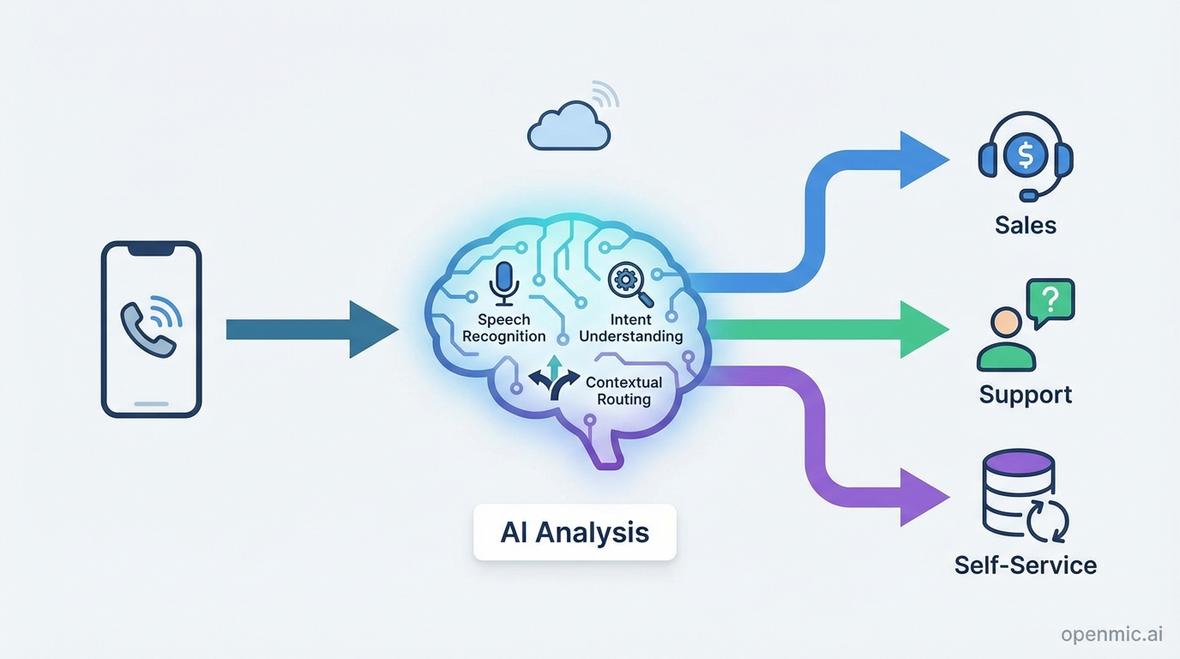
How AI Call Routing Works: Technical Deep Dive
Understanding the technical architecture behind ai call routing helps business leaders make informed implementation decisions. Modern systems typically operate through a multi-layered process:
Step 1: Call Initiation and Voice Capture
When a customer initiates a call, the AI system immediately begins capturing audio data. Advanced speech recognition engines convert this audio into text with near-human accuracy, even accounting for accents, background noise, and conversational speech patterns.
Step 2: Intent Classification and Entity Extraction
Natural language understanding models analyze the transcribed text to identify the caller's intent. The system extracts key entities (account numbers, product names, dates) and categorizes the inquiry into predefined intent buckets. This happens in milliseconds, often before the customer finishes their first sentence.
Step 3: Contextual Analysis and Data Enrichment
The routing engine queries connected systems CRM databases, order management platforms, customer service histories to build a complete context profile. This might include the customer's lifetime value, recent purchases, previous support tickets, and current account status.
Step 4: Intelligent Routing Decision
Using machine learning models trained on historical routing outcomes, the system determines the optimal destination. This could be:
- A specialized human agent with expertise in the identified topic
- An AI voice agent capable of fully resolving the inquiry
- A callback queue during peak hours
- An escalation path for high-priority or emotionally-charged calls
Step 5: Continuous Learning and Optimization
After each interaction, the system captures outcome data: Was the issue resolved? Did the customer escalate? What was the satisfaction score? This feedback trains the routing algorithms to improve future decisions.
Platforms like OpenMic.ai excel in this architecture, offering API-first integration that connects seamlessly with existing business systems while providing real-time routing intelligence.
Key Benefits of AI Call Routing for Businesses
Beyond the statistics, what do these improvements mean for day-to-day operations? Let's examine the tangible benefits:
24/7 Availability Without Proportional Cost Increases
AI call routing enables true round-the-clock service without the expense of night shifts, overtime pay, or international support centers. AI voice agents never sleep, never take breaks, and maintain consistent service quality regardless of call volume spikes.
Personalized Customer Experiences at Scale
By integrating with CRM systems and customer databases, AI routing delivers personalization that would be impossible for human operators to match. The system instantly recalls past interactions, preferences, and account details, creating a seamless experience even for first-time callers to a specific department.
Reduced Wait Times and Abandoned Calls
Intelligent routing dramatically decreases queue times by directing calls only to available, qualified resources. Predictive algorithms can even initiate proactive outbound calls during low-volume periods to address pending issues before customers call in.
Effortless Scalability During Growth or Peak Periods
Traditional call centers require weeks or months to hire and train new agents for seasonal spikes or business growth. AI routing scales instantly handling 100 calls or 10,000 with the same infrastructure. This elasticity is particularly valuable for retail businesses during holiday seasons or healthcare providers during flu season.
Enhanced Compliance and Quality Assurance
AI systems maintain perfect consistency in following scripts, disclosures, and regulatory requirements. Every interaction is automatically recorded, transcribed, and analyzed for compliance violations, providing audit trails that satisfy even the strictest industry regulations.
Implementing AI Call Routing: A Practical Guide
Successfully deploying ai call routing requires strategic planning and phased execution. Here's a proven implementation framework:
Phase 1: Current State Assessment
Begin by auditing your existing call infrastructure. Document call volumes by time of day, common inquiry types, average handle times, escalation rates, and customer satisfaction scores. Identify pain points: where are calls being dropped? Which inquiry types have the longest resolution times? What percentage of calls could be handled without human intervention?
Phase 2: Platform Selection and Integration Planning
Choose an AI routing platform that aligns with your technical architecture and business requirements. Key evaluation criteria include:
- Integration capabilities with existing CRM, telephony, and business systems
- Customization flexibility for industry-specific workflows
- Scalability to accommodate growth
- Security and compliance certifications
- Vendor support and implementation services
OpenMic.ai offers comprehensive integration support, connecting with popular platforms through its extensive integrations library and providing Zapier connectivity to support 8000+ apps.
Phase 3: Pilot Deployment
Launch with a controlled pilot targeting a specific inquiry type or customer segment. This might be appointment scheduling, FAQ handling, or after-hours support. Monitor performance metrics closely, comparing AI-routed calls against traditional routing for the same inquiry types.
Phase 4: Training and Optimization
Use pilot data to refine intent models, routing logic, and escalation triggers. Train customer service teams on collaborating with AI systems understanding when to override automated decisions and how to leverage AI-generated insights during interactions.
Phase 5: Full Deployment and Continuous Improvement
Gradually expand AI routing across all inquiry types and customer touchpoints. Establish ongoing monitoring processes to track KPIs, identify emerging patterns, and continuously optimize routing algorithms based on business outcomes.
Industry-Specific AI Call Routing Applications
Different industries leverage ai call routing in unique ways tailored to their specific operational challenges:
Healthcare and Medical Practices
Healthcare providers use AI routing to triage patient calls based on urgency, automatically schedule appointments, handle prescription refills, and provide post-visit follow-up. Medical practices report significant reductions in no-show rates and improved patient satisfaction through proactive appointment reminders and rescheduling assistance.
Automotive Dealerships
Car dealerships deploy AI routing for service appointment scheduling, sales lead qualification, and test drive coordination. The technology enables automotive retailers to capture leads 24/7, even when sales teams are unavailable, and to provide instant responses to service inquiries without tying up service advisors.
Real Estate Agencies
Real estate professionals leverage AI routing to qualify buyer leads, schedule property showings, and provide instant property information. Real estate agencies using intelligent routing report higher lead conversion rates and more efficient agent time allocation, focusing human expertise on serious buyers while AI handles initial qualification.
Legal Practices
Law firms implement AI routing for client intake, appointment scheduling, and case status updates. The system ensures urgent legal matters receive immediate attention while routine inquiries are handled efficiently. Legal practices particularly value the compliance and documentation capabilities, creating automatic records of all client communications.
Debt Collection Agencies
Collection agencies use AI routing to prioritize accounts based on likelihood to pay, handle payment arrangements, and provide compliant, consistent communications. Debt collection operations benefit from AI's ability to maintain regulatory compliance while scaling outreach efforts without proportional staffing increases.
Choosing the Right AI Call Routing Platform
Selecting the optimal ai call routing solution requires evaluating several critical factors:
API-First Architecture
Modern businesses require flexible integration capabilities. API-first platforms like OpenMic.ai enable seamless connectivity with existing business systems, allowing data to flow bidirectionally between your routing infrastructure and CRM, ERP, scheduling, and analytics platforms.
Customization and Industry Specialization
Generic routing solutions often require extensive customization to match industry-specific workflows. Evaluate whether platforms offer pre-built templates and configurations for your industry vertical, reducing implementation time and accelerating time-to-value.
Security and Compliance Certifications
Particularly for regulated industries like healthcare, finance, and legal services, verify that routing platforms maintain appropriate security certifications (SOC 2, HIPAA, GDPR compliance) and implement robust data protection measures.
Scalability and Reliability
Assess the platform's ability to handle peak call volumes without degradation in performance or routing accuracy. Review uptime guarantees, disaster recovery capabilities, and geographic redundancy to ensure business continuity.
Analytics and Reporting Capabilities
Comprehensive analytics are essential for ongoing optimization. Evaluate the platform's reporting dashboards, customization options, and ability to export data for integration with business intelligence tools.
Future Trends in AI Call Routing
As we progress through 2026, several emerging trends are shaping the evolution of ai call routing:
Enhanced Emotional Intelligence
Next-generation routing systems incorporate advanced emotion detection, identifying not just frustration or satisfaction but subtle emotional nuances like confusion, hesitation, or enthusiasm. These insights enable more sophisticated routing decisions automatically escalating calls where customers show signs of churn risk or routing satisfied customers to upsell opportunities.
Predictive and Proactive Routing
AI systems are moving beyond reactive call handling to predictive engagement. By analyzing customer behavior patterns, usage data, and lifecycle stages, platforms can initiate proactive outbound calls before problems arise reaching out about potential service issues, renewal opportunities, or personalized offers at optimal moments.
Multimodal and Omnichannel Integration
Future routing systems seamlessly coordinate across voice, video, chat, email, and social media channels. A customer might begin an inquiry via chat, escalate to voice, and receive follow-up via email with the routing engine maintaining context and continuity across all touchpoints.
Hyper-Personalization Through AI
Advanced machine learning models are enabling unprecedented personalization, adapting not just what information is provided but how it's delivered adjusting speaking pace, vocabulary complexity, and communication style to match individual customer preferences learned from previous interactions.
Overcoming Implementation Challenges
While the benefits of ai call routing are substantial, organizations should prepare for common implementation challenges:
Data Quality and Integration Complexity
AI routing systems are only as effective as the data they access. Poor CRM data quality, incomplete customer profiles, or integration gaps can undermine routing accuracy. Address data cleansing and integration challenges early in the implementation process.
Change Management and Staff Adoption
Customer service teams may initially resist AI systems, viewing them as threats to employment. Successful implementations emphasize how AI augments rather than replaces human agents, handling routine tasks while elevating agents to more complex, rewarding interactions.
Balancing Automation and Human Touch
Not every interaction should be automated. Define clear criteria for when calls should route to human agents versus AI resolution, typically based on inquiry complexity, emotional intensity, and customer value.
Continuous Optimization Requirements
AI routing isn't a 'set it and forget it' solution. Plan for ongoing monitoring, model retraining, and routing logic refinement as business needs evolve and customer expectations shift.
The OpenMic.ai Advantage
For organizations seeking a comprehensive ai call routing solution, OpenMic.ai delivers enterprise-grade capabilities with SME-friendly implementation. The platform's key differentiators include:
API-First Architecture: Seamless integration with existing business systems through comprehensive APIs and pre-built connectors.
Industry-Specific Templates: Pre-configured routing workflows for healthcare, automotive, real estate, legal, retail, and other verticals, reducing implementation time from months to weeks.
Flexible Deployment Options: Deploy AI voice agents for lead qualification, appointment booking, FAQ handling, and numerous other use cases.
Transparent Pricing: Clear, predictable pricing structures without hidden fees or complex licensing tiers.
Comprehensive Support: Implementation assistance, training resources, and ongoing technical support to ensure successful deployment and continuous optimization.
Frequently Asked Questions
How accurate is AI call routing compared to human operators?
Modern AI routing systems achieve 90-95% intent classification accuracy, often exceeding human operators who may misinterpret requests or lack contextual information. The key advantage is consistency AI maintains this accuracy across millions of interactions without fatigue or variation.
Can AI call routing integrate with my existing phone system?
Yes, most enterprise-grade AI routing platforms including OpenMic.ai offer integration with popular telephony systems through SIP trunking, APIs, and middleware connectors. The specific integration approach depends on your current infrastructure.
How long does it take to implement AI call routing?
Implementation timelines vary based on complexity, but typical deployments range from 2-8 weeks for pilot programs and 2-4 months for full enterprise rollouts. Organizations using platforms with industry-specific templates can often deploy faster.
What happens when AI cannot handle a call?
Effective AI routing systems include sophisticated escalation protocols. When the AI determines it cannot adequately address an inquiry based on complexity, emotional intensity, or confidence thresholds it seamlessly transfers to an appropriate human agent with full context about the interaction history.
Is AI call routing cost-effective for small businesses?
Absolutely. While large enterprises achieve massive cost savings through scale, small businesses often see proportionally higher ROI by eliminating missed calls, extending service hours without additional staffing, and improving lead conversion rates. Cloud-based platforms offer usage-based pricing that scales with business needs.
Conclusion
In 2026, ai call routing has evolved from emerging technology to essential infrastructure for customer-centric organizations. The data is compelling: businesses implementing intelligent routing report substantial cost reductions, productivity gains, and customer satisfaction improvements while scaling operations without proportional resource increases. As AI capabilities continue advancing incorporating deeper emotional intelligence, predictive analytics, and seamless omnichannel coordination early adopters are establishing competitive advantages that will define market leadership for years to come. Whether you're a founder seeking to scale efficiently, a customer support manager looking to reduce costs, or a developer tasked with modernizing communication infrastructure, platforms like OpenMic.ai provide the powerful, secure, API-first solutions needed to transform voice communication into a strategic business asset.