
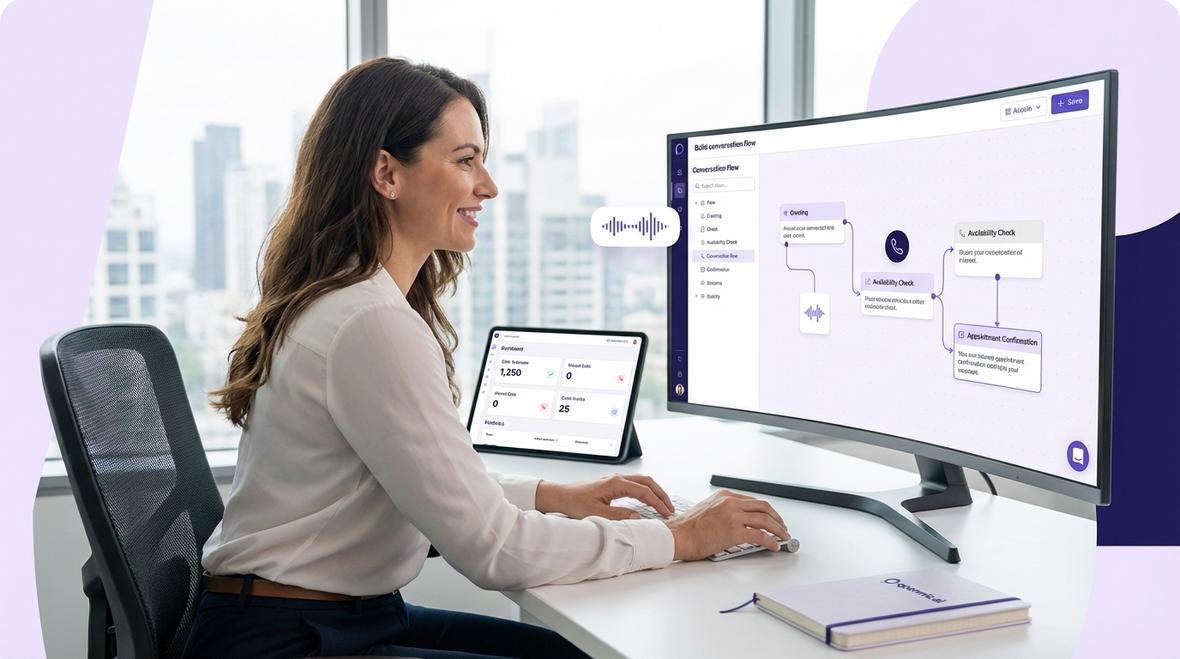
Introduction: The No-Code AI Agent Revolution
The demand for AI agent no code platforms has skyrocketed as businesses seek to deploy intelligent voice automation without extensive technical resources. In 2026, enterprises and SMEs alike are discovering that sophisticated AI voice agents once requiring developer teams and months of implementation can now be built and deployed in hours using no-code solutions.
For tech-savvy business leaders, founders, and customer support managers, the promise is compelling: eliminate missed calls, reduce staffing overhead, and deliver 24/7 customer responsiveness without writing a single line of code. Forrester reports AI in customer service yields 30% cost reductions, addressing the core pain points of high staffing costs and operational inefficiencies that plague traditional contact centers.
This comprehensive guide explores how no-code AI agent platforms are transforming business communication, what features to prioritize, and how solutions like OpenMic.ai empower non-technical teams to build enterprise-grade voice AI systems rapidly.
What Is a No-Code AI Agent?
A no-code AI agent is an intelligent software system capable of conducting human-like voice conversations, processing natural language, executing workflows, and integrating with business systems all without requiring traditional programming skills. These platforms utilize visual builders, drag-and-drop interfaces, and pre-built templates to democratize AI deployment.
Core Components of No-Code AI Agents
Modern no-code AI agent platforms typically include:
- Visual Conversation Designers: Flowchart-style interfaces for building dialogue trees and logic flows
- Natural Language Processing (NLP): Pre-trained models that understand intent, context, and sentiment
- Voice Synthesis & Recognition: Text-to-speech and speech-to-text engines with human-like quality
- Integration Connectors: Pre-built APIs to CRM, ERP, scheduling, and communication tools
- Analytics Dashboards: Real-time monitoring of call metrics, conversation quality, and business outcomes
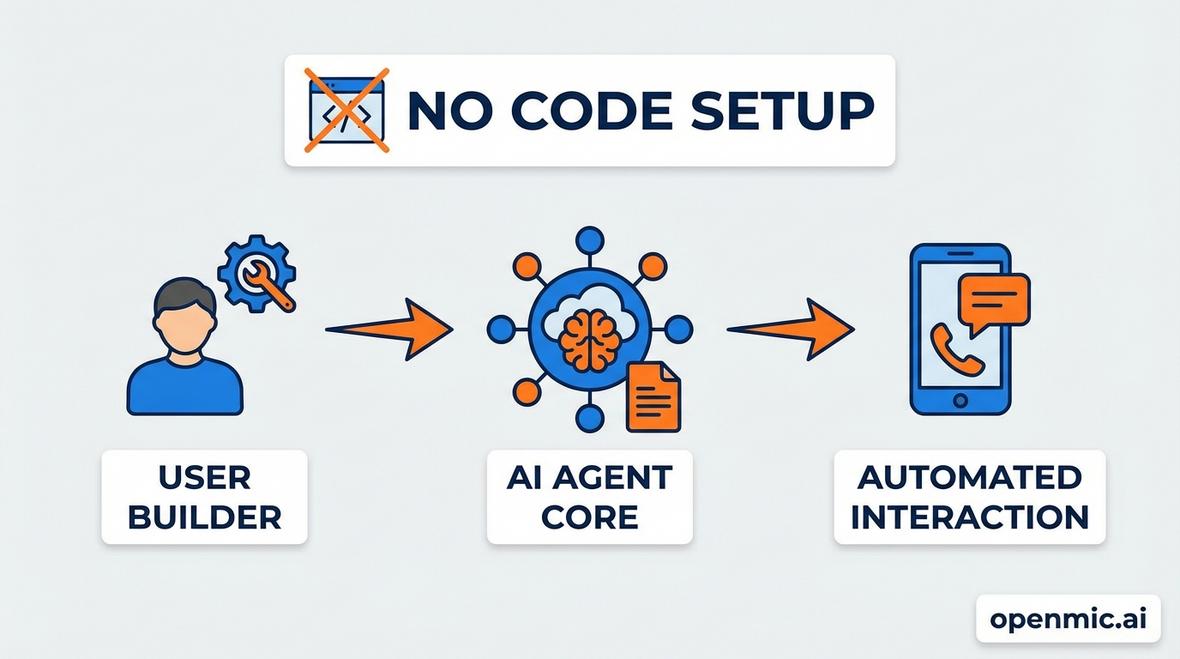
The illustration above demonstrates the typical no-code setup process: users leverage a visual builder to configure an AI agent core (powered by machine learning models and knowledge bases), which then handles automated interactions through voice calls, SMS, or chat channels all without coding expertise.
Why Businesses Need No-Code AI Agents in 2026
Addressing Critical Operational Challenges
The business case for AI agent no code solutions is driven by several converging pressures:
1. Missed Call Revenue Loss: Studies indicate that 60-80% of inbound calls to small and mid-sized businesses go unanswered during peak times or after hours, representing significant lost opportunities. AI voice agents ensure every call is answered instantly, capturing leads that would otherwise disappear.
2. Staffing Cost and Turnover:Customer service rep churn at 45% annually creates constant recruitment and training expenses. No-code AI agents provide consistent service quality regardless of staffing levels, reducing dependency on human labor for routine inquiries.
3. Speed to Market: Traditional development cycles for custom voice AI systems can stretch 6-12 months. No-code platforms compress this timeline to days or weeks, enabling rapid experimentation and iteration based on real customer feedback.
4. Scalability Without Infrastructure: Cloud-based no-code AI solutions scale dynamically to handle call volume spikes without provisioning additional infrastructure or hiring temporary staff.
Competitive Advantages of No-Code Deployment
Organizations leveraging no-code AI agent platforms gain several strategic benefits:
- Business User Empowerment: Marketing, sales, and support teams can build and modify agents without IT bottlenecks
- Rapid A/B Testing: Test different conversation scripts, voice personas, and workflows to optimize conversion rates
- Cost Predictability: Subscription-based pricing models eliminate unpredictable development costs
- Continuous Improvement: Update agent knowledge and behaviors in real-time as business needs evolve
Essential Features to Look for in No-Code AI Agent Platforms
When evaluating AI agent no code solutions, business leaders should prioritize platforms offering comprehensive capabilities that match enterprise requirements while remaining accessible to non-technical users.
Intuitive Conversation Design Tools
The best platforms provide visual editors where users can map conversation flows, define conditional logic, and handle multiple dialogue branches without scripting. Look for:
- Drag-and-drop node-based editors
- Pre-built templates for common use cases (appointment booking, lead qualification, FAQ handling)
- Version control and rollback capabilities
- Multi-language support for global deployments
Rich Integration Ecosystem
A truly effective no-code AI agent must connect seamlessly with your existing technology stack. Essential integrations include:
- CRM Systems: Salesforce, HubSpot, Pipedrive, Zoho CRM for automatic lead creation and data synchronization
- Calendar Tools: Google Calendar, Outlook, Calendly for scheduling automation
- Communication Platforms: Twilio, Vonage, or native telephony for voice connectivity
- Business Applications: Zapier, Make.com, or direct API connections to ERP and custom systems
Platforms like OpenMic.ai's integrations offer hundreds of pre-configured connectors, enabling rapid deployment across diverse technology environments.
Voice Quality and Low Latency
Conversation naturalness depends heavily on voice synthesis quality and response latency. Enterprise-grade platforms should deliver:
- Sub-500ms response times for natural conversational flow
- Neural voice synthesis with emotional expressiveness
- Interrupt handling allowing customers to speak naturally
- Background noise suppression and acoustic echo cancellation
For technical insights, explore best signal processing techniques for voice AI to understand the underlying technology.
Security and Compliance
For industries handling sensitive data healthcare, financial services, legal security features are non-negotiable:
- HIPAA, SOC 2, GDPR compliance certifications
- End-to-end encryption for call recordings
- Role-based access controls
- Audit trails for compliance reporting
Top Use Cases for No-Code AI Agents
The versatility of AI agent no code platforms enables deployment across virtually every customer-facing function. Here are the most impactful applications in 2026:
Automated Appointment Scheduling
AI agents handle the entire booking lifecycle: answering availability questions, checking calendar slots, confirming appointments, and sending reminders. This eliminates phone tag and reduces no-show rates significantly. Appointment booking agents are particularly transformative for healthcare, home services, and professional services firms.
Lead Qualification and Outreach
Rather than having sales teams manually dial hundreds of prospects, no-code AI agents conduct initial outreach calls, qualify leads based on predefined criteria, and schedule meetings only with high-intent prospects. This increases sales productivity by 3-5x according to industry benchmarks. Learn more about lead qualification automation.
24/7 Customer Support and FAQ Handling
The most common application of AI voice agents is answering frequently asked questions, providing account information, and routing complex issues to human agents. Platforms with robust knowledge base integration enable agents to access company wikis, documentation, and product catalogs in real-time. Explore FAQ agent implementations for best practices.
Cart Abandonment Recovery
E-commerce businesses deploy AI agents to proactively call customers who abandoned shopping carts, offering assistance, discount incentives, or alternative product suggestions. This highly personalized outreach recovers 15-25% of otherwise lost sales. See cart abandonment management strategies.
Payment Reminders and Debt Collection
AI agents handle sensitive collection calls with empathy and compliance, offering payment plan options and processing transactions directly. This reduces collection costs by 40-60% while maintaining positive customer relationships. For industry-specific insights, review debt collection automation trends.
How to Build Your First No-Code AI Agent: Step-by-Step
Deploying an AI agent no code solution typically follows a straightforward process that non-technical teams can complete in days:
Step 1: Define Clear Objectives and Use Cases
Begin by identifying the specific business problem your AI agent will solve. Ask:
- What percentage of calls are currently going unanswered?
- What are the most common customer inquiries consuming agent time?
- What is the desired outcome (lead capture, appointment booking, information provision)?
- What metrics will define success (call answer rate, conversion rate, cost per interaction)?
Step 2: Select the Right No-Code Platform
Evaluate platforms based on your specific requirements. Consider factors like:
- Industry-specific templates and pre-built agents
- Integration availability with your existing tools
- Pricing model alignment with your budget and call volume
- Customer support and onboarding resources
For a comprehensive comparison, explore OpenMic.ai pricing options alongside competitor offerings.
Step 3: Design the Conversation Flow
Using the platform's visual editor, map out the conversation structure:
- Greeting and introduction
- Intent identification (what does the caller need?)
- Information gathering (collect necessary data)
- Action execution (book appointment, create ticket, transfer call)
- Confirmation and next steps
Start with simple, linear flows and add complexity iteratively based on testing feedback.
Step 4: Configure System Integrations
Connect your AI agent to CRM, calendar, and communication systems. Most platforms offer OAuth-based authentication for secure, one-click integration setup. For advanced automation, integrating with Zapier unlocks connectivity to 8,000+ applications.
Step 5: Test, Iterate, and Deploy
Conduct thorough testing with internal team members before live deployment:
- Test all conversation branches and edge cases
- Verify integration data flow accuracy
- Assess voice quality and response timing
- Gather feedback from diverse user personas
Deploy initially to a subset of traffic, monitor performance metrics closely, and refine based on real-world interactions.
Industry-Specific Applications of No-Code AI Agents
Different industries have unique requirements that AI agent no code platforms address with specialized capabilities:
Healthcare and Medical Practices
Medical offices leverage AI receptionists for appointment scheduling, insurance verification, prescription refill requests, and post-visit follow-ups all while maintaining HIPAA compliance. Discover healthcare-specific AI solutions.
Real Estate
Real estate agents deploy AI voice agents to qualify buyer leads, schedule property showings, and conduct initial property inquiries, enabling agents to focus on high-value client interactions. Learn about real estate voice AI applications.
Automotive Dealerships
Car dealerships use AI agents for test drive scheduling, service appointment booking, and trade-in inquiries, significantly improving lead response times. Explore automotive dealership automation.
Legal Services
Law firms implement AI intake specialists to qualify potential clients, gather case details, and schedule consultations reducing administrative burden on paralegals and attorneys. See legal industry solutions.
Home Services and HVAC
HVAC companies, plumbers, and electricians capture emergency service requests 24/7, dispatch technicians, and provide pricing estimates without human intervention. Review home services automation strategies.
Common Challenges and How to Overcome Them
Managing Customer Expectations
Customers may initially be skeptical of AI agents. Overcome this by:
- Clearly identifying the agent as AI-powered at the conversation start
- Providing seamless escalation paths to human agents for complex issues
- Continuously improving conversation quality based on customer feedback
Handling Complex or Ambiguous Queries
No AI agent will perfectly handle every scenario. Design fallback mechanisms:
- Recognize when confidence in understanding is low
- Offer to transfer to human agents proactively
- Capture unhandled intents for continuous training
Data Quality and Integration Issues
AI agents are only as effective as the data they access. Ensure:
- CRM data is clean, up-to-date, and properly structured
- Integration testing validates data flow accuracy
- Regular audits identify and correct data inconsistencies
The Future of No-Code AI Agents: Trends for 2026 and Beyond
The AI agent no code landscape is evolving rapidly, with several emerging trends poised to reshape business communication:
Multimodal AI Experiences
Future agents will seamlessly blend voice, text, video, and visual interfaces, adapting communication style to customer preference and context. Imagine an AI agent that starts a voice conversation but sends a confirmation link via SMS with embedded video instructions.
Enhanced Emotional Intelligence
Advanced sentiment analysis and affective computing will enable AI agents to detect customer frustration, confusion, or satisfaction in real-time and adjust tone, pacing, and responses accordingly creating more empathetic interactions.
Autonomous Learning and Adaptation
Next-generation platforms will leverage reinforcement learning to automatically optimize conversation flows, identify successful patterns, and adapt strategies without manual intervention true 'self-improving' AI agents.
Hyper-Personalization at Scale
Integration with customer data platforms will enable AI agents to access complete customer histories, preferences, and behaviors, delivering highly personalized experiences that rival or exceed human agent capabilities.
Frequently Asked Questions About No-Code AI Agents
Do I need technical skills to build a no-code AI agent?
No. Modern no-code AI agent platforms are designed explicitly for business users without programming backgrounds. If you can create a flowchart or use common business software, you can build functional AI agents using visual editors and pre-built templates.
How much does a no-code AI agent cost?
Pricing varies widely based on call volume, feature requirements, and integration needs. Most platforms offer tiered subscription models starting from $99-$499/month for small businesses, scaling to enterprise plans at $2,000+/month for high-volume deployments with advanced features.
How long does implementation typically take?
Basic AI agents for simple use cases (appointment booking, FAQ handling) can be deployed in 1-3 days. More complex implementations with extensive integrations and custom logic may require 2-4 weeks. This contrasts dramatically with 6-12 month timelines for custom-coded solutions.
Will AI agents replace human customer service teams?
AI agents augment rather than replace human teams. They handle high-volume, repetitive inquiries, allowing human agents to focus on complex problem-solving and relationship-building that requires empathy, creativity, and judgment. Most successful deployments adopt a hybrid model where AI handles tier-1 support and seamlessly escalates to humans when needed.
How accurate are AI agents in understanding customer requests?
Modern NLP models achieve 85-95% intent recognition accuracy for well-defined domains with proper training. Accuracy improves continuously as the system processes more conversations and incorporates feedback. Domain-specific fine-tuning and knowledge base quality significantly impact performance.
Can no-code AI agents handle multiple languages?
Yes. Leading platforms support 40+ languages with varying degrees of fluency. Neural machine translation enables real-time language switching within conversations, making global deployment feasible without building separate agents for each market.
Conclusion
The AI agent no code revolution is democratizing access to enterprise-grade voice automation, enabling businesses of all sizes to deliver exceptional customer experiences without technical expertise or massive budgets. By eliminating programming barriers, these platforms empower business users to rapidly deploy intelligent voice assistants that handle everything from appointment scheduling to complex customer inquiries.
As demonstrated throughout this guide, the strategic benefits extend far beyond cost savings improved lead capture, 24/7 availability, consistent service quality, and data-driven optimization create sustainable competitive advantages. Whether you operate in healthcare, real estate, automotive, legal services, or any customer-facing industry, no-code AI agents offer tangible ROI measurable in weeks rather than months.
For organizations ready to transform their customer communication, platforms like OpenMic.ai provide the perfect balance of power, flexibility, and accessibility enabling you to build, deploy, and optimize AI voice agents without writing a single line of code.