
Understanding the Evolution of Artificial Intelligence
The artificial intelligence landscape is evolving rapidly, and two terms are increasingly dominating conversations among tech-savvy business leaders and developers: AGI (Artificial General Intelligence) and Agentic AI. While both represent significant milestones in AI development, they serve fundamentally different purposes and offer distinct capabilities for modern enterprises. Understanding the difference between AGI vs agentic AI is crucial for business leaders looking to leverage AI to scale operations, reduce costs, and enhance customer responsiveness.
As organizations seek to automate customer communication and streamline operations, the choice between implementing agentic AI solutions versus waiting for AGI becomes increasingly relevant. This comprehensive guide will explore the fundamental differences, practical applications, and strategic implications of both technologies, helping you make informed decisions for your business automation strategy.
What is AGI (Artificial General Intelligence)?
Artificial General Intelligence refers to a hypothetical form of AI that possesses human-like cognitive abilities across a broad range of tasks. Unlike narrow AI systems designed for specific functions, AGI would theoretically be capable of understanding, learning, and applying knowledge across any intellectual task that a human can perform.
Key Characteristics of AGI
AGI represents the pinnacle of artificial intelligence development, characterized by several defining features. First, it would demonstrate general reasoning abilities that allow it to tackle unfamiliar problems without specific programming. Second, AGI would possess transfer learning capabilities, enabling it to apply knowledge gained in one domain to entirely different contexts. Third, it would exhibit autonomous decision-making that rivals or exceeds human judgment across diverse scenarios.
According to leading AI researchers, true AGI remains a distant goal, with most experts estimating it won't be achieved for several decades. The current AI systems, while impressive, operate within narrow parameters and lack the general cognitive flexibility that defines human intelligence.
Current State and Timeline
Despite significant advancements in machine learning and neural networks, AGI remains largely theoretical. Current AI systems excel at specific tasks but struggle with the contextual understanding and adaptability that humans take for granted. The timeline for achieving AGI is highly debated, with estimates ranging from 20 to 100+ years, depending on which expert you consult.
What is Agentic AI?
Agentic AI, in contrast to AGI, represents a practical and immediately deployable form of artificial intelligence that can autonomously perform specific tasks and make decisions within defined parameters. The term 'agentic' refers to the AI's ability to act as an agent taking initiative, making decisions, and executing actions to achieve predefined goals without constant human intervention.
Core Capabilities of Agentic AI
Agentic AI systems are designed with goal-oriented behavior, allowing them to work toward specific outcomes autonomously. These systems demonstrate contextual awareness within their operational domain, understanding nuances and adapting to changing circumstances. They also feature decision-making frameworks that enable them to choose appropriate actions based on real-time data and predefined rules.
For example, an AI voice agent for real estate lead screening can autonomously qualify prospects, schedule appointments, and update CRM systems without human intervention, demonstrating clear agentic capabilities within a defined business context.
Real-World Applications Today
Unlike AGI, agentic AI is already transforming business operations across multiple industries. In customer service, AI contact centers deploy voice agents that handle complex customer inquiries, resolve issues, and escalate when necessary. In healthcare, AI systems are transforming patient engagement through automated appointment scheduling and follow-up care coordination.
Research from Forrester AI customer satisfaction scores shows that AI-powered voice agents achieve 85% first contact resolution rates, compared to 60% for traditional IVR, boosting CSAT by 20 points in SMEs. This demonstrates the tangible business value of agentic AI implementations today.
AGI vs Agentic AI: The Fundamental Differences
Understanding the distinction between AGI vs agentic AI is essential for business leaders evaluating AI investments. While both represent advanced forms of artificial intelligence, they differ fundamentally in scope, capability, and practical application.
Scope and Capability
AGI represents a broad, general-purpose intelligence capable of performing any intellectual task a human can do. It would theoretically possess consciousness, self-awareness, and the ability to learn anything independently. Agentic AI, however, operates within specific domains where it demonstrates autonomous behavior and decision-making capabilities tailored to particular business processes or tasks.
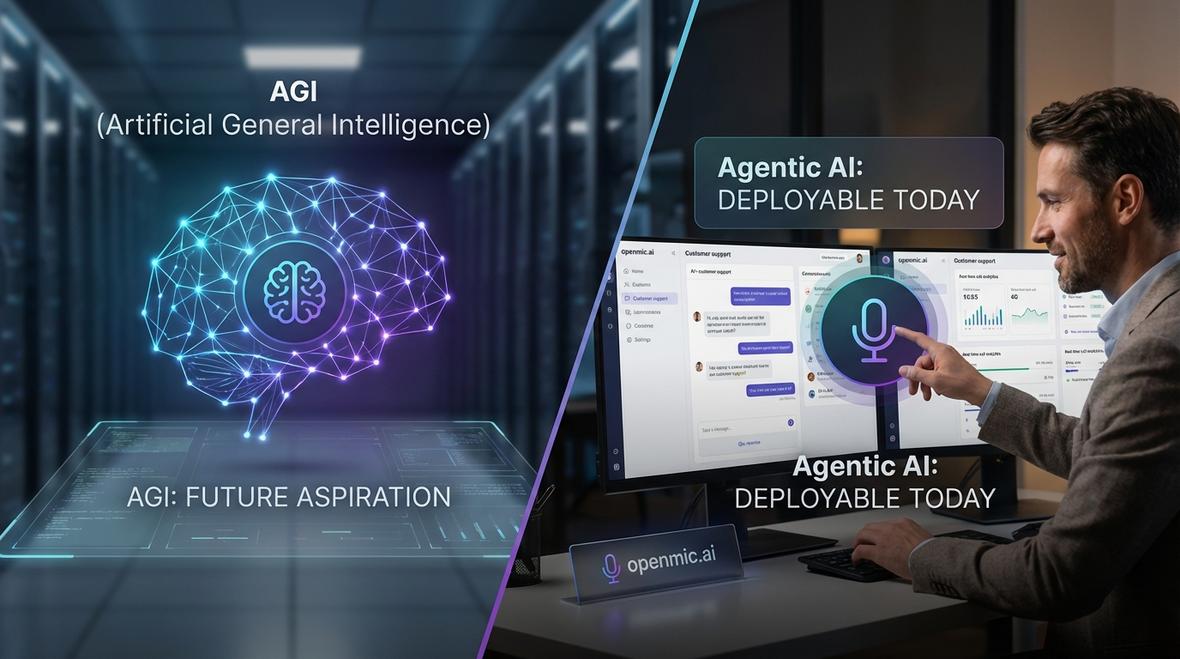
The practical implication is clear: AGI is a future aspiration, while agentic AI delivers immediate value. Businesses can deploy agentic AI solutions today to automate customer interactions, qualify leads, and manage appointments, as demonstrated by OpenMic.ai's API-first voice AI platform.
Learning and Adaptation
AGI would theoretically learn and adapt across unlimited domains without human intervention or retraining. Agentic AI systems, while capable of learning and improving within their operational scope, require human oversight for training, refinement, and domain expansion. This makes agentic AI more predictable and controllable critical factors for enterprise deployment.
Levels of Autonomy
When comparing AGI vs agentic AI on autonomy, AGI would possess complete autonomy, making decisions across any context without human guidance. Agentic AI demonstrates bounded autonomy—it operates independently within defined parameters but requires human-set goals, guardrails, and oversight. This bounded autonomy is actually advantageous for business applications, ensuring AI systems align with company policies and regulatory requirements.
Business Applications: Why Agentic AI Matters Now
For SMEs and enterprises focused on scaling operations and reducing costs, agentic AI offers immediate, measurable value. The question isn't whether to wait for AGI, but how to leverage agentic AI to solve today's business challenges.
Voice AI and Customer Communication
Agentic AI has revolutionized voice automation, enabling businesses to deploy intelligent voice agents that handle inbound and outbound calls autonomously. These systems go beyond traditional IVR by understanding context, adapting to customer needs, and making decisions in real-time.
For example, conversational AI for sales teams can autonomously qualify leads, answer product questions, schedule demos, and even handle objections tasks that previously required human sales representatives. This level of agentic behavior dramatically improves response times and reduces operational costs.
Industry-Specific Implementations
Different industries benefit from agentic AI in unique ways. In healthcare, AI voice agents manage appointment scheduling, insurance verification, and patient follow-ups. For automotive dealerships, agentic AI systems handle service appointments, lead qualification, and after-hours customer support.
The debt collection industry has seen particular transformation, with AI voice agents conducting compliant, empathetic collection calls that improve recovery rates while reducing operational costs. Similarly, real estate professionals leverage agentic AI to screen leads, schedule property viewings, and maintain consistent follow-up with prospects.
Cost Reduction and Scalability
One of the most compelling advantages of agentic AI over waiting for AGI is immediate cost reduction. Traditional 24/7 human support is expensive, requiring multiple shifts, benefits, and ongoing training. Agentic AI voice agents operate continuously without fatigue, sick days, or turnover, providing consistent service quality at a fraction of the cost.
Businesses implementing voice AI solutions report cost savings of 40-60% compared to traditional call center operations, while simultaneously improving customer satisfaction scores. This makes agentic AI not just a future-looking investment but a practical solution to today's operational challenges.
Implementing Agentic AI: Practical Considerations
For business leaders and developers evaluating agentic AI solutions, several key factors determine successful implementation and ROI.
Integration and API-First Architecture
Modern agentic AI platforms must integrate seamlessly with existing business systems. An API-first architecture enables voice AI agents to connect with CRM systems, scheduling tools, payment processors, and other critical business applications. This integration capability is what transforms simple chatbots into true agentic systems capable of autonomous action.
Platforms like OpenMic.ai offer extensive integration options, connecting with popular CRM systems, communication platforms, and business tools to enable end-to-end automation of customer interactions.
Security and Compliance
When implementing agentic AI for customer communication, security and compliance are paramount. Voice AI systems handling customer data must comply with regulations like GDPR, HIPAA (for healthcare), and industry-specific requirements. Choosing a platform with robust security measures and compliance certifications ensures your agentic AI deployment meets regulatory standards.
Customization and Control
Effective agentic AI requires the ability to customize behavior, conversation flows, and decision-making logic to match your specific business needs. Look for platforms that offer granular control over AI behavior while maintaining ease of use. The balance between autonomy and control is what makes agentic AI valuable it should operate independently within boundaries you define.
The Path Forward: From Agentic AI to AGI
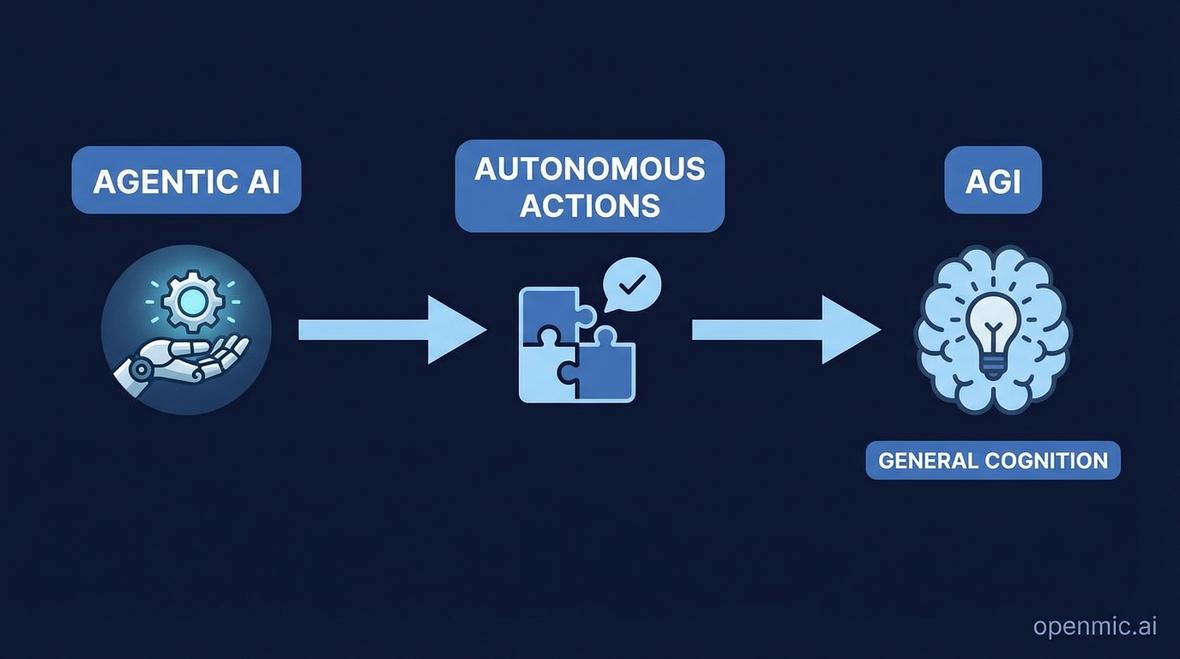
While the debate of AGI vs agentic AI often positions them as alternatives, they're actually points on a continuum. Agentic AI represents the practical stepping stone toward more general intelligence, with each advancement in autonomous decision-making and contextual understanding bringing us closer to AGI.
Progressive Capability Development
Current agentic AI systems are becoming increasingly sophisticated, handling more complex tasks and demonstrating better contextual understanding. As these systems evolve, they'll operate across broader domains, make more nuanced decisions, and require less human oversight. This progressive development is the realistic path toward more general AI capabilities.
Strategic Business Implications
For business leaders, the strategic question isn't whether to bet on AGI or agentic AI, but how to leverage today's agentic AI capabilities while remaining adaptable to future advancements. Implementing agentic AI solutions now builds organizational capability, generates immediate ROI, and positions your business to adopt more advanced AI systems as they emerge.
The businesses gaining competitive advantage today are those deploying best-in-class voice AI agents to automate customer interactions, qualify leads, and scale operations efficiently. Waiting for AGI means missing years of efficiency gains and competitive positioning.
Choosing the Right Agentic AI Platform
With the clear advantages of agentic AI for immediate business value, selecting the right platform becomes critical. Consider these factors when evaluating voice AI solutions.
Key Evaluation Criteria
First, assess integration capabilities—the platform should connect seamlessly with your existing tech stack. Second, evaluate customization options to ensure the AI can be tailored to your specific use cases and brand voice. Third, consider scalability—the solution should grow with your business without requiring platform migration.
Additionally, examine the provider's track record, customer support quality, and commitment to ongoing innovation. The AI landscape evolves rapidly, and your platform partner should demonstrate continuous improvement and feature development.
Why OpenMic.ai Stands Out
OpenMic.ai addresses the core pain points of tech-savvy business leaders seeking powerful, secure, and highly integrable voice AI solutions. As an API-first platform, it enables rapid deployment of intelligent voice agents for both inbound and outbound call automation across industries.
The platform's strength lies in its combination of sophisticated agentic capabilities autonomous decision-making, contextual understanding, and multi-system integration with enterprise-grade security and ease of implementation. Whether you're automating customer support, qualifying leads, or managing appointments, OpenMic.ai provides the agentic AI infrastructure to scale operations efficiently.
Frequently Asked Questions
Is AGI available today?
No, AGI (Artificial General Intelligence) is not available today. Current AI systems, including the most advanced language models and neural networks, are examples of narrow or agentic AI designed for specific tasks. True AGI AI with human-like general intelligence across all domains remains a theoretical future development with no confirmed timeline for achievement.
Can agentic AI replace human workers?
Agentic AI augments rather than replaces human workers in most scenarios. It excels at handling routine, high-volume tasks like call routing, appointment scheduling, and initial customer inquiries, freeing human employees to focus on complex problem-solving, relationship building, and situations requiring empathy and creative thinking. The most effective implementations combine agentic AI automation with human expertise.
What industries benefit most from agentic AI?
Industries with high call volumes and repetitive customer interactions see the greatest immediate benefit from agentic AI. These include healthcare (appointment scheduling and patient follow-up), automotive (service scheduling and lead qualification), real estate (lead screening and property inquiries), financial services (account inquiries and payment reminders), and customer support across all sectors. Any business struggling with missed calls or expensive 24/7 support requirements can benefit significantly.
How does agentic AI improve customer satisfaction?
Agentic AI improves customer satisfaction through immediate response times, 24/7 availability, consistent service quality, and personalized interactions. Unlike traditional IVR systems that frustrate customers with rigid menu trees, agentic AI understands natural language, adapts to customer needs, and resolves issues efficiently. Studies show AI-powered voice agents achieve higher first-contact resolution rates than traditional systems, directly improving customer satisfaction scores.
What is the ROI timeline for implementing agentic AI?
Most businesses implementing agentic AI voice solutions see positive ROI within 3-6 months. The timeline depends on call volume, implementation complexity, and current operational costs. High-volume call centers typically see faster ROI due to significant labor cost savings, while smaller operations benefit from improved lead conversion and reduced missed opportunities. The immediate reduction in staffing costs, combined with increased customer engagement, often delivers measurable returns within the first quarter of deployment.
Conclusion
The comparison of AGI vs agentic AI reveals a clear strategic path for business leaders in 2026. While AGI remains a distant aspiration, agentic AI delivers immediate, measurable value through autonomous customer communication, lead qualification, and operational automation. For SMEs and enterprises seeking to scale efficiently, reduce costs, and enhance customer responsiveness, agentic AI represents not just a competitive advantage but a necessity in today's market. By implementing robust, API-first voice AI platforms like OpenMic.ai, businesses can leverage cutting-edge agentic capabilities today while positioning themselves for the AI-driven future. The question isn't whether to adopt AI, but how quickly you can implement agentic solutions to transform your customer engagement and operational efficiency.