
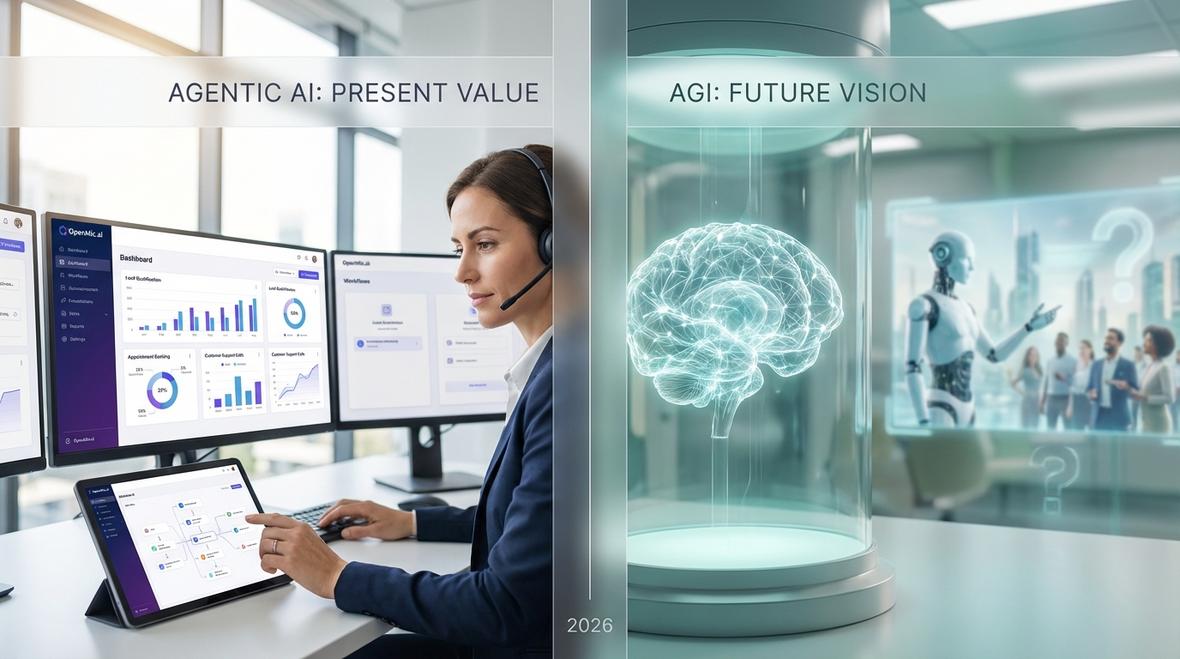
The artificial intelligence landscape is evolving at a breathtaking pace, and two terms are dominating boardroom conversations: agentic AI and AGI (Artificial General Intelligence). While they sound similar and both represent advanced forms of artificial intelligence, they serve vastly different purposes and possess fundamentally different capabilities. For tech-savvy business leaders and developers looking to scale operations, understanding the distinction between agentic AI vs AGI is not just academic it's strategic.
In 2026, businesses are increasingly leveraging AI to automate customer interactions, reduce operational costs, and enhance responsiveness. However, choosing the right AI approach depends on understanding what each technology can and cannot do. This comprehensive guide will unpack the differences, explore real-world applications, and help you determine which AI strategy aligns with your business goals.
What Is Agentic AI?
Agentic AI refers to intelligent systems designed to autonomously perform specific tasks or achieve well-defined goals. Unlike traditional AI that simply responds to inputs, agentic AI can plan, use tools, make decisions, and adapt its behavior to accomplish objectives with minimal human intervention. The 'agentic' aspect emphasizes agency—the AI acts on behalf of users or organizations to complete discrete workflows.
Key characteristics of agentic AI include:
- Goal-Oriented: Designed to achieve specific business outcomes such as booking appointments, qualifying leads, or processing claims.
- Tool Usage: Can interact with external systems, APIs, databases, and CRMs to complete tasks.
- Adaptive Planning: Adjusts its approach based on context, user responses, or system feedback.
- Domain-Specific: Excels within particular industries or functions like customer service, debt collection, or healthcare.
According to Statista: AI market $184B in 2024 with agentic focus, the AI market is projected to reach $184 billion, with agentic AI subsets driving customer service adoption and deflection from human agents. This surge is driven by businesses seeking to automate repetitive, high-volume interactions without sacrificing quality.
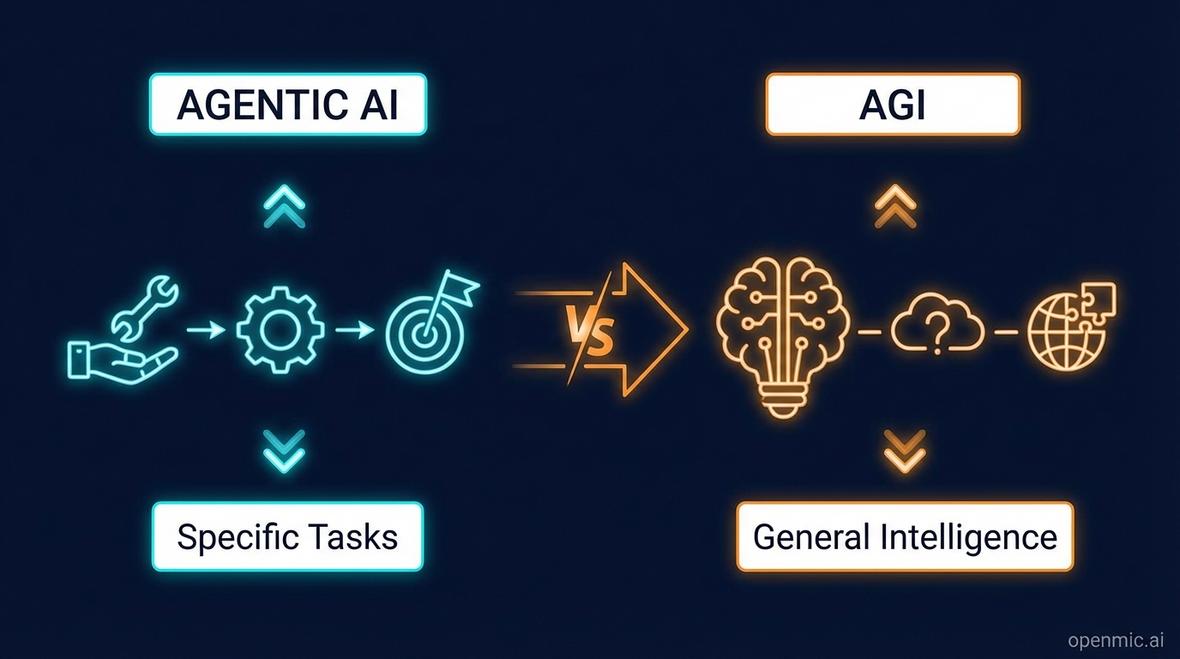
For example, platforms like OpenMic.ai deploy agentic voice AI agents that handle inbound and outbound calls autonomously. These agents qualify leads, schedule appointments, answer FAQs, and even update CRM records all without human oversight. The focus is on executing specific tasks exceptionally well, rather than replicating broad human intelligence.
What Is AGI (Artificial General Intelligence)?
Artificial General Intelligence (AGI) represents a theoretical form of AI that possesses human-level cognitive abilities across a wide range of domains. Unlike narrow or agentic AI, which excels at predefined tasks, AGI would be capable of learning, reasoning, abstract thinking, and problem-solving in any context just like a human being.
Characteristics of AGI include:
- Generalized Intelligence: Can understand and learn any intellectual task that a human can perform.
- Transfer Learning: Applies knowledge from one domain to entirely new, unrelated domains without retraining.
- Self-Improvement: Potentially capable of improving its own algorithms and learning methods autonomously.
- Consciousness (Hypothetical): Some theories suggest AGI might possess self-awareness or consciousness, though this remains speculative.
As of 2026, AGI remains a long-term aspiration rather than a reality. While significant progress has been made in machine learning, natural language processing, and neural networks, no AI system today exhibits true general intelligence. Researchers debate whether AGI will emerge in the next decade, several decades, or even if it's achievable at all.
Agentic AI vs AGI: Core Differences
When comparing agentic AI vs AGI, it's essential to understand that they exist on entirely different planes of capability and purpose. Here's a detailed breakdown:
1. Scope and Capability
Agentic AI: Designed for narrow, domain-specific tasks. It excels at what it was built to do whether that's lead qualification, appointment booking, or customer support but cannot generalize beyond its training.
AGI: Would possess broad, generalized intelligence capable of learning and performing any cognitive task across unlimited domains without additional programming or training.
2. Learning and Adaptability
Agentic AI: Learns within constrained parameters. It can adapt to user behavior, optimize workflows, and improve performance via machine learning, but always within its defined function.
AGI: Would learn continuously and autonomously across domains, transferring knowledge seamlessly from one area to another, much like human cognition.
3. Tool Usage and Action
Agentic AI: Actively uses tools, APIs, and integrations to accomplish goals. For instance, an AI voice agent might access a CRM to update lead status or trigger a follow-up email based on call outcomes.
AGI: Would theoretically be able to use any tool or interface a human could, learning new tools on the fly without explicit programming.
4. Current Availability
Agentic AI: Widely available and actively deployed in business environments today. Solutions like AI call agents and AI calling services are transforming customer engagement across industries.
AGI: Does not currently exist. It remains a research goal pursued by organizations like OpenAI, DeepMind, and various academic institutions.
5. Risk and Ethics
Agentic AI: Poses manageable risks related to bias, data privacy, and misuse, but these can be mitigated through governance, testing, and transparency.
AGI: Presents existential and ethical concerns, including potential loss of human control, unintended consequences, and alignment challenges (ensuring AGI goals align with human values).
Business Applications of Agentic AI in 2026
For SMEs and enterprises focused on scaling operations, reducing costs, and improving customer responsiveness, agentic AI offers immediate, tangible value. Here are key applications:
Customer Support Automation
Agentic AI powers intelligent AI receptionists and customer service agents that handle inbound queries 24/7. Research from Forrester: 68% of customers expect AI personalization in support highlights that 68% of customers expect AI-driven personalization, linking agentic AI capabilities to improved retention and reduced cost per interaction compared to traditional IVR systems.
Outbound Sales and Lead Qualification
Agentic AI excels at AI cold calling and lead nurturing. Voice agents can initiate conversations, qualify prospects based on predefined criteria, and schedule follow-ups all while integrating seamlessly with CRM platforms like HubSpot, Salesforce, or Zoho.
Appointment Scheduling
From healthcare to real estate, agentic AI streamlines appointment booking by engaging customers conversationally, checking availability, and confirming bookings without human intervention.
Debt Collection and Reminders
In financial services, agentic AI handles sensitive debt collection calls with empathy and compliance, reducing delinquency rates while maintaining customer relationships. Similarly, invoice reminders are automated, improving cash flow for businesses.
Voice Surveys and Feedback
Agentic AI can conduct voice surveys at scale, gathering customer insights, measuring satisfaction, and identifying areas for improvement all through natural, conversational interactions.
Why Agentic AI Matters More Than AGI for Businesses Today
While AGI captures the imagination and headlines, the reality is that agentic AI delivers measurable ROI right now. According to a Forrester TEI: 365% ROI from AI contact centers study, AI-enhanced contact centers demonstrate a 365% ROI over three years, quantifying agentic AI benefits for cost savings and customer satisfaction.
For business leaders grappling with missed calls, the high cost of 24/7 human support, and the limitations of traditional IVR systems, agentic AI provides an immediate solution. It doesn't require waiting for breakthroughs in general intelligence it leverages today's robust natural language processing, machine learning, and API integrations to deliver results.
The Technology Behind Agentic AI
Agentic AI systems combine several advanced technologies:
- Large Language Models (LLMs): Power natural, human-like conversation and context understanding.
- Speech Recognition and Synthesis: Enable voice-based interactions with low latency and high accuracy.
- Tool-Calling and Function Execution: Allow AI agents to interact with external APIs, databases, and CRM systems.
- Reinforcement Learning: Helps agents optimize their actions based on feedback and outcomes.
- Context Management: Maintains conversation history and user intent across multi-turn interactions.
Platforms like OpenMic.ai integrate these components into a secure, API-first architecture that enables developers to deploy voice AI agents quickly and scale them across thousands of concurrent calls.
Challenges and Considerations
While agentic AI offers significant advantages, businesses must address several challenges:
Data Privacy and Security
Voice interactions often involve sensitive customer information. Ensuring compliance with regulations like GDPR, HIPAA, and CCPA is critical. Choose platforms with end-to-end encryption, secure data handling, and transparent privacy policies.
Bias and Fairness
AI models can inadvertently perpetuate biases present in training data. Regular audits, diverse datasets, and fairness-aware algorithms are essential to mitigate this risk.
Integration Complexity
Seamless integration with existing systems (CRMs, ERPs, telephony) is necessary for agentic AI to deliver value. API-first platforms simplify this process, but proper implementation and testing are still required.
Customer Acceptance
Some customers may prefer human interaction, especially for complex or emotionally charged issues. Providing easy escalation paths to human agents ensures a balanced approach.
Future Outlook: Agentic AI and AGI
Looking ahead, agentic AI will continue to evolve, becoming more sophisticated, context-aware, and capable of handling increasingly complex workflows. We can expect:
- Multimodal Agents: Combining voice, text, and visual inputs for richer interactions.
- Proactive Assistance: AI agents that anticipate customer needs and initiate helpful actions before being asked.
- Enhanced Personalization: Leveraging deeper customer insights to tailor interactions in real time.
- Collaborative Intelligence: Agentic AI working alongside human agents, augmenting their capabilities rather than replacing them.
As for AGI, while research continues, most experts agree we are still years if not decades away from true general intelligence. In the meantime, businesses should focus on harnessing the power of agentic AI to drive immediate value, improve customer experiences, and stay competitive in a rapidly changing market.
Frequently Asked Questions
What is the main difference between agentic AI vs AGI?
Agentic AI is designed to perform specific, goal-oriented tasks autonomously within defined domains, such as customer service or lead qualification. AGI, or Artificial General Intelligence, would possess broad, human-level cognitive abilities across all domains, capable of learning and reasoning in any context. As of 2026, agentic AI is widely deployed, while AGI remains theoretical.
Can agentic AI replace human employees?
Agentic AI is best suited for automating repetitive, high-volume tasks, allowing human employees to focus on complex, strategic, and emotionally nuanced work. Rather than replacing humans, it augments their capabilities and improves overall efficiency.
How secure is agentic AI for handling sensitive customer data?
Reputable agentic AI platforms implement robust security measures including end-to-end encryption, compliance with privacy regulations (GDPR, HIPAA), and secure API integrations. Always vet vendors for their security certifications and data handling practices.
What industries benefit most from agentic AI?
Industries with high-volume customer interactions benefit significantly, including healthcare, real estate, automotive, legal services, restaurants, and financial services. Any business dealing with missed calls, appointment scheduling, or customer inquiries can leverage agentic AI effectively.
When will AGI become a reality?
Predictions vary widely, with some experts estimating AGI could emerge within 10-30 years, while others believe it may take much longer or may not be achievable. Current AI research focuses on incremental improvements in narrow AI and agentic capabilities rather than immediate AGI breakthroughs.
Conclusion
Understanding the distinction between agentic AI vs AGI is crucial for business leaders navigating the AI landscape in 2026. While AGI represents a distant, transformative vision of human-level machine intelligence, agentic AI delivers measurable, immediate business value today. By automating specific tasks like customer support, lead qualification, and appointment scheduling, agentic AI reduces costs, enhances responsiveness, and scales operations efficiently. For enterprises and SMEs seeking to stay competitive, the choice is clear: invest in proven agentic AI solutions that integrate seamlessly with your existing systems, empower your teams, and delight your customers. Explore how platforms like OpenMic.ai can transform your communication strategy and drive sustainable growth.