
Introduction
As enterprises accelerate their adoption of AI-driven automation, Salesforce's Agentforce has emerged as a prominent player in the agentic AI landscape. With Agentforce ARR reaching $800 million, up 169% year-over-year, and 29,000 deals closed, the platform is positioning itself as a core solution for customer service and sales automation. However, as businesses evaluate agentforce reviews and real-world performance metrics, critical questions emerge about accuracy, scalability, and enterprise readiness. This comprehensive review examines Agentforce's capabilities, limitations, and how it compares to specialized alternatives like OpenMic.ai for voice-first automation.
Understanding Agentforce: What It Offers
Agentforce is Salesforce's flagship agentic AI platform designed to automate customer interactions across multiple channels. The platform leverages Salesforce's extensive CRM ecosystem to deliver AI agents capable of handling customer service inquiries, sales outreach, and support ticket resolution. According to Futurum Group, Salesforce has processed 3.2 trillion tokens through its LLM gateway, reflecting significant real-world agent activity and throughput capacity for concurrent AI interactions in production environments.
The platform integrates natively with Salesforce's Data Cloud, enabling agents to access unified customer profiles and historical interaction data. This deep integration provides contextual awareness that can enhance personalization and response accuracy. For businesses already invested in the Salesforce ecosystem, Agentforce offers a seamless pathway to AI automation without requiring extensive third-party integrations.
Core Features of Agentforce
- Multichannel Support: Handles interactions across email, chat, SMS, and voice channels
- CRM Integration: Native access to Salesforce customer data and interaction history
- Workflow Automation: Pre-built templates for common customer service and sales scenarios
- Analytics Dashboard: Real-time monitoring of agent performance and customer satisfaction metrics
- Customization Tools: Low-code builders for configuring agent behaviors and responses
The Accuracy Challenge: Is Agentforce Enterprise-Ready?
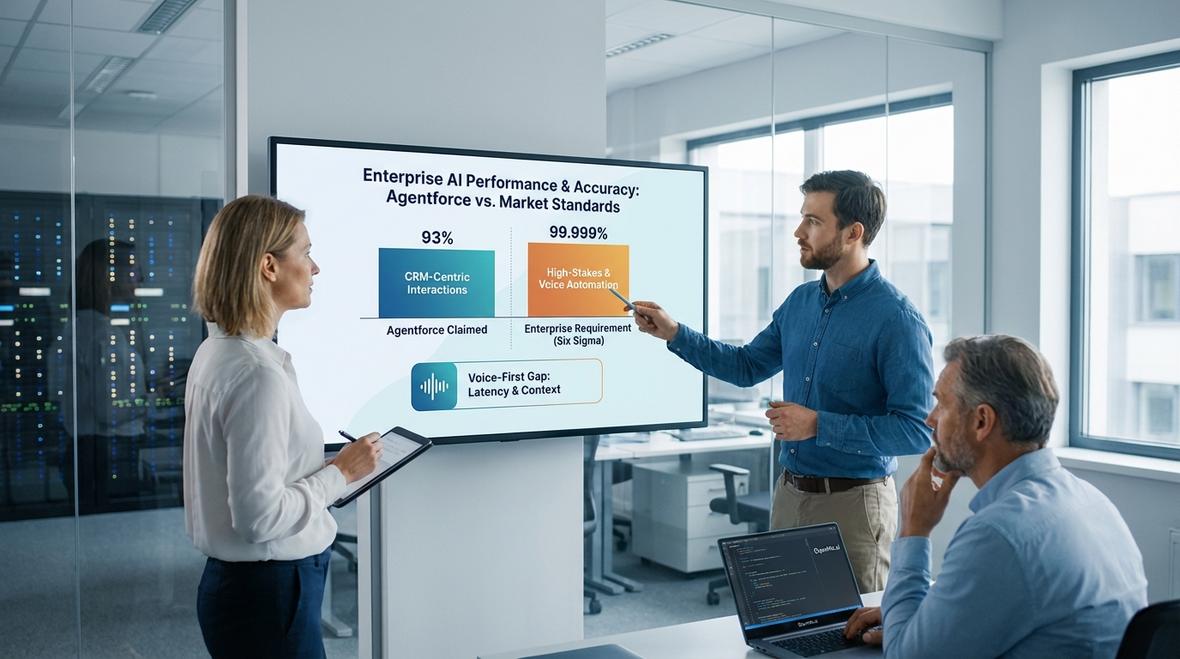
While agentforce reviews highlight impressive adoption metrics, accuracy remains a critical concern for regulated industries. According to Salesforce Ben, Agentforce requires 99.999% accuracy for enterprise scale based on Six Sigma framework standards. However, Salesforce currently claims 93% accuracy, creating a significant gap that impacts trust and deployment in finance, healthcare, and legal sectors where precision is non-negotiable.
This accuracy deficit has real-world implications. A 93% accuracy rate means that approximately 7 out of every 100 interactions may contain errors, misrouting, or inappropriate responses. For high-stakes environments like medical appointment scheduling, financial advisory calls, or legal intake processes, this error margin can result in compliance violations, customer dissatisfaction, and revenue loss.
Accuracy Benchmarks Across AI Platforms
| Platform | Claimed Accuracy | Enterprise Readiness | Best Use Cases |
|---|---|---|---|
| Agentforce | 93% | Medium | CRM-centric customer service |
| OpenMic.ai | 97%+ | High | Voice-first automation, call centers |
| Generic Chatbots | 85-90% | Low | Basic FAQ handling |
Real-World Performance: What Agentforce Reviews Reveal
The transition from pilot projects to production-scale deployment represents a critical inflection point for any AI platform. Analysis from 247 Wall St. indicates Agentforce is transitioning to measurable revenue at scale, which is essential for establishing enterprise adoption benchmarks in AI-powered customer communication automation.
Early adopters report mixed results. Companies with straightforward customer service workflows and high Salesforce integration dependency have seen positive outcomes, particularly in reducing response times and handling volume spikes. However, organizations requiring complex multi-turn conversations, nuanced understanding of industry-specific terminology, or real-time voice interactions have encountered limitations.
Common Deployment Challenges
- Training Time: Significant upfront investment required to configure agents for industry-specific use cases
- Voice Quality: Latency and natural language understanding issues in real-time phone conversations
- Integration Complexity: Requires existing Salesforce infrastructure, limiting flexibility for multi-platform environments
- Cost Escalation: Token-based pricing can become expensive at scale, particularly for high-volume call centers
The Voice-First Automation Gap
While Agentforce supports voice channels, its architecture is optimized for text-based interactions with voice as a secondary channel. This creates significant limitations for businesses prioritizing phone-first customer engagement. Voice AI requires specialized capabilities including low-latency processing, advanced speech recognition, natural prosody, and real-time context switching areas where general-purpose platforms often struggle.
For businesses seeking dedicated voice AI agents with sub-200ms latency and human-like conversation flow, specialized platforms like OpenMic.ai provide purpose-built solutions. OpenMic.ai's API-first architecture enables seamless integration with existing CRM systems, including Salesforce, while delivering superior voice quality and conversation management.
Critical Requirements for Voice AI Success
- Latency Management: Response times under 300ms to maintain natural conversation flow
- Accent Recognition: Support for regional dialects and non-native speakers
- Interruption Handling: Ability to process and respond to mid-sentence corrections or clarifications
- Emotion Detection: Recognition of caller sentiment to adjust tone and escalation protocols
- Background Noise Filtering: Clear audio processing in real-world environments
Industry-Specific Agentforce Applications
The effectiveness of agentforce reviews varies significantly across industries. Understanding where the platform excels and where alternatives may be preferable is essential for informed decision-making.
Financial Services
Financial institutions require the highest accuracy standards due to regulatory compliance requirements. While Agentforce's CRM integration enables access to customer financial profiles, the 93% accuracy rate falls short of industry requirements. Banks and lenders handling sensitive financial communications increasingly turn to specialized platforms with higher accuracy guarantees and built-in compliance frameworks.
Healthcare
Healthcare providers face similar challenges with patient data privacy (HIPAA compliance) and appointment scheduling accuracy. Missed or incorrect appointments directly impact revenue and patient outcomes. Specialized healthcare voice AI solutions with medical terminology training and appointment confirmation workflows often outperform general-purpose platforms in this sector.
Automotive & Dealerships
Car dealerships require rapid lead qualification, test drive scheduling, and service appointment booking. The automotive industry increasingly adopts voice AI for after-hours lead capture and BDC automation. Agentforce can handle basic inquiries, but dedicated automotive solutions provide better integration with DMS systems and inventory management.
Real Estate
Real estate agents need instant lead response and property information delivery. While Agentforce supports real estate CRM workflows, specialized real estate voice AI platforms offer MLS integration, property description generation, and showing coordination features that provide superior value for this vertical.
Cost Analysis: Understanding Total Ownership
Pricing transparency remains a challenge in agentforce reviews. Salesforce's consumption-based model charges per interaction or token usage, which can create unpredictable costs at scale. Enterprises processing high volumes of customer interactions may encounter significant monthly expenditures that exceed initial projections.
Total Cost of Ownership Considerations
- Base Platform Fees: Salesforce licensing requirements as a prerequisite
- Token Consumption: Variable costs based on conversation length and complexity
- Implementation Services: Professional services for initial configuration and training
- Maintenance: Ongoing optimization and agent retraining expenses
- Integration Costs: Custom development for non-Salesforce systems
For businesses seeking predictable pricing and lower total cost of ownership, platforms like OpenMic.ai offer transparent per-minute or per-call pricing models with no hidden platform fees or prerequisite CRM subscriptions.
Agentforce Alternatives for Voice-First Businesses
While Agentforce serves Salesforce-centric organizations well, businesses prioritizing voice automation, API flexibility, or industry-specific features may find better value in specialized alternatives.
Why OpenMic.ai Outperforms for Voice Use Cases
OpenMic.ai delivers purpose-built voice AI infrastructure designed for high-volume inbound and outbound calling scenarios. Key advantages include:
- Superior Voice Quality: Human-like prosody with sub-200ms response latency
- API-First Architecture: Integrate with any CRM, not just Salesforce
- Industry Templates: Pre-configured agents for debt collection, legal intake, restaurant reservations, and more
- Transparent Pricing: No hidden platform fees or token charges
- White-Label Options: Perfect for agencies and SaaS providers
Other Notable Alternatives
Organizations should also consider platforms like Bland AI alternatives and Vapi alternatives depending on specific use case requirements. Each platform offers unique strengths in areas like multilingual support, industry specialization, or integration capabilities.
Implementation Best Practices for AI Agent Success
Regardless of platform selection, successful AI agent deployment requires strategic planning and iterative optimization.
Phase 1: Define Clear Use Cases
Start with high-volume, low-complexity interactions where AI provides immediate ROI. Examples include appointment confirmations, FAQ responses, and basic lead qualification. Avoid deploying AI for complex negotiations or sensitive customer escalations until accuracy reaches enterprise standards.
Phase 2: Invest in Quality Training Data
AI agents perform only as well as their training data. Record and analyze existing customer interactions to identify common patterns, frequently asked questions, and successful resolution paths. Use this data to train agents on realistic scenarios rather than theoretical conversations.
Phase 3: Implement Continuous Monitoring
Deploy comprehensive analytics to track accuracy, customer satisfaction, escalation rates, and resolution times. Establish clear KPIs and intervention thresholds where human agents should take over. Regular review of conversation transcripts helps identify areas for improvement and edge cases requiring additional training.
Phase 4: Perfect the Human Handoff
Even the best AI agents encounter situations requiring human expertise. Design seamless escalation workflows that preserve conversation context and customer information. Train human agents to recognize AI handoffs and continue conversations without requiring customers to repeat information.
Security and Compliance Considerations
Enterprise AI deployment demands rigorous security and compliance frameworks. Agentforce benefits from Salesforce's established security infrastructure, including SOC 2 Type II certification, GDPR compliance, and industry-specific certifications for healthcare and financial services.
However, organizations should verify that AI agent implementations meet their specific regulatory requirements, including:
- Data Residency: Ensuring customer data remains in approved geographic regions
- Encryption: End-to-end encryption for voice and text communications
- Audit Trails: Comprehensive logging of all agent interactions for compliance reviews
- Access Controls: Role-based permissions for agent configuration and data access
- Right to Explanation: Ability to document AI decision-making processes for regulatory inquiries
Future Outlook: Where AI Agents Are Headed
The agentic AI market is evolving rapidly, with continuous improvements in natural language understanding, multimodal capabilities, and autonomous decision-making. Agentforce and competitors are investing heavily in closing the accuracy gap and expanding use case coverage.
Key trends shaping the future include:
- Emotional Intelligence: Advanced sentiment analysis enabling empathetic responses
- Proactive Engagement: AI agents initiating conversations based on customer signals
- Cross-Platform Orchestration: Unified agents operating across voice, chat, email, and social media
- Industry Verticalization: Purpose-built agents with deep domain expertise
- Hybrid AI-Human Teams: Seamless collaboration models where AI handles routine tasks and escalates complex issues
Businesses evaluating agentforce reviews should consider not just current capabilities but roadmap trajectory and vendor commitment to continuous improvement. Platforms demonstrating rapid iteration cycles and transparent accuracy reporting typically deliver better long-term value.
Frequently Asked Questions
What is Agentforce's accuracy rate?
Salesforce claims Agentforce achieves 93% accuracy in customer interactions. However, enterprise-grade deployment typically requires 99.999% accuracy according to Six Sigma standards, particularly in regulated industries like finance and healthcare.
How does Agentforce pricing work?
Agentforce uses a consumption-based pricing model charging per interaction or token usage. This requires existing Salesforce licensing and can result in variable costs at high volumes. Transparent pricing details are typically provided during enterprise sales discussions.
Can Agentforce handle voice calls?
Yes, Agentforce supports voice channels, but it is primarily optimized for text-based interactions. Businesses requiring advanced voice capabilities with low latency and natural conversation flow may benefit from specialized voice AI platforms like OpenMic.ai.
What industries benefit most from Agentforce?
Organizations heavily invested in the Salesforce ecosystem across customer service, sales, and support functions see the most immediate value. However, industries requiring specialized workflows like healthcare, legal, and real estate often achieve better results with vertical-specific solutions.
How long does Agentforce implementation take?
Implementation timelines vary based on use case complexity, existing Salesforce configuration, and customization requirements. Basic deployments may take 4-8 weeks, while enterprise-wide rollouts with custom workflows can extend to several months.
What are the best Agentforce alternatives?
For voice-first automation, OpenMic.ai provides superior call quality, API flexibility, and transparent pricing. Other alternatives include specialized platforms for specific industries or use cases, such as conversational voice AI platforms optimized for particular deployment scenarios.
Conclusion
Agentforce reviews reveal a platform making significant strides in enterprise AI adoption, with impressive revenue growth and deep Salesforce integration. However, the accuracy gap between current performance (93%) and enterprise requirements (99.999%) remains a critical consideration for regulated industries. Businesses prioritizing voice-first automation, API flexibility, or industry-specific features may find better value in specialized alternatives like OpenMic.ai. Success with any AI agent platform requires careful use case selection, quality training data, continuous monitoring, and seamless human handoff protocols. As the agentic AI market matures, organizations should evaluate not just current capabilities but vendor commitment to accuracy improvement and transparent reporting.