
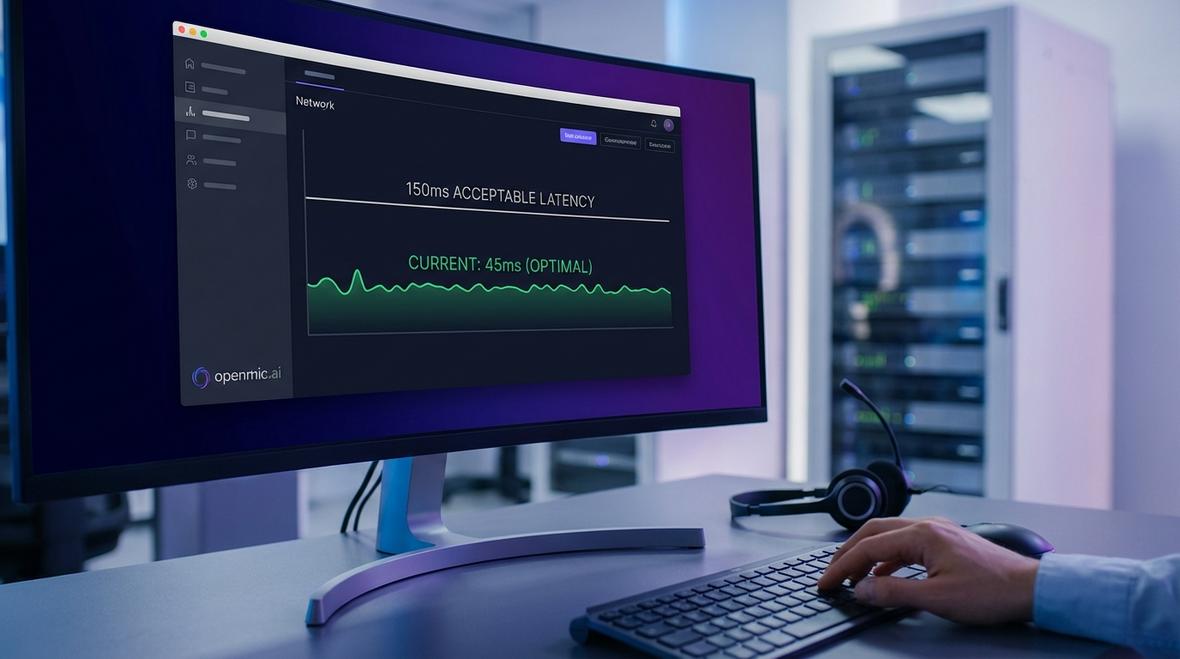
Understanding VoIP Latency and Why It Matters
Voice over Internet Protocol (VoIP) has revolutionized business communications, enabling cost-effective, scalable voice solutions for enterprises worldwide. However, the quality of VoIP calls depends heavily on network performance metrics, with latency being one of the most critical factors. Acceptable latency for VoIP refers to the maximum delay that can occur in voice packet transmission without degrading call quality to the point where users experience frustration or communication breakdowns.
Latency, measured in milliseconds (ms), represents the time it takes for a voice packet to travel from the sender to the receiver. In real-time communication, even small delays can cause significant problems. When latency exceeds acceptable thresholds, users experience symptoms like delayed responses, overlapping speech, and awkward conversational pauses that undermine the natural flow of dialogue.
For businesses deploying AI-powered voice solutions or traditional phone systems, understanding and managing latency is crucial. Whether you're implementing automated appointment booking agents or handling high-volume customer service calls, maintaining optimal latency ensures your voice infrastructure delivers professional, reliable communication that meets modern business standards.
ITU Standards: What Is Acceptable Latency for VoIP?
The International Telecommunication Union (ITU) has established comprehensive guidelines for acceptable voice transmission quality. According to the ITU-T G.114 one-way delay limits for telephony, one-way delays are categorized into three distinct ranges that define user experience quality.
The ITU standard VoIP latency threshold of 150ms one-way represents the gold standard for telecommunications. Within this framework, delays less than 150ms are considered acceptable for most conversational applications, providing users with a natural, seamless communication experience indistinguishable from traditional telephony.
For delays ranging between 150ms and 400ms, the ITU acknowledges that communication remains possible but with noticeable impairment. Users in this range may experience slight delays that require adaptation in conversational rhythm. While not ideal, many applications can tolerate this level of latency, particularly for non-critical communications.
When latency exceeds 400ms one-way, voice quality becomes unacceptable for most interactive applications. At this level, conversations become extremely difficult, with significant echo problems, frequent interruptions, and user frustration that can damage business relationships and operational efficiency.
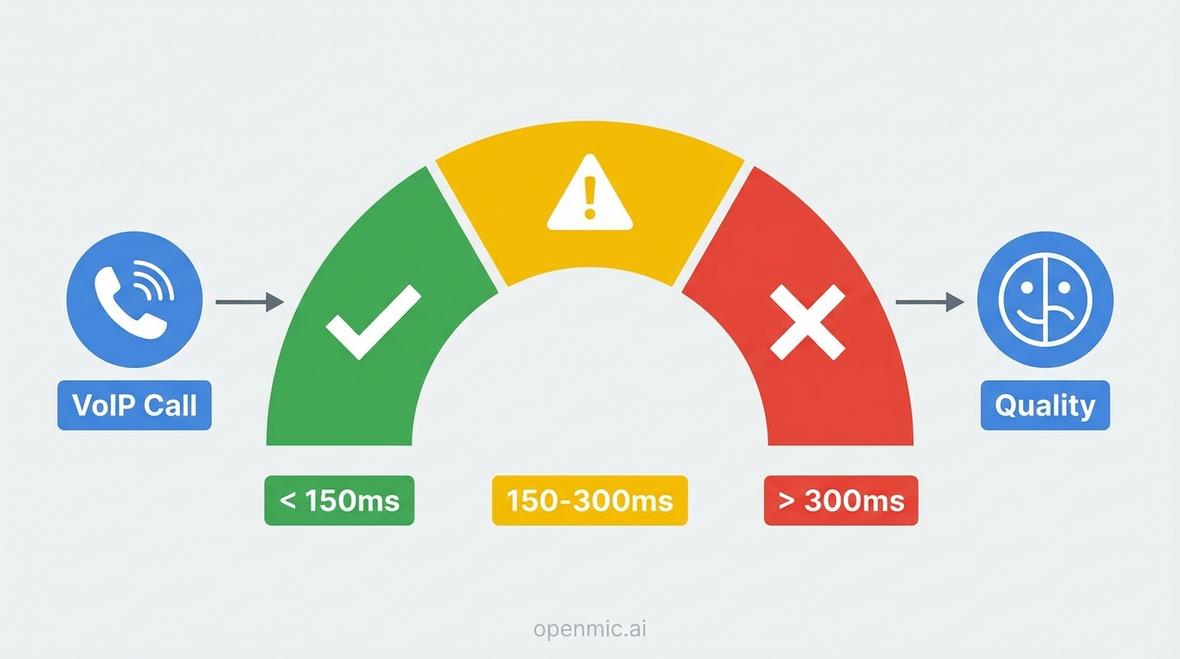
Breaking Down Latency Thresholds
To better understand acceptable latency for VoIP, let's examine each threshold category in detail:
- Optimal Range (0-150ms): This represents the target zone for all professional VoIP deployments. Conversations feel natural, with no perceptible delay. Users can interrupt each other naturally, and the communication flow matches face-to-face interaction quality.
- Acceptable Range (150-300ms): While the ITU extends tolerance to 400ms, practical experience shows that delays above 300ms begin causing significant user dissatisfaction. In the 150-300ms range, users notice slight delays but can generally adapt their communication style.
- Poor Quality Range (300ms+): Beyond 300ms, communication quality degrades rapidly. Echo becomes prominent, conversations feel disjointed, and users frequently talk over each other due to delayed feedback. For business applications, this range is unacceptable.
For businesses implementing car dealership communication solutions or healthcare voice systems, maintaining latency within the optimal range ensures professional interactions that build customer trust and operational efficiency.
Factors That Impact VoIP Latency
Understanding what causes latency helps businesses optimize their voice infrastructure. Several key factors contribute to overall delay in VoIP systems:
Network Propagation Delay
Physical distance creates inherent delays as voice packets traverse network infrastructure. Light and electrical signals travel at finite speeds through fiber optic cables and copper wiring. While propagation delay is relatively small for local communications, international calls or connections to geographically distant data centers add measurable latency.
Processing and Serialization Delay
Each device in the communication path routers, switches, firewalls, and endpoints adds processing time as it examines, routes, and forwards voice packets. Additionally, serialization delay occurs when packets are converted into electrical signals for transmission across physical media. High-performance network equipment minimizes these delays, but they remain unavoidable components of total latency.
Codec Processing Time
Voice codecs compress and decompress audio data to reduce bandwidth requirements. This compression process introduces algorithmic delay as the codec analyzes voice patterns and applies compression algorithms. More sophisticated codecs offering better compression ratios typically require more processing time, creating a trade-off between bandwidth efficiency and latency.
Queuing and Buffering Delay
When network congestion occurs, voice packets wait in device queues before transmission. This queuing delay varies dynamically based on network traffic patterns. Jitter buffers at receiving endpoints also introduce deliberate delay to smooth out packet arrival time variations, adding to total latency but improving overall call quality by reducing audio artifacts.
Organizations deploying real estate voice AI solutions must account for these factors when designing their communication infrastructure to ensure consistent performance across various usage scenarios.
How to Measure VoIP Latency Effectively
Accurate latency measurement is essential for maintaining acceptable latency for VoIP in production environments. Several methodologies and tools enable comprehensive latency assessment:
Ping and Traceroute Tools
Basic network diagnostic tools provide initial latency estimates. Ping commands measure round-trip time (RTT) between endpoints, while traceroute identifies each network hop and its contribution to total delay. For VoIP planning, divide RTT measurements by two to estimate one-way latency, though this assumes symmetric routing paths.
Specialized VoIP Monitoring Platforms
Professional VoIP monitoring solutions offer comprehensive latency tracking with features including real-time alerting, historical trend analysis, and per-call quality metrics. These platforms typically measure Mean Opinion Score (MOS), jitter, packet loss, and latency simultaneously, providing holistic voice quality assessment.
Synthetic Testing and Active Monitoring
Proactive monitoring using synthetic test calls identifies latency problems before they affect users. Automated systems continuously place test calls through production infrastructure, measuring performance metrics and alerting administrators to degradation. This approach enables predictive maintenance and quality assurance validation.
Businesses implementing debt collection automation or other mission-critical voice applications should establish continuous monitoring to ensure consistent performance and rapid problem identification.
Strategies to Optimize VoIP Latency
Achieving and maintaining acceptable latency requires systematic optimization across multiple infrastructure layers. The following strategies help organizations minimize delay and maximize voice quality:
Quality of Service (QoS) Implementation
QoS mechanisms prioritize voice traffic over less time-sensitive data. Properly configured QoS policies ensure voice packets receive preferential treatment during network congestion, minimizing queuing delays. Implementation requires coordination across all network devices in the voice path, from edge routers to core switches.
Adequate Bandwidth Provisioning
Insufficient bandwidth creates congestion and queuing delays. Each concurrent VoIP call typically requires 80-100 kbps including overhead. Organizations should provision bandwidth with sufficient headroom for peak usage periods, factoring in both voice traffic and concurrent data applications.
Network Segmentation and VLAN Configuration
Separating voice traffic onto dedicated VLANs reduces interference from data traffic and simplifies QoS implementation. Voice VLANs enable targeted optimization and monitoring while providing security benefits through traffic isolation.
Endpoint and Device Optimization
Modern VoIP endpoints with hardware-accelerated codec processing reduce algorithmic delay. Regular firmware updates address performance issues and security vulnerabilities. For softphone deployments, ensuring adequate computing resources prevents processing delays on endpoint devices.
Carrier and Provider Selection
Selecting VoIP carriers with robust, well-peered networks and geographically distributed infrastructure minimizes propagation delay. Evaluate potential providers based on their network topology, peering relationships, and published quality metrics before making commitments.
Organizations leveraging AI voice solutions for legal practices should implement these optimization strategies to ensure professional-grade communication quality that meets strict confidentiality and reliability requirements.
The Business Impact of VoIP Latency
Understanding the tangible effects of latency on business operations helps justify infrastructure investments and prioritize optimization efforts. Poor voice quality resulting from excessive latency creates measurable negative impacts:
Customer Experience Degradation
When customers encounter delayed, choppy, or echo-laden voice interactions, their perception of your business suffers. Research consistently shows that communication quality directly influences customer satisfaction scores and brand perception. In competitive markets, poor voice quality can drive customers to competitors offering superior experiences.
Reduced Agent Productivity
Contact center agents handling calls with excessive latency require more time per interaction to compensate for communication difficulties. This reduced efficiency translates directly to decreased throughput, longer queue times, and increased operational costs. Agent frustration also contributes to higher turnover rates in already challenging roles.
Missed Business Opportunities
Sales calls plagued by latency issues create unprofessional impressions that can cost deals. Prospects interpreting communication problems as indicators of broader organizational dysfunction may choose competitors with more polished interactions. For high-value transactions, voice quality becomes a subtle but significant competitive differentiator.
Businesses implementing lead qualification automation must ensure their voice infrastructure maintains acceptable latency to maximize conversion rates and protect revenue opportunities.
Industry-Specific Latency Requirements
Different industries have varying tolerance levels for latency based on their unique operational requirements and customer expectations:
Healthcare Communications
Medical environments demand exceptional voice quality for accurate clinical information exchange. Misunderstandings resulting from poor communication can have serious consequences. Healthcare organizations typically target latency well below 100ms to ensure clear, reliable communication for patient care coordination and emergency response.
Financial Services
Trading floors and financial advisors require instantaneous communication where even slight delays can impact transaction timing and customer service quality. Financial institutions typically implement premium voice infrastructure with latency targets of 50-75ms to maintain competitive advantages.
Contact Centers
High-volume contact centers balance cost efficiency with quality requirements. While they may tolerate latency approaching the 150ms threshold, leading organizations target 100ms or lower to maximize agent productivity and customer satisfaction while supporting AI-enhanced call center operations.
Future Trends: VoIP Latency in 2025 and Beyond
Technological advances continue reshaping the latency landscape for voice communications. Several emerging trends promise improved performance in coming years:
Edge Computing Deployment
Distributing voice processing closer to end users through edge computing architectures reduces propagation delays by minimizing physical distance between callers and processing infrastructure. This geographic optimization becomes increasingly important for global organizations and distributed workforces.
5G Network Integration
Fifth-generation mobile networks offer significantly reduced latency compared to previous cellular technologies, with theoretical minimums below 10ms. As 5G deployment expands, mobile VoIP applications will achieve quality levels previously possible only on fixed broadband connections.
AI-Powered Network Optimization
Machine learning algorithms increasingly enable predictive network optimization, identifying potential latency problems before they impact users and automatically adjusting routing and QoS policies. These intelligent systems continuously learn from network behavior patterns to optimize performance dynamically.
Forward-thinking organizations already leverage these technologies through platforms like AI voice agents integrated with CRM systems to deliver superior customer experiences while optimizing operational efficiency.
Frequently Asked Questions About VoIP Latency
What is the acceptable latency range for VoIP calls?
The universally accepted standard for acceptable latency for VoIP is less than 150ms one-way delay. This threshold ensures natural conversation flow without noticeable delays. Latency between 150-400ms is technically usable but introduces perceptible impairment, while delays exceeding 400ms create unacceptable quality for interactive voice communications.
How can I reduce VoIP latency in my business?
Reducing VoIP latency requires a multi-faceted approach including implementing Quality of Service (QoS) policies to prioritize voice traffic, ensuring adequate bandwidth provisioning, selecting VoIP providers with robust low-latency networks, optimizing network routing, upgrading to modern codec-capable endpoints, and regularly monitoring performance to identify and address problems proactively.
What's the difference between latency and jitter in VoIP?
Latency measures the total time delay for voice packets to travel from sender to receiver, expressed as a fixed value in milliseconds. Jitter measures the variation in packet arrival times, representing inconsistency in delay. While consistent latency can be compensated for through jitter buffers, high jitter creates unpredictable voice quality that's difficult to manage effectively.
Can satellite internet support acceptable VoIP latency?
Traditional geostationary satellite internet typically introduces 500-700ms latency due to the extreme distance signals must travel to orbit and back, making it unsuitable for VoIP. However, newer low-earth orbit (LEO) satellite constellations offer dramatically reduced latency of 20-40ms, approaching terrestrial broadband performance and enabling acceptable VoIP quality in previously underserved areas.
How often should I test VoIP latency?
Organizations should implement continuous monitoring using synthetic testing that runs every few minutes to detect problems immediately. Additionally, perform comprehensive quarterly assessments of all voice paths, routes, and failover scenarios. After any network changes new circuits, equipment upgrades, or configuration modifications conduct thorough latency testing before returning systems to production use.
Conclusion
Maintaining acceptable latency for VoIP is fundamental to delivering professional communication experiences that meet modern business standards. With the ITU-established threshold of less than 150ms one-way delay serving as the benchmark for quality, organizations must implement comprehensive strategies spanning network optimization, provider selection, and continuous monitoring. As businesses increasingly adopt conversational voice AI platforms and sophisticated communication tools, understanding and managing latency becomes even more critical. By prioritizing voice quality through proper infrastructure design, QoS implementation, and proactive performance management, organizations can ensure their VoIP systems deliver the reliable, clear communication that customers expect and business operations demand.